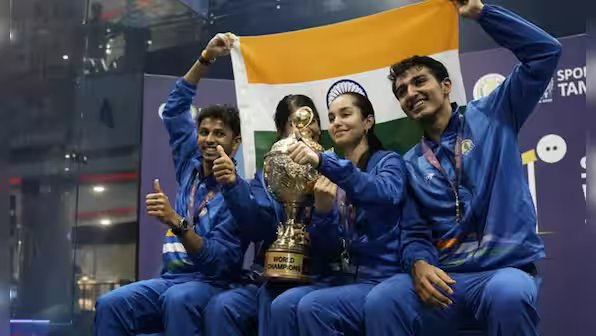
One of the biggest talking points amongst those who follow and cover squash regularly is the fact that the sport will finally be making its Olympic debut in the next edition, in Los Angeles, in 2028. For Indian squash too, that is a very exciting thing to look forward to, especially given how the national teams have been doing of late.
The quartet of team captain Abhay Singh, the legendary Joshna Chinappa, seven-time Asian Championship medallist, Velavan Senthilkumar and 17-year-old prodigy and already two-time Asian Games medallist, Anahat Singh made history earlier this month by clinching
India’s first-ever squash World Cup title, which made the country the first Asian nation and only the fourth overall to win the prestigious trophy.
WORLD CUP CHAMPIONS 🏆🥇🇮🇳 pic.twitter.com/B944URyqL0
— Abhay Singh (@abhaysinghk98) December 15, 2025
At the 2024 World Team Championships, the quartet of Abhay Singh, Velavan Senthilkumar, Veer Chotrani and Suraj Kumar Chand had registered a historic fifth place finish – their best result so far at the Championships, while the women’s team of Akanksha Salunkhe, Anahat Singh, Urwashi Joshi and Nirupama Dubey, entered the quarters after a huge upset win against nine-time champions Australia in the pre-quarterfinals, before losing to the USA in the quarters and eventually finishing seventh.
India are pushing traditional global squash powerhouses like Egypt and Hong Kong. The first-choice national players seem to be in a great headspace and are enjoying each other’s company. World Cup team captain Abhay Singh’s leadership in particular has been praised a lot. Add to that the fact that 5-time Asian Games medallist, Harinder Pal Singh Sandhu, who, according to Abhay, is an extremely popular figure amongst the players and shares great camaraderie with everyone, is now working with the national teams as coach, and you have a set-up that will be aiming for greatness at the Olympics in 2028. An Olympic medal will no doubt be the biggest shot in the arm for Indian squash, which desperately needs more visibility.
In a free-flowing exclusive interview, World Cup winning team captain, Abhay Singh, who is currently ranked 29th in the world and is poised to be one of India’s top performers at the Asian Games next year, talked about why he doesn’t want to look too far ahead, especially all the way to LA 2028, right now, what the legendary Indian player turned coach, Harinder Pal Singh Sandhu brings to the table, his take on squash coaching overall in India, what he personally is aiming to do in the new year, his big targets to make himself a better, more competitive squash player and more.
This is part two of the interview.
Check out part one here.
One very exciting thing to look forward to is squash making its Olympic debut in 2028 in Los Angeles. The men’s and women’s singles events will be played with 16 players per draw. How excited are you about that and have there already been conversations in the players’ circles about squash becoming an Olympic sport and the plans that all of you need to make, etc?
Abhay Singh: I am not sure about the others, but personally I am not thinking about this (the 2028 Olympics) much. Of course, when we heard about it (squash at the Olympics) there were conversations that I had with my team, to expand the team a little bit and get some better support staff onboard. But that is all we have done as of now. I used to be someone who used to forecast, but now it’s all about what’s in the near future. We are done with the World Cup and (now) I am focused on the PSA (Professional Squash Association – the governing body of men’s and women’s professional squash) season and then the Asian Games (September 19 – October 4, 2026 in Japan) and then we might have a few other big events, before we go into the Olympics. But until we have a qualification-criteria and until we near qualification itself, for me it (the Olympics) is really not something I am even talking about with my team, because it can play against you if you are thinking that far ahead and then you end up overanalysing many other things which are not necessary in the moment.
If I could talk to you a bit now about your own journey in the sport. You began very young of course, were India Number 1 in the juniors, you are currently ranked 29th in the world in the men’s senior rankings. Along the way you picked up medals at the Asian junior championships, the Asian Games, Asian Championships, South Asian Games. When you look back at your career so far, what are the things that really standout for you? What were the big watershed moments for you – and they need not necessarily be on-court moments…
Abhay Singh: I think it’s hard to measure progress without medals or trophies or rankings, and all of that collectively has been good to look at so far. I think there’s certainly a lot left in the bag. It’s nice to be greedy when you are an athlete. Two Asian Games medals (what he has won so far), when there are other athletes in India who have won 7 or 8, doesn’t make you very happy. The same goes for National titles. I will be very honest – I am grateful for everything I have achieved and for everyone who has helped me achieve that. Once the Asian Games finish next year and hopefully, I bag two golds there and I think that is when you can talk about me being an established squash player in India. For a lot of people, if I stop playing today, they would take it as a very successful career, but I think I am not even halfway there. And that’s how I look at it.
As things stand right now, what are the few things that you are going to try and use 2026 for – to improve yourself as a player. The areas of improvement that you might have identified in your game?
Abhay Singh: Firstly, I think I need to spend a lot of time on court with the bigger players – the guys in the (world) top 10. I am not shying away from entering the big events. Bad draws and bad results are part and parcel of getting to the top. That is something I am not really worried about. I can always choose to play smaller events or the Challenger Tour and win titles and make it look like I am having a successful and happy time, but that is just not who I am. In my next two tournaments, I have two really tough players who I am playing against in my draws. These are the moments you work so hard to get to and I am really taking them head-on. I have the right team and squad around me and I am firstly very excited to spend time with these players on court. Every year you realise that you are capable of more, that your body can be put through more hell and so can your mind and I am just excited to double down and play harder and work harder as well.
You have also been coached by some of the biggest names in world squash – from Malcolm Willstrop, to his son, the legendary James Willstrop to Harinder Pal Singh Sandhu, to former England national coach David Campion etc. So, you have learnt from some of the best in the business. When you look at squash coaching in India – in the academies, at the ISA, at academies founded by former players etc. and others, what is your take on the level of coaching that is available these days to youngsters who want to make a mark on the international squash stage?
Abhay Singh: Good question. I have always looked at coaches from the perspective of who can help me improve and give me what I am looking for, in that moment. I had access to Malcolm Willstrop very early on because of my Indian seniors and James (Willstrop) of course over the last two years now, because I have always liked the Willstrop way of squash. Harinder (Pal Singh Sandhu – 5-time Asian Games medallist) becoming coach is a huge blessing for all of us – just to have someone who was in the top 50 in the world (Harinder Pal Singh Sandhu reached a career high singles ranking of 47) be accessible to you in India. As for other coaches in India, personally speaking I haven’t had the chance to work with anybody, simply because how restricted my life was with High School, because I was based in Chennai and I was under Major Maniam (Consultant Coach for the Squash Rackets Federation of India (SRFI) for 14 years and played a crucial role in creating a structured coaching and administration system through the Indian Squash Academy (ISA) in Chennai) and Cyrus Poncha (former Indian player turned administrator and coach, is the current Secretary General of the Squash Rackets Federation of India (SRFI) and Vice President of the Asian Squash Federation) at that time – during my juniors. As soon as I finished High School, I had the great opportunity to work with Malcolm. We are looking not just at seniors achieving a lot, we are also looking at junior squash becoming predominant in India. Our juniors have won medals at the World juniors now. I am not going to put Anahat (Singh) in this conversation, because that’s a different league (level that Anahat is playing at), but if Indian junior squash is achieving good things, then the juniors are in good hands. But I also think it’s important to give former players a platform to coach and nurture talent, because we experience things that other people don’t, being on (the) Tour. Some of the junior squash I am watching is very promising, although it’s not at the same level that it was at my time, because I think our batch of juniors had some of the strongest juniors who played squash for India. I think, just like the players, it’s a very exciting time for the coaches (too) to come forward and establish themselves. At the moment I think a lot of the spotlight should be on Harinder (Pal Singh Sandhu) and what he has already achieved with the Indian teams. He was at the World Team Championships last year and at the World Cup this time. He is someone who really, really gets along with everybody. He understands that everyone has a different personality and (he) adjusts accordingly. With him leading the Indian squad right now, I think India have found the coach they needed after a very long time.
As somebody who is always so busy with international sport, which can be very difficult in terms of travel, staying away from family etc, when you do get some down time, what do you do to take your mind off the sport, for a while?
Abhay Singh: Something that really helps is gaming, which I have been doing a lot, of late. Over the last year and a half, I have been gaming quite a bit. It’s a very good way to unwind and switch off. I am on flights a lot, so I use that time to watch movies. On Tour, I travel with a Playstation. I explore the cities I travel to and the rest of the time is spent with family, back home.
End of Article