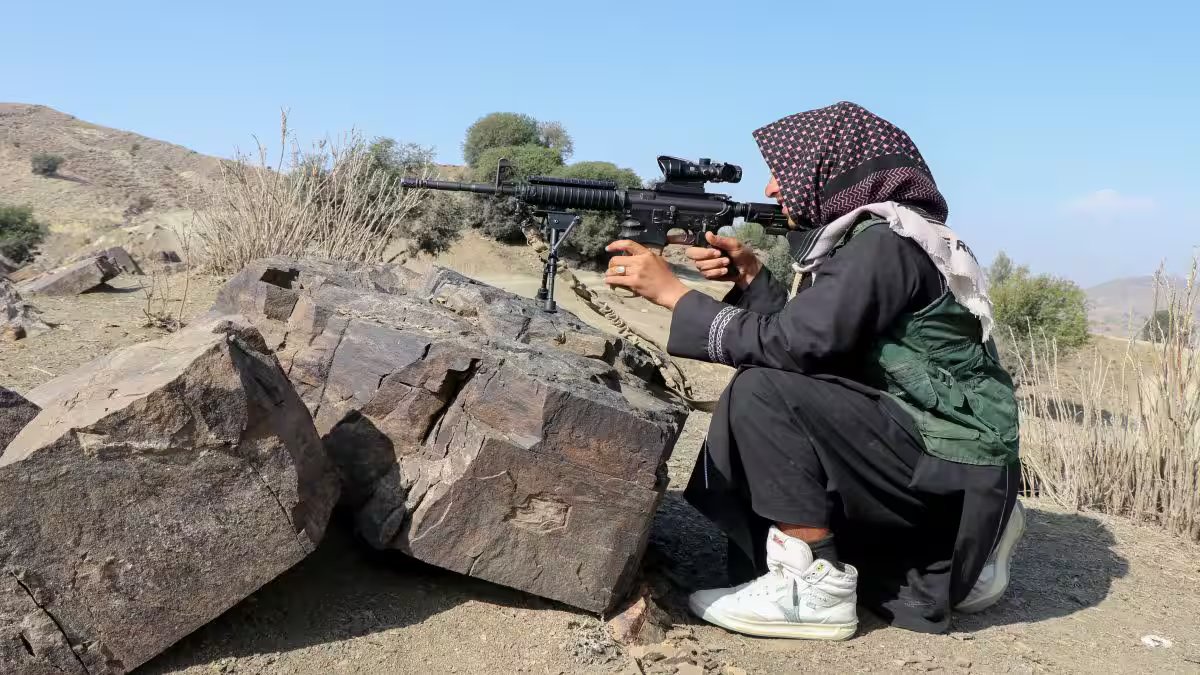
Three months into the new year and peace across the world seems elusive. Russia and Ukraine continue to battle; Israel hasn’t stopped its attack against Hamas in Gaza. And on Friday (February 27), an ‘open war’ ignited between Pakistan and Afghanistan.
In the wee hours of Friday, Islamabad carried out airstrikes, titled Ghazab Lil Haqq – or “Operation Righteous Fury”, across different provinces hitting multiple defence installations. The attacks targeted ammunition depots, Afghan Taliban military installations and militant hideouts across Afghanistan, including Kabul, Kandahar and Paktia.
Pakistan’s aerial attacks, which claimed to have killed over 133 Taliban fighters, is a tit-for-tat against Afghanistan, who had earlier attacked Pakistani border troops along the disputed Durand Line.
In fact, many experts note that the tensions between the two battling nations is over this contested Durand Line. As the Washington Post explains — to Pakistan, it’s a fixed border. To Afghanistan, it’s merely hypothetical.
In our weekly series,
_Word of the Week_, we take a deep dive into the Durand Line and explain how it has stoked tensions between the two countries.
What is the Durand Line?
At the heart of Friday’s clashes is the
Durand Line, the 2,611-km border drawn during British colonial rule in the 19th century. It was the result of an 1893 agreement between Sir Mortimer Durand, a secretary of the British Indian government, and Abdur Rahman Khan, the emir of Afghanistan.
The Durand Line came into existence as a result of the so-called Great Game — a geopolitical struggle between Russia and the British Empire for control of Central Asia. To stop Russia from expanding its sphere of influence in the region, Britain sought to make Afghanistan a buffer between its and Moscow’s spheres of influence.
Under British pressure, Afghan Emir Abdur Rahman Khan accepted the loss of some ethnic Pashtun tribal lands, which were effectively annexed into British India. When Pakistan was created in the 1947 partition of India, it inherited the border.
How do Pakistan & Afghanistan view the Durand Line?
Since its inception, Islamabad has considered the matter of the Durand Line as settled, accepting the border as it was initially drawn up. Successive Pakistani government have urged their Afghan counterparts to treat it as such.
However, Afghanistan governments, past and present, including the Taliban, dispute the line’s legitimacy. In the past, Kabul has argued that the original agreement was imposed under British pressure and should not automatically apply to Pakistan.
They also argue that the Durand Line divides the homeland of the ethnic Pashtun and Baloch populations.In 1947, following the founding of Pakistan, Afghanistan demanded that Pashtuns living on the Pakistani side of the Durand Line be given the right to self-determination. Pakistan and Britain refused this request.
Some even describe the Durand Line as a “line of hatred”, arbitrary, illogical, cruel and a trickery on the Pashtuns. Some historians believe it was a ploy to divide the Pashtuns so that the British could keep control over them easily.
The Taliban goes further, calling it a “hypothetical” or “imaginary” border.
How is the Durand Line central to Pak-Afghanistan conflict?
In March 2017, Pakistan started constructing a fence along the Durand Line. The purpose was to prevent terrorism, smuggling, and illegal immigration. According to reports, 98 per cent of the fencing was completed by April 2023.
However, many view it as Pakistan’s attempt of making the border more permanent, and has lent to the tensions between the two countries.
Over the years, Pakistan and Afghanistan have seen a series of skirmishes along the Durand Line. Last October, the two neighbours traded
air strikes and were locked into intense border clashes and ground fighting, which killed at least 47 civilians in Afghanistan, according to a UN report, as well as soldiers on either side, although reported casualty counts differ.
Days into the fighting, the two nations agreed to an immediate ceasefire during talks mediated by Qatar and Turkey.
However, this truce is now on shaky grounds with
fresh fighting. On Thursday (February 26), Kabul accused Pakistani forces of violating Afghan territory and carrying out airstrikes on civilian areas and carried out retaliatory operations along the Durand Line.
In a press release, the ministry said, “A few days ago, the Pakistani military circles, with great audacity, violated Afghan territory, breached our borders, and martyred women and children here.” Afghan forces said they targeted Pakistani military posts in eastern and southeastern sectors near Paktika, Paktia, Khost, Nangarhar, Kunar and Nuristan. “In these retaliatory operations along the Durand Line, a total of 55 Pakistani soldiers were killed, two bases and 19 posts were captured,” the statement said.
Islamabad then responded forcefully, with
Defence Minister Khawaja Asif announcing an “open war” against Afghanistan. He further added: “Our cup of patience has overflowed. Now it is open war between us and you. Now it will be ‘Dama Dam Mast Qalandar’. Pakistan’s army did not come from across the seas. We are your neighbours; we know your ins and outs. Allahu Akbar.”
In the attack, Pakistan claimed at least 133 Taliban officials were killed and 200 wounded, while Afghanistan said that there were no reported casualties.
While Pakistan claims their operation is completed, the situation remains volatile, raising fears of a broader military confrontation in the region.
End of Article