On February 12,
Bangladesh chose a new government, one and a half years after the July uprising overthrew then-Prime Minister
Sheikh Hasina in 2024. The parliamentary election, held after a long delay under the interim government led by Nobel laureate
Muhammad Yunus, came with its share of challenges. It was held against the backdrop of a turbulent law and order situation that saw frequent targeted attacks on minorities, particularly Hindus, and with a practical ban on the Awami League, the party with arguably the largest political organisation and base, from contesting in the polls.
The historic polls saw the return of the
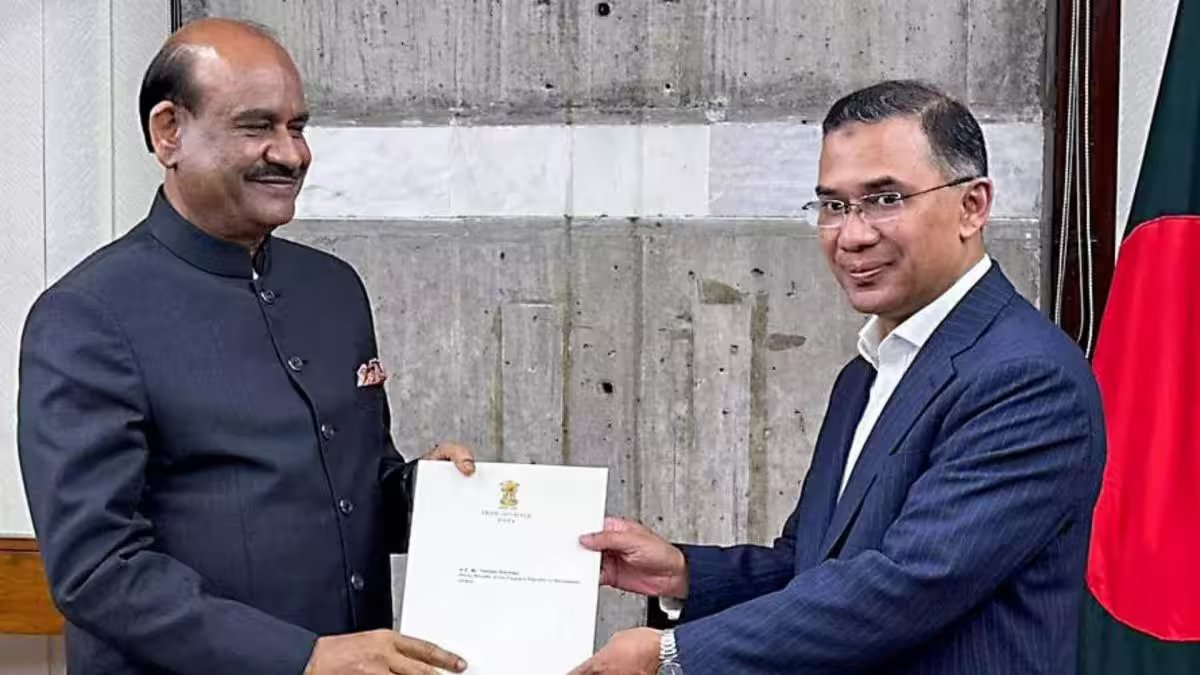
Bangladesh Nationalist Party (BNP) to power after two decades. This time, the party was led by Bangladeshi political scion Tarique Rahman, son of the country’s former Prime Minister
Khaled Zia, who passed away in the run-up to the national election. This was the first election after decades when Bangladesh’s two leading ladies, Sheikh Hasina and Zia, were not in the contest.
The election also saw the Islamist party
Jamaat-e-Islami record its best performance, reflecting the rise of extremist idiosyncrasies within Bangladesh.
The victory of the BNP under a new leader, Tarique Rahman, has set off speculation about how he would deal with the domestic situation, shifting geopolitical alliances and regional powerplay, especially in the context of Bangladesh’s ties with India and Pakistan. The question becomes more significant given the tinted glass; Yunus was perceived as looking at Bangladesh’s ties with India.
India too has been cautious, but New Delhi “can expect perhaps a rapprochement” efforts from Bangladesh under Rahman,
Pearl Pandya, South Asia Senior Analyst of Armed Conflict Location & Event Data (ACLED) tells Firstpost’s Bhagyasree Sengupta.
‘Hard-fought victory’
Speaking to Firstpost, Pandya emphasised that the February 12 election was a “hard-fought victory” for the people of Bangladesh. She said that without the Awami League, the polls were less competitive, but insisted that it would be difficult to conduct safe elections with Hasina’s party still in the race.
“I think it is a hard-fought victory for the Bangladeshi people. The fact that elections were held, albeit a bit delayed, with the participation of all the opposition parties in Bangladesh gives them legitimacy. Of course, without the Awami League participating, it is not as full of an election and as competitive an election as it could have been, but the circumstances were difficult,” Pandya told Firstpost.
“It would have been difficult to have safe elections with the
Awami League. The security risks might have been too high for the interim government. So just the fact that the elections were held, they were quite competitive, they were safe.”
“When we look at the data, the instances of disorder on election day were actually fewer than in the 2024 elections under the Awami League. So that signals that it’s a democratic transition. Of course, the BNP is an establishment party, but it is coming back to power after 17 years,” she said.
When asked if the victory of Rahman signals Bangladesh’s tendency to lean back on dynasty politics, Pandya said that the BNP of today is different from how the party operated 17 years ago. “It’s a different party than it was before. The leaders are different. It has gone through repression under Sheikh Hasina’s rule, which is why I think it would be unfair to characterise it as another elite capture,” she told Firstpost.
“We need to give them the benefit of the doubt to see how they would govern going forward. Several new parties, the NCP most famously, have also made gains. They are not an establishment party. Several independent candidates have won. So in that sense, yes, it does look like a democratic transition,” she explained.
The NCP: Why the party that ousted Hasina failed
The National Citizen Party (NCP), led by Nahid Islam, was born out of the July uprising. While the party had a promising start, some of its voter base disagreed with its decision to join the 11-party alliance, which included Jamaat.
The party eventually managed to win 6 seats in the polls. When asked about the party’s rise and its performance, Pandya emphasised that an alliance with Jamaat came with pragmatic consideration. “It’s a new party. It’s only been formed for the last year and a half. It didn’t have a base. It’s an organic movement. So from that, they made a calculated risk to align with the Jamaat rather than go on their own,” she said.
“I think that was based mainly on pragmatic considerations. They were a party which grew out of university campuses and cities, and for them to make inroads in villages without a base of supporters or organisers, they would have struggled to make any electoral gains at all on their own.”
Pandya emphasised that the party’s “religious and conservative bend was also a part of the reason it became a natural ally to Jamaat. “They’ve not done too badly. They’ve won seats, which, again, in South Asia, for new parties to do that in a first-past-the-post system is not always easy,” she told Firstpost.
When asked if NCP lost supporters due to the Jamaat alliance, Pandya said that the move was not a popular one. “It was not universally popular, of course, when the alliance was announced. Several women leaders, particularly those at the forefront of the protests, resigned from the NCP because they did not subscribe to the Jamaat’s stance on gender equality. But they still maintained their base of sorts. And if they might have lost their supporters to the BNP, they’ve also gained some of the Jamaat supporters because that’s how they won their seats,” she said.
The Yunus regime
When Nobel Peace Prize winner Muhammad Yunus came to power, many in Bangladesh hoped that the transitional phase would be a smooth one. However, many criticised the Yunus regime for taking one and a half years to conduct polls. When asked if the new parliament should constitutionally clarify the limits of the caretaker authority to prevent any future ambiguity, Pandya said that such a move would be helpful.
“They [Bangladesh] have had this experience in the past when caretaker governments clung on to power longer than perhaps was necessary and delayed elections. So clear limits would obviously be helpful. As far as the Yunus regime’s tenure itself is concerned, they came in at a difficult time. And I think it was a mixed bag,” she said.
“He was a unifying figure who was at that time acceptable to most people, which is why he was chosen to lead. I think his leading the Bangladeshi government internationally, perhaps not in India, but internationally, gave it more name recognition and legitimacy than other leaders might have done. But internally, they faced struggles,” Pandya explained.
“I mean, they had mob violence, the law and order situation, and vigilantism remained higher than normal throughout his tenure. A lot of the things which they accused the Awami League of doing were done by themselves to Awami League supporters. There were mass arrests and repression of Awami League party members.”
The South Asian scholar pointed out that the Yunus government did manage to stabilise the economy. “They instituted some commissions to look into excesses during Hasina, which were able to come out with the results. The most notable one was on the Committee on Enforced Disappearances, which published its report. That’s a notable win,” she said.
‘Not Delhi, not Pindi’: Bangladesh’s new geopolitical dynamic
Countries such as India, China, Pakistan and the US watched the Bangladesh elections closely since each country had its vested geopolitical interest with Dhaka. When asked about Pandya’s take on Rahman’s foreign policy, she pointed out how the Bangladeshi prime minister maintained that he “wants to put Bangladesh first”.
“I think he recently said, not Delhi, not Pindi. So we can expect perhaps a rapprochement in ties with India, which were particularly frayed during Yunus’s administration. It would be in both countries’ interests to have an improvement in relations. But there are a few sticking points. I mean, Hasina remaining in India is likely to be a sticking point,” she averred.
Pandya noted that while Bangladesh would continue to demand Hasina’s extradition, India is “unlikely to grant that request”.
“This gives the opposition, even if the government understands, an issue to target the government with that Hasina is still in India. And any escalation in anti-India rhetoric might also cause problems. We have seen an increase in that since Hasina fell,” she told Firstpost.
Pandya explained that under Hasina, Bangladesh’s ties with Pakistan “were very much one way”. “When you compare it to that metric, we will see an increase, and we already have seen an increase in improvement in relations between Bangladesh and Pakistan. And that is likely to continue.”
Bangladesh after Hasina
Hasina has become a divisive figure in Bangladesh, with her critics calling for “justice” as they accuse the toppled prime minister of persecuting her rivals, while neutral observers and her Awami League supporters press for political stability in the country. When asked what model should be followed, Pandya said that Dhaka currently has a bit of everything on its plate.
“It’s a difficult question to answer, and different things have worked in different contexts. But it’s a very politically active society, and in a way that the politics is entrenched, it goes to the grassroots,” she said.
“And so there is a large section of the population, who were Awami League supporters, they were Awami League members, active members, and they are still in Bangladesh. So accommodating them in a political setup is necessary and will have to be done at some point,” she said.
So what happened to the Awami League voter base this year?
Pandya also shared her assessment on what happened to the massive Awami League voterbase this year. “I think some just sat out because the turnout was 60 per cent, which is less than some of the historic highs we’ve seen earlier. Others might have voted in support. There are two views on it,” she said.
“Some say or believe that some Awami League supporters voted for the BNP, recognising it as the more centrist party than the Jamaat, which they thought was more right-wing. But the other side is that the BNP is the arch-rival of the Awami League. And for the older supporters, it has always been against anyone but the BNP. And so those might have swayed towards independent candidates, Jamaat or NCP,” Pandya explained.
Is history repeating itself?
Bangladesh had a long history of a turbulent political order. When asked if Pandya sees any parallels between the July uprising and the events in the past, she insisted that things are different this time. “I think the BNP coming back to power gives a link to the past. But in the past, there was always a spectre of either one of these two parties coming back and being in Bangladesh. What will happen now will depend on whether the Awami League is allowed to make a return or not,” she said.
“If it is not and if its supporters slowly die out, then you are looking at a fundamentally changed political landscape. But even without the Awami League, the Jamaat’s historic performance indicates that this is a different political landscape than it was before,” Pandya said.
Overall, only time will tell what Bangladesh under Tarique Rahman would look like.
End of Article