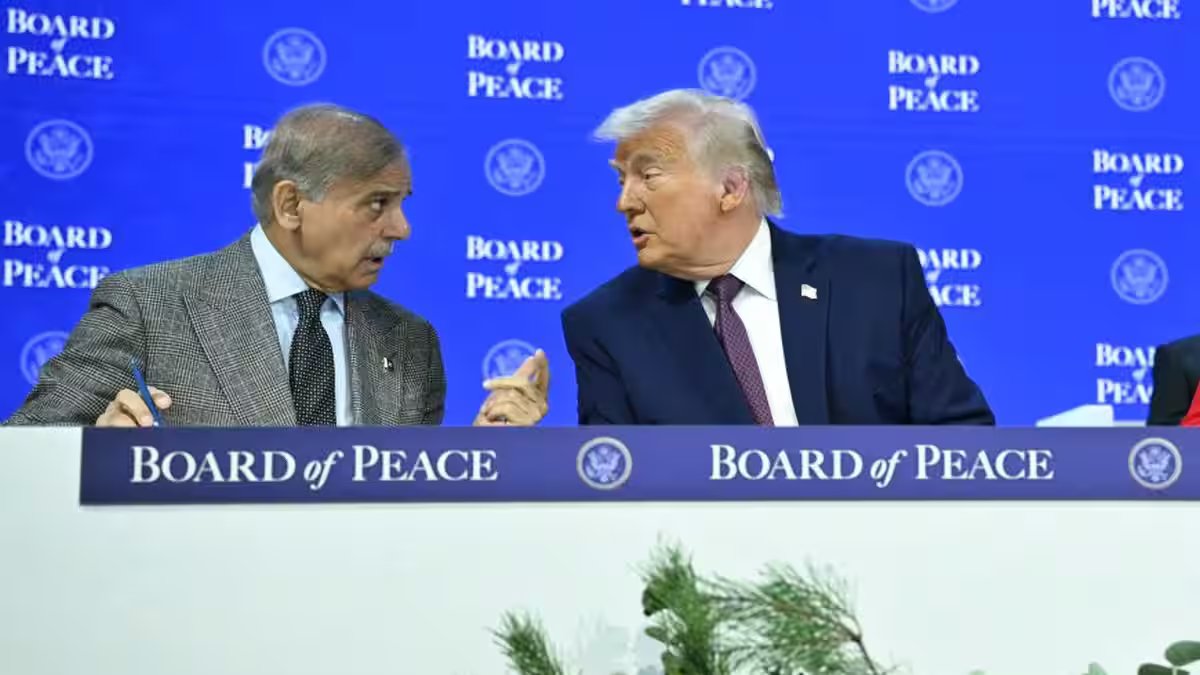
Pakistan’s decision to join US President Donald Trump’s newly announced “Board of Peace” has placed Islamabad in a delicate position, raising questions about how long it can maintain neutrality while aligning with a US-led security framework.
Pakistan’s decision to formally join US President Donald Trump’s newly announced so-called “Board of Peace” (BoP) has opened up uncomfortable strategic questions for Islamabad, forcing it to balance its stated neutrality with Washington’s expectations — even as it seeks to remain in the US President’s good books.
While Pakistani officials maintain that the move does not alter the country’s foreign policy fundamentals, critics argue that BoP membership could soon push Islamabad into difficult choices, particularly on Hamas in Gaza or the Iran-backed Houthi rebels in Yemen.
What joining the ‘Board of Peace’ means
By signing on to Trump’s “Board of Peace”, Pakistan has aligned itself with a US-led framework focused on stabilisation and conflict management in global flashpoints. However, participation also carries implicit expectations, especially if Washington presses for enforcement actions against groups it considers destabilising.
Analysts warn that Pakistan could soon face pressure to either back efforts to disarm Hamas or support US-led strikes against the Houthis if tensions in the Red Sea escalate.
Official line: No combat role, no disarmament
Islamabad has publicly ruled out any offensive military role. Foreign Minister Ishaq Dar has clarified that any Pakistani troop contribution to a proposed International Stabilisation Force (ISF) for Gaza would be limited strictly to peacekeeping and reconstruction.
“There will be no peace enforcement or combat role,” Dar said, stressing that Pakistan would not participate in the disarmament of Hamas.
The Gaza problem: Israel and the US factor
Despite Pakistan’s stated position, two major obstacles remain. Israel has made it clear that it does not want Pakistani troops deployed on the ground in Gaza. At the same time, the US remains central to efforts aimed at ensuring Hamas’s disarmament as part of any post-war arrangement.
This places Pakistan in a bind — publicly vocal in its support for the Palestinian cause, yet aligned with a US-led mechanism that views Hamas primarily through a security lens.
Yemen dilemma: Houthis and past resistance
A similar contradiction exists on Yemen. Pakistan has repeatedly resisted US calls to join military coalitions targeting the Houthi rebels. In 2024, Islamabad declined to join Task Force 153 when the US launched Operation Prosperity Guardian to protect shipping in the Red Sea.
BoP membership, however, could renew pressure on Pakistan to support or legitimise US action if Washington orders strikes against Houthi positions.
Domestic backlash at home
The move has sparked sharp criticism within Pakistan. Opposition parties, including Imran Khan’s Pakistan Tehreek-e-Insaf (PTI), have condemned the decision as a “shameful betrayal” of the Palestinian cause.
PTI leaders have described the arrangement as “neo-colonial” and are demanding a national referendum, arguing that such a strategic shift requires public approval.
A narrowing space for neutrality
For years, Pakistan has attempted to walk a careful line — opposing US-led interventions rhetorically while avoiding direct confrontation with Washington. Joining the “Board of Peace” may have narrowed that room for manoeuvre.
Whether Islamabad can hold to its stated red lines — no combat, no disarmament and no offensive strikes — is likely to be tested sooner rather than later.
End of Article