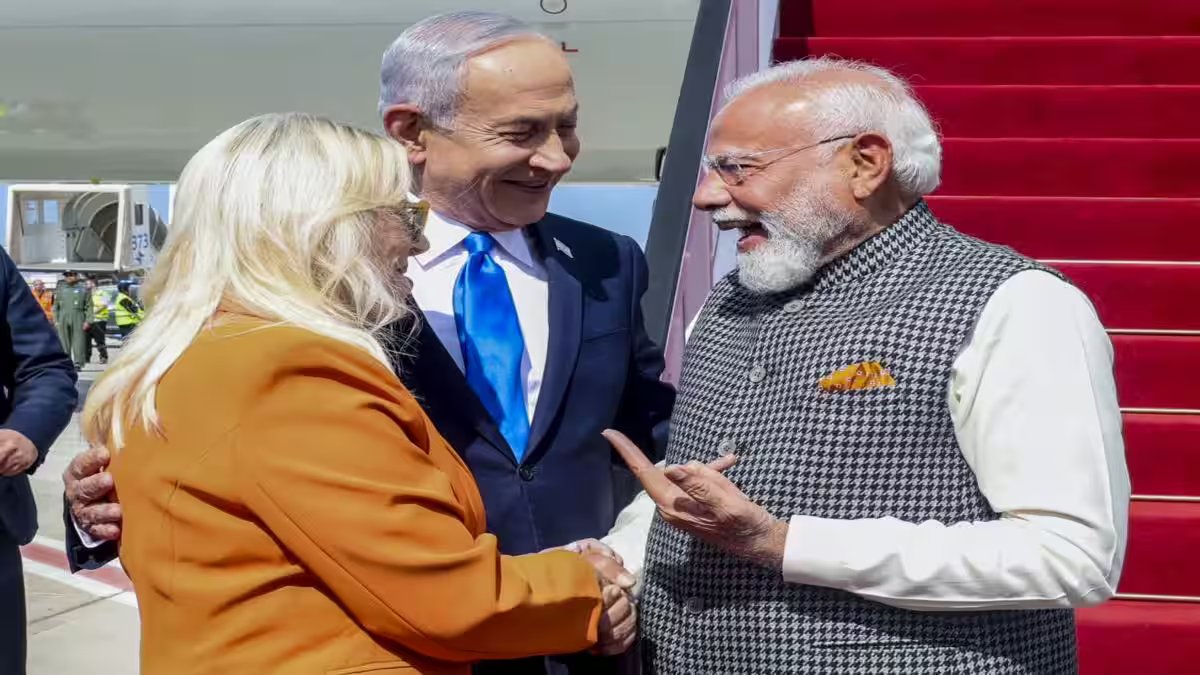
All eyes are on Israel as Prime Minister Narendra Modi is visiting the country — this marks his second visit, the previous one was in 2017. Prime Minister Modi’s visit is expected to deepen India-Israel ties with talks on trade, defence and AI being on the agenda. Moreover, Prime Minister Modi will address the Knesset, Israel’s parliament, an indicator of the importance of the India-Israel relationship.
For many,
Modi’s visit will also be significant as he is expected to discuss the so-called ‘hexagon of alliances’ with his Israeli counterpart, Benjamin Netanyahu. Earlier, the Israeli PM had pitched this idea in which he sees Israel partnering with India and other countries in West Asia to collectively stand against what he called “radical” adversaries.
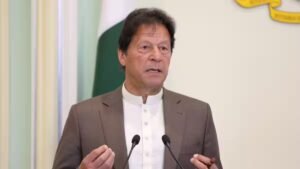
However, this proposed alliance between India and Israel has spooked Pakistan. Islamabad has called it an “anti-Muslim Ummah bloc”.
What is Netanyahu’s ‘hexagon of alliances’?
Ahead of PM Modi’s visit, Israel’s Benjamin Netanyahu proposed a new geopolitical idea called the
“hexagon of alliances” and invited India to be a partner in it.
In a statement, Netanyahu said, “In the vision I see before me, we will create an entire system, essentially a hexagon of alliances around or within West Asia.”
“The intention here is to create an axis of nations that see eye to eye on the reality, challenges, and goals against the radical axes, both the radical Shia axis, which we have struck very hard, and the emerging radical Sunni axis.”
The Israeli PM said that this new six-sided bloc would include Israel, India, Greece and Cyprus, along with other unnamed Arab, African and Asian states. Together, they would unite to collectively stand against what he called “radical” adversaries.
While Netanyahu hasn’t clarified further on the architecture of this proposed bloc, many see it as Netanyahu’s way of counterbalancing the influence of
Iran and its regional network, which includes groups such as the Hezbollah in Lebanon, the Houthis in Yemen, and the Kataib Hezbollah in Iraq.
Why has Netanyahu pitched ‘hexagon of alliances’ now?
The timing of Netanyahu’s proposal is significant. According to Andreas Krieg, associate professor of security studies at King’s College London, the idea of the hexagon of alliances is Netanyahu’s attempt of projecting statesmanship.
“With elections due later this year, Netanyahu has a clear incentive to project statesmanship and to argue that Israel is not diplomatically isolated and that it can still convene meaningful regional and extra-regional partnerships,” Krieg told Al Jazeera.
Also, ever since Israel began its war against the Hamas in Gaza, the country’s
economy is in the doldrums. Jobs are non-existent and investments are few. “Nothing Israel does seems to work. So what’s better than to fully retreat into a fantasy world where you have a hexagonal alliance?” Ori Goldberg, an independent Israeli analyst and political commentator, was quoted as telling Al Jazeera.
So, will India join Netanyahu’s ‘hexagon of alliances’?
While Netanyahu has invited India to be part of this new bloc, it remains to be seen if PM Modi accepts the invitation.
That’s because New Delhi has typically steered clear of rigid bloc politics; even today, it engages with China, Russia and the United States, irrespective of their ties with one another. India also enjoys close relations with Iran — ties that have been described as ‘civilisational’ — and is expanding strategic collaboration with Saudi Arabia. India also maintains strong relationships across the Gulf region, which hosts a large Indian diaspora that sends billions of dollars in remittances annually.
This axis vs axis pitch that Netanyahu has proposed would pull India West Asia fault lines that New Delhi would prefer to avoid.
How has Pakistan reacted to ‘hexagon of alliances’?
But even before India accepts Netanyahu’s proposal, Pakistan has been spooked by it, condemning the ‘hexagon of alliances’.
The Pakistani senate, the upper house of its parliament, passed a resolution condemning Israel’s proposed alliance framework, calling it a threat to regional and international stability.
The resolution, which was moved by Pakistan Peoples Party lawmaker Palwasha Mohammad Zai Khan, described it as a “vile proclivity of the leadership of the Israeli occupying power towards diminishing the unity and integrity of the Muslim Ummah on political and ideological grounds”.
“The Senate takes strong exception to statements that undermine regional stability and international legal norms,” the resolution stated.
Why is Pakistan spooked by ‘hexagon of alliances’?
The hexagon of alliances could shake up Islamabad’s diplomatic standing among Muslim countries in the West Asian region.
Pakistan would be uncomfortable if Israel was to reach out to other Muslim nations at a time when it is also engaging with the countries in the Gulf. In recent meetings with Qatar’s emir and prime minister, Pakistan’s Shehbaz Sharif has pushed for deepening of economic ties.
Moreover, India’s participation in the hexagon of alliances could be seen as a direct challenge to Pakistan’s influence in West Asia and as a departure from what Islamabad frames as Muslim unity.
It remains to be seen if Netanyahu’s hexagon of alliances is actually realised. But it’s evident that Pakistan is not happy with the bloc or with India’s participation in it.
With inputs from agencies
End of Article