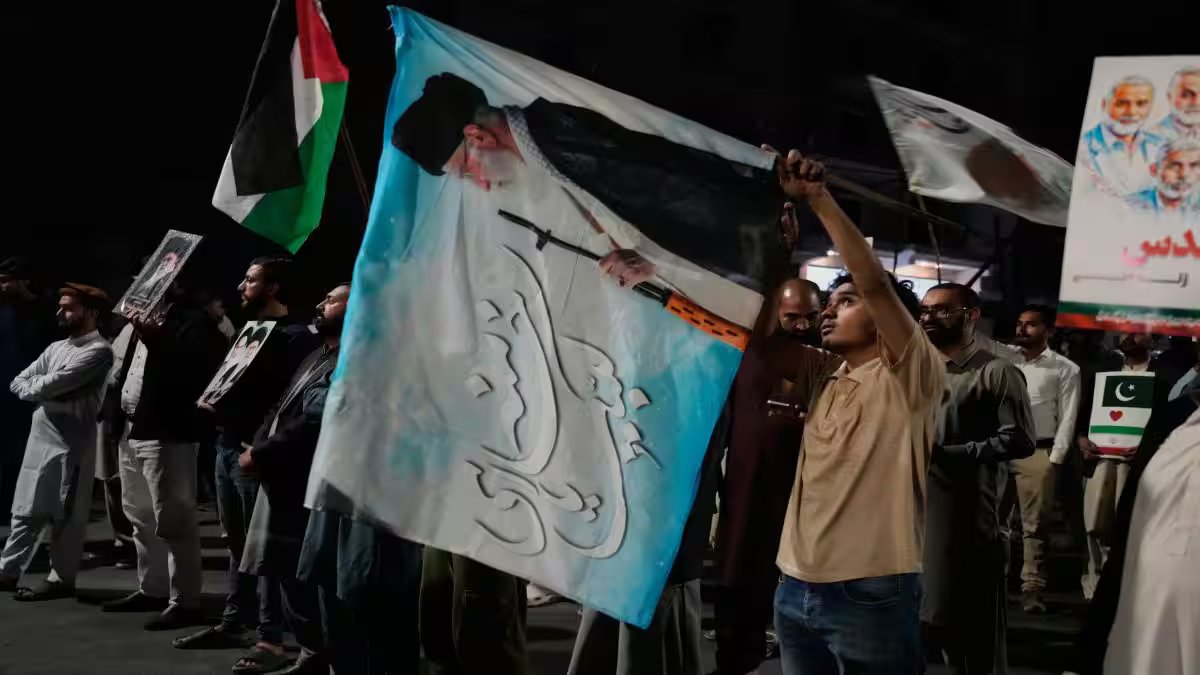
As news broke of the death of Iran’s Ayatollah Ali Khamenei, protests and anger erupted in many parts of the world. In Iran itself, celebrations and mourning took place over the loss of the Supreme Leader.
And away from Iran, in Pakistan too, anger erupted on the streets on Sunday (March 1) after the United States and Israel confirmed the killing of Iran’s supreme leader, Ayatollah Ali Khamenei, in coordinated air strikes on Tehran.
Catch all the latest updates from the
Israel-Iran war here
The Israel-US conflict against Iran puts Pakistan in a quandary; not only does Islamabad share ties with both the United States and Iran, it even shares a defence pact with Saudi Arabia, which pushed Donald Trump to attack Tehran.
Anger in Pakistan over Khamenei’s death
On Sunday, as news emerged of
Ayatollah Ali Khamenei’s death in the joint US-Israel strikes, protests erupted all across Pakistan, triggering violent clashes, arson attacks, and anti-US demonstrations in several Shia-majority regions.
According to officials, 22 people have died in the ensuing
clashes in Pakistan. Of the 22 dead, 10 died in Karachi, at least eight in Skardu, and two in the capital, Islamabad.
In Islamabad, thousands gathered near the Red Zone, the heavily fortified district that houses the parliament, government offices, and foreign embassies. Protesters chanted, “Those who side with the US are traitors” and called for “revenge against Israel”.
When protesters tried to push through the barricades at the Red Zone, which also houses the US embassy, security forces fired tear gas and rubber bullets. Witnesses said live rounds were also heard. As the crowd retreated, further volleys of tear gas were fired, injuring several people.
Violence was also reported from near the US consulate in Karachi and Lahore, where hundreds of protesters gathered and vandalised property and set parts of the premises on fire. In the northern region of Gilgit-Baltistan, protesters also set fire to a United Nations office in Skardu and damaged nearby buildings.
Pakistan government reacts to Khamenei’s death
Following the death of the Iranian supreme leader, Pakistan’s Prime Minister Shehbaz Sharif expressed his “grief and sorrow” over Khamenei’s death in a social media post.
“Pakistan expresses concern over the violation of the norms of international law. It is an age-old convention that the heads of state/government should not be targeted. We pray for the departed soul. May God Almighty grant patience and strength to the Iranian people to bear this irreparable loss,” the prime minister said.
Pakistan’s Minister of Foreign Affairs Ishaq Dar also “strongly condemned the unwarranted attacks against Iran” and called for an immediate halt to escalation through diplomacy.
Minister for Interior Mohsin Naqvi also noted, “After the martyrdom of Ayatollah Khamenei, every citizen of Pakistan is saddened in the same way as the citizens of Iran are grieving. “We are all with you. We request the citizens not to take the law into their hands, and to record their protest peacefully.”
Pakistan’s balancing act after Khamenei’s death
Interestingly, following the condemnation of the strikes that killed Khamenei, Pakistan also condemned Tehran’s retaliation against Saudi Arabia, Bahrain, Jordan, Kuwait, Qatar, and the UAE, calling it “blatant violations of sovereignty”.
The Pakistani prime minister also held a telephone call with the rulers of Jordan and Bahrain to discuss the evolving regional situation. Meanwhile, Pakistan’s foreign minister also held talks with his Omani and Iraqi counterparts.
The conflict between Israel, the US, and Iran has put Pakistan in a hard spot. That’s because Islamabad shares close ties to the US as well as Iran. In recent times,
Pakistan has nurtured close ties with US President Donald Trump. The US president has referred to Pakistan’s Shehbaz Sharif as a friend, signalling the close ties that they have cultivated.
Islamabad is also heavily dependent on the US for defence. Its deadly F-16 comes from the US. Moreover, the Asian nation depends on Washington for security cooperation as well as counterterrorism coordination.
There’s also Pakistan’s joining of the
Gaza Board of Peace as well as reports that Pakistan would provide troops to monitor Gaza, despite the fact that it doesn’t recognise Israel, and has long supported a two-state solution to the Israeli-Palestinian conflict.
There’s also Saudi Arabia. On Saturday, the Saudi capital, Riyadh, was targeted by Iran, prompting an angry statement from its government. The Kingdom of Saudi Arabia expresses its rejection and condemnation in the strongest terms of the blatant and cowardly Iranian attacks that targeted the Riyadh Region and the Eastern Province, which were successfully intercepted. These attacks cannot be justified under any pretext,” the statement said.
For Pakistan, there’s a fear that if Saudi Arabia launched strikes against Iran, it would be dragged into the conflict. That’s because Riyadh and Islamabad have signed the
Strategic Mutual Defence Agreement, a Nato-like agreement, which sees an “attack on one is an attack on both”
However, Pakistan shares historical, cultural, economic, and diplomatic ties with Iran, maintaining bilateral engagement on regional issues. Tehran has publicly acknowledged Pakistan’s support during past crises, reflecting traditionally friendly relations.
Pakistan also has its own internal security complications to take into consideration. A direct military confrontation with Iran, with which it shares a border, poses extreme risks. Furthermore, Pakistan is engaged in what its defence minister called an
“open war” with Afghanistan. This leaves little military capacity to open a second front with Tehran.
It’s a wait-and-watch game to see which way Pakistan swings amid this conflict.
With inputs from agencies
End of Article