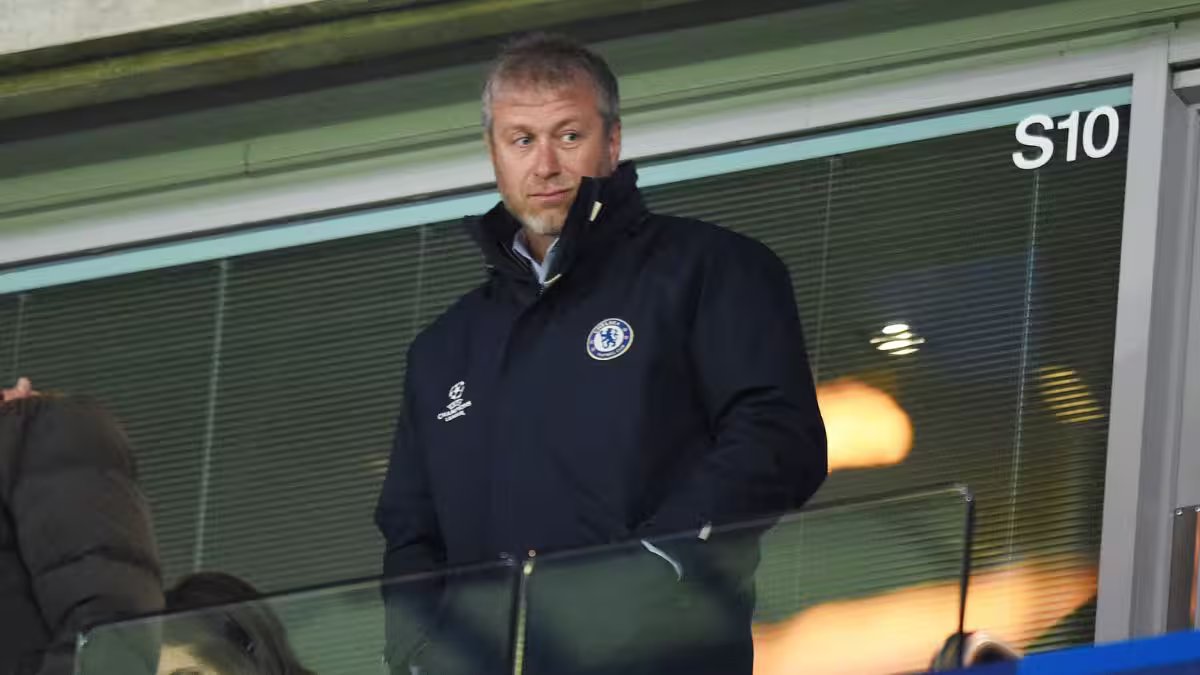
The British government has taken decisive steps to unlock £2.5 billion (US$3.3 billion) generated from the sale of Chelsea Football Club, directing the pressure on sanctioned Russian billionaire Roman Abramovich to release the funds for humanitarian assistance in Ukraine.
The move represents the UK’s most forceful intervention yet in a dispute that has stretched on for nearly three years as European debates over using frozen Russian assets to finance Ukraine’s survival and eventual reconstruction.
The sum of money has been sitting frozen in a UK bank account since 2022. The government now says time has run out for negotiations, and that court action will follow if Abramovich fails to comply within months.
When Abramovich was forced to sell Chelsea FC
Roman Abramovich sold Chelsea FC in 2022
after coming under UK sanctions in the wake of Russia’s full-scale invasion of Ukraine.
British authorities had moved swiftly at the time to prevent sanctioned individuals from benefiting financially while still allowing certain transactions to proceed under tightly controlled conditions.
Abramovich was granted a special licence by the UK government to complete the sale of the Premier League club. That authorisation came with a clear stipulation: the proceeds from the transaction were to be directed towards supporting victims of the war in Ukraine.
The sale ultimately raised around £2.5 billion. However, instead of being transferred to humanitarian causes, the money was placed into a UK bank account controlled by Fordstam, a company linked to Abramovich.
Since then, the funds have remained frozen, unable to move without further government approval and agreement over how the money would be used.
The prolonged stalemate has its roots in fundamental disagreements between Abramovich and the UK government.
While Abramovich has said he wanted the money to help “all victims of the war in Ukraine”, including Russians, the British government has maintained that the funds must be used specifically for humanitarian purposes inside Ukraine.
How negotiations broke down
Successive UK governments have said they attempted repeatedly to reach a voluntary settlement with Abramovich.
Ministers have pointed out that they explored various proposals and were willing to consider “any proposal” that would result in the money being donated to Ukraine in line with the original licence conditions.
Despite these efforts, talks failed to deliver an agreement. By March this year, ministers were already signalling that legal action was becoming increasingly likely, reported The Guardian. Reports at the time indicated that officials believed court proceedings might be the only way to gain access to the funds.
The frustration was publicly acknowledged again in June, when UK Chancellor Rachel Reeves and then-UK foreign secretary David Lammy said they were “frustrated” by the lack of progress.
The issue remained unresolved through the summer and autumn, even as the humanitarian and financial pressures on Ukraine increased.
Opposition figures, including the Liberal Democrats, argued that the government had been too patient and called for a far shorter deadline for Abramovich to act, suggesting he should be given only until the end of the month rather than several more months.
How Starmer issued a final warning
The impasse reached a turning point this month when UK Prime Minister Keir Starmer addressed the House of Commons on Wednesday and issued what officials described as a final warning.
Starmer confirmed that a new licence had been issued, enabling the £2.5 billion to be transferred into a foundation that would direct the money towards humanitarian causes in Ukraine.
The licence, he said, was effectively Abramovich’s last opportunity to comply voluntarily before the government initiated legal proceedings.
“The clock is ticking on Roman Abramovich to honour the commitment he made when Chelsea FC was sold and transfer the £2.5bn to a humanitarian cause for Ukraine,” Starmer told UK MPs.
“This government is prepared to enforce it through the courts so that every penny reaches those whose lives have been torn apart by Putin’s illegal war.”
Government sources clarified that Abramovich had been given around 90 days to take the necessary steps. While no fixed calendar date was publicly announced, ministers made it clear that patience had worn thin.
“It’s unacceptable that more than £2.5bn owed to the Ukrainian people can be allowed to remain frozen in a UK bank account. It’s time for Roman Abramovich to pay up. If he doesn’t act, then we are prepared to do what is necessary to make sure that money gets to the Ukrainian people,” said Reeves.
“This money was promised to Ukraine over three years ago. It is time Roman Abramovich does the right thing, but if he won’t – we will act. That’s why the licence has been issued. It is time this money was used to rebuild the lives of people who’ve seen devastation as a result of Putin’s illegal war,” added UK Foreign Secretary Yvette Cooper.
The prime minister’s spokesperson explained that while the licence now permits the transfer, Abramovich still has administrative responsibilities to fulfil before the money can move.
“The licence enables the transfer. Mr Abramovich must take the necessary steps to establish the foundation and arrange the transfer in accordance with the licence. In terms of the setting up of that, it’s a few steps away. This is the first step in that process.”
How the funds could be used
Under the terms of the licence, the £2.5 billion must be channelled into a newly established foundation. That entity would be responsible for distributing the funds to humanitarian causes in Ukraine, ensuring the money is used to assist civilians affected by the war.
The licence places strict limits on how the funds can be used. They cannot benefit Abramovich or any other individuals subject to UK sanctions.
While future gains generated by the foundation could potentially be spent more broadly on victims of conflict worldwide, the original proceeds from the Chelsea sale are required to go to Ukraine.
Officials have stressed that the structure is designed to ensure transparency and prevent any diversion of funds. The government has also indicated that failure to establish the foundation or complete the transfer within the expected timeframe would trigger legal enforcement.
How Abramovich has responded
Despite the pressure, Abramovich has not indicated that he will immediately comply. He is not expected to make a public statement in response to the government’s announcement.
However, officials familiar with the discussions say Abramovich has told the UK government that he cannot release the funds while a separate legal case brought against him by the government of Jersey remains unresolved, reported The Independent. That case concerns the source of his wealth.
The UK government has not accepted that argument as a valid reason for further delay.
How Europe is moving to use frozen Russian assets
The decision to push ahead with the Chelsea funds comes at a politically sensitive moment in Europe. It was announced on the eve of a major EU summit where leaders are expected to debate whether
to use frozen Russian state assets to support Ukraine.
Officials have described the UK’s move as one of the first major steps by a European country to actively force the transfer of Russia-linked assets for Ukraine’s benefit, rather than merely freezing them.
The announcement followed a mini-summit between Starmer and Belgian Prime Minister Bart de Wever, where the issue of Russian assets — most of which are held in Belgium — was discussed in detail.
The European Union has immobilised around €210 billion of Russian central bank assets since the invasion of Ukraine. The majority of these assets are held at Euroclear, a Brussels-based central securities depository that acts as a key hub in the global financial system.
Euroclear does not hold physical cash. Instead, it facilitates the electronic movement of money and securities, including bonds and other financial instruments.
It currently safeguards assets worth more than €40 trillion on behalf of clients such as central banks, investment firms and international institutions.
EU leaders agreed last year to use the interest generated by Russia’s frozen sovereign assets to support Ukraine. However, directly touching the underlying assets has proven far more controversial.
Under the plan now under discussion, the EU would borrow against the frozen Russian assets to provide Ukraine with an initial €90 billion loan.
This sum would cover roughly two-thirds of Kyiv’s projected funding needs for 2026 and 2027, with other allies expected to contribute the remainder.
Ukraine would only repay the loan if and when Russia agrees to pay reparations for the destruction caused by the war. Throughout this process, Russia would technically remain the legal owner of the assets.
The proposal has exposed sharp divisions within the EU. Belgium, which hosts Euroclear and holds the largest share of the frozen assets, has argued that the plan is “fundamentally wrong”.
Belgian officials fear the country could face multibillion-euro liabilities if Russia succeeds in legal claims against Euroclear or retaliates by seizing Belgian property.
Russia has already described the use of frozen assets as theft and has threatened to confiscate European private investors’ holdings inside Russia. The Russian central bank has launched a $230 billion damages claim against Euroclear, which is already defending more than 100 legal cases in Russian courts.
President Vladimir Putin has reinforced those threats by signing decrees that make it easier for the Kremlin to seize Western-owned assets in Russia as retaliation.
Some EU member states, including Italy, Bulgaria and Malta, have backed Belgium’s call for an alternative approach. One proposed “plan B” would involve using unallocated EU budget funds as collateral for loans to Ukraine, leaving Russian assets untouched for future reconstruction.
Others argue that this approach is politically unworkable because it would require unanimity among EU members.
Hungary’s government has already indicated it would veto such a move.
Why timing matters for Ukraine
The urgency behind both the UK’s action on the Chelsea funds and the EU’s asset debate is driven by Ukraine’s deteriorating financial position.
According to the European Commission, Ukraine will need around €136 billion in 2026 and 2027 to sustain its defence, pay public sector workers and keep basic state functions running. Without fresh funding by spring, officials warn Kyiv could face severe cash shortages, jeopardising salaries for soldiers, teachers and police.
The situation has become more acute following decisions by US President Donald Trump to halt new American military aid to Ukraine. European governments, already under strain from sluggish economic growth and tight public finances, have struggled to fill the gap.
Proposals reportedly floated by Trump involving US companies profiting from Russian assets have further galvanised European leaders to secure those resources for Ukraine instead.
European officials have warned that failure to agree on funding mechanisms could severely damage the EU’s credibility. German chancellor Friedrich Merz has been among those arguing that inaction would undermine the bloc’s ability to act collectively at a critical moment.
“If we do not succeed in this, then the European Union’s ability to act will be severely damaged for years, if not longer, and we will show the world that we are incapable of standing together and acting at such a crucial moment in our history,” Merz said.
Also Watch:
With inputs from agencies
End of Article