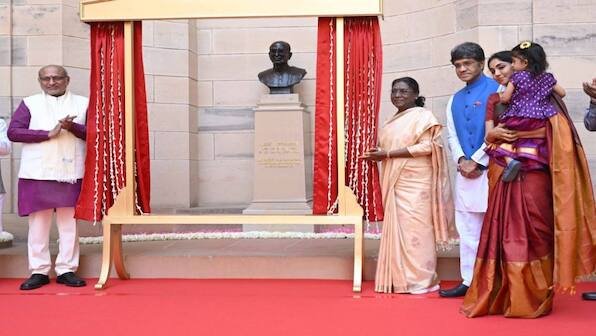
India’s decolonisation drive continues. On Monday (February 23), President Droupadi Murmu unveiled the bust of the first and only Indian Governor-General Chakravarti Rajagopalachari at Rashtrapati Bhavan. What made this interesting, however, was that Rajagopalachari’s figurine replaced that of British architect Sir Edwin Lutyens.
At the ceremony, President Murmu noted, “This initiative is part of a series of steps being taken towards shedding the vestiges of colonial mindset and embracing, with pride, the richness of India’s culture.”
But what’s the big deal? Why has this move garnered so much attention? Here’s a deep dive into the situation.
Hello Rajagopalachari, bye-bye Lutyens
On Monday, President Murmu unveiled the bust of Chakravarti Rajagopalachari at the Grand Open Staircase near Ashok Mandap at Rashtrapati Bhavan. This black-coloured bust will now replace the bronze statue of British architect Edwin Lutyens.
The unveiling took place during the ‘Rajaji Utsav’ event at Rashtrapati Bhavan, attended by Vice-President CP Radhakrishnan and several ministers from PM Modi’s Cabinet.
Earlier, during his monthly radio address, Mann ki Baat, Prime Minister Narendra Modi noted that after independence, statues of British administrators remained in Rashtrapati Bhavan, while those of India’s great leaders were not honoured. “Today, the country is leaving behind the symbols of slavery and has begun to value symbols related to Indian culture.”
And at the event on Monday, in a message read by Culture Minister Gajendra Singh Shekhawat, PM Modi stated that it was fitting to have Rajagopalachari’s bust close to Gandhi. “It is fitting that Rajaji’s bust is being installed right opposite the statue of Mahatma Gandhi. Further, the fact that Rajaji’s bust will be positioned where Edwin Lutyens’ bust used to stand is a crucial detail, making it an important act of mental decolonisation.
“Today, Rashtrapati Bhavan stands not as a seat of power, but as a visible embodiment of democratic self-confidence rooted in Indian civilisation. Initiatives such as the ‘Rajaji Utsav’ and the unveiling of a bust of Shri C Rajagopalachari Ji reinforce this direction. They honour leaders who shared the nation and remind us that freedom is sustained by celebrating their memory.”
Other leaders also praised the move of installing a bust to honour Rajaji. Vice-President Radhakrishnan called the installation another milestone in India’s effort to move away from colonial influence, describing it as part of a wider transformation across governance, law, and culture.
Congress leader Shashi Tharoor also praised the Modi government in a X post. “I’m truly pleased to see Rajaji honoured by a statue at Rashtrapati Bhavan. He was its first Indian occupant as the only Indian Governor-General of India, before we became a Republic, and he yielded his seat to the new President,” he wrote on social media.
Edwin Lutyens’ designs in Delhi
But what was a British architect’s statue doing at Rashtrapati Bhavan? A prominent British architect, Sir Edwin Lutyens, was picked to design large parts of Delhi in 1912, after the
capital was shifted from Kolkata.
This includes Rashtrapati Bhavan, India Gate, North Block, South Block, and even
Hyderabad House — the residence of the Nizam of Hyderabad, designed in a distinct “butterfly plan” with a central dome. The vast ceremonial pathway, now known as Kartavya Path, was also designed by him.
According to a Hindustan Times report, Lutyens viewed his work on New Delhi as an enduring monument designed for imperial grandeur. He once said that while the Viceroy thought only of the next three years, “I am thinking of the next 300 years”. He aimed for a style that was neither purely European nor just Indian or Mughal, but rather a hybrid that combined Western traditions with subtle local elements.
As years passed, Lutyens not only became synonymous with the 26-square kilometre of land in India’s capital, but also for a particular type of people: English-speaking, foreign-educated, and reportedly sealed off from ordinary Indian life.
In fact, PM Modi has used the term Lutyens Delhi in quite a harsh manner in the past. In 2019, speaking to the Indian Express, Modi said that it is “45 years of toil” and not the “Khan Market gang or Lutyens Delhi” that has created his image, and it cannot be dismantled.
In 2025, when speaking about the continuation of colonial-era laws, Modi once again noted, “I am surprised that the Lutyens Jamaat and the Khan Market Gang have been silent on this for so many years. The people who are the thekedaar of PIL, those who visit court every now and then, why weren’t they worried about liberty back then?”
Lutyens’ family reacts
But not everyone is happy with the installation of Rajagopalachari’s bust at Rashtrapati Bhavan. Matt Ridley, a great-grandson of Edwin Lutyens, was saddened by the removal of the bronze figurine.
In a post on X, Ridley wrote, “Sad to read that the bust of Lutyens (my great grandfather) is to be removed from the presidential palace he designed in Delhi. Here I am with it last year. I wondered at the time why his name had been removed from the plinth.”
Sad to read that the bust of Lutyens (my great grandfather) is to be removed from the presidential palace he designed in Delhi. Here I am with it last year. I wondered at the time why his name had been removed from the plinth. pic.twitter.com/EITcGKUAMa
— Matt Ridley (@mattwridley) February 23, 2026
Modi’s decolonisation drive
The removal of Lutyen’s figurine from Rashtrapati Bhavan is yet another example of Modi’s efforts to shed India’s colonial past.
In September 2022, Modi renamed
Rajpath, designed by Lutyens, to ‘Kartavya Path’, meaning “path of duty”. He also introduced a
new ensign for the Indian Navy in place of the St George’s Cross, a move he said removed “the remaining traces of slavery and a colonial past”.
The following year, PM Modi inaugurated a grand new Parliament, replacing the
colonial-era building, also designed by Lutyens along with his British colleague, Herbert Baker.
And that’s not all. Earlier this month, the Prime Minister’s Office was relocated from the colonial-era South Block to a newly built complex named ‘
Seva Teerth’, meaning “a sacred place of service”.
Moreover, railway staff has been banned from wearing the traditional uniform of a “prince suit” — a black jacket with a Chinese collar that was introduced by the British in the 19th century and modelled on Western railway uniforms.
With inputs from agencies
End of Article

