Minneapolis has one again erupted after a series of immigration enforcement actions has led to another shooting in the already distraught neighbourhoods.
The city’s tensions were previously heightened following the fatal shooting of a US citizen by an
Immigration and Customs Enforcement (ICE) agent earlier this month.
A second shooting involving a Venezuelan man, along with aggressive enforcement operations and the arrest of American citizens, has deepened the crisis.
Protests have spread across the city, drawing in thousands of residents, while state leaders and federal officials exchange sharp accusations.
How Minneapolis erupted again
The latest escalation occurred on January 14, when a Venezuelan man
was shot and wounded by a federal immigration officer following a traffic stop in Minneapolis.
According to the US Department of Homeland Security (DHS), the man attempted to flee after crashing his vehicle into a parked car during the stop.
As temperatures dropped below freezing, the suspect ran from the scene on foot. A pursuing officer caught up with him, and a physical struggle followed.
DHS said the man resisted arrest and became violent toward the officer. During the confrontation, two individuals emerged from a nearby apartment building and attacked the officer using a snow shovel and a broom handle.
The Venezuelan man reportedly broke free and struck the officer with one of the tools. The officer then discharged his weapon, hitting the man in the leg.
The wounded suspect and the two others retreated into the apartment and barricaded themselves inside before being taken into custody.
Both the officer and the man who was shot were hospitalised. A person familiar with the case said the wounded suspect was in stable condition, while the officer’s medical status was not immediately disclosed.
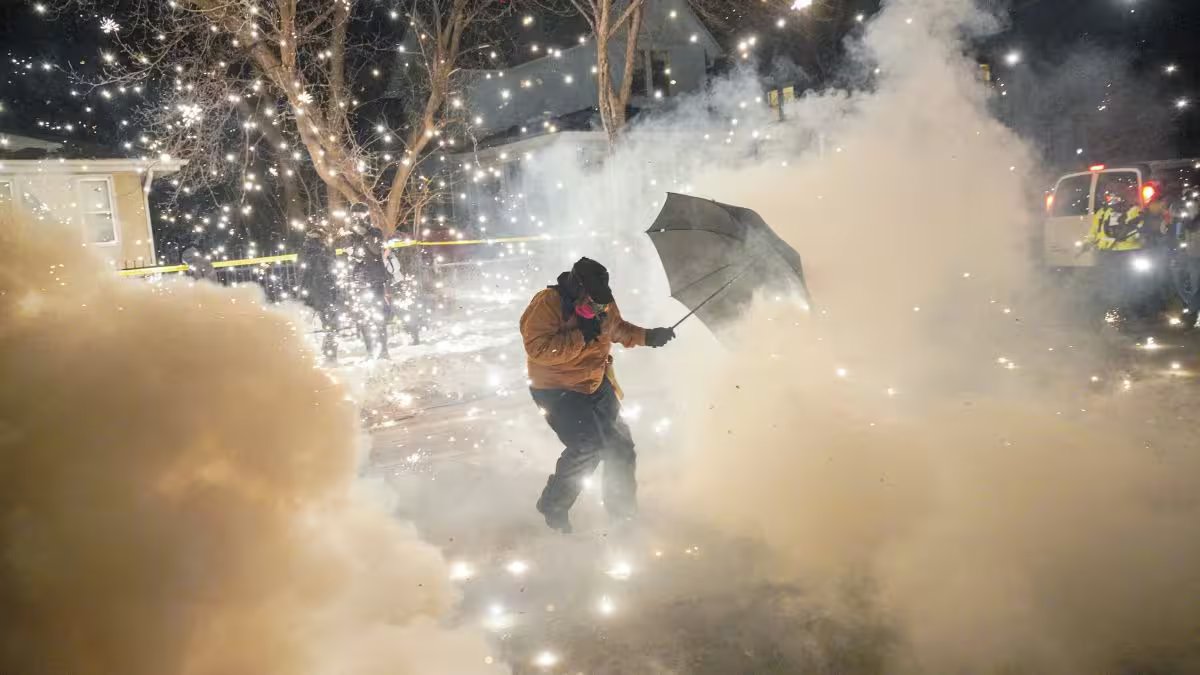
News of the shooting spread quickly, triggering clashes between protesters and law enforcement officers late into the night. Demonstrators threw rocks, chunks of ice, and fireworks, while agents responded with tear gas and other crowd-control munitions.
Thick clouds of gas filled the streets, and flashing lights from headlamps and riot equipment illuminated the darkness.
Minneapolis Police Chief Brian O’Hara, appearing alongside Mayor Jacob Frey at a press conference, called on people gathered near the scene to disperse. “We do not need this to escalate any further,” O’Hara said.
DHS accused Frey and Minnesota Governor Tim Walz of encouraging resistance to federal immigration officers through what it described as “hateful rhetoric.” Frey rejected the claim and warned against further disorder.
“We cannot counter Donald Trump’s chaos with our own brand of chaos,” the mayor said.
How the city was already shaken by the fatal shooting of Renee Good
The January 14 shooting came just one week after a far more serious incident that had already shaken Minneapolis.
On January 7, 37-year-old Renee Good, a US citizen and mother of three,
was fatally shot while sitting in her car during an encounter with ICE agents.
Good had been taking part in a neighbourhood patrol network that monitored and recorded the activities of federal immigration officers.
Supporters say she posed no physical threat to law enforcement. They have disputed government claims that the agent who shot her believed she was attempting to run him over.
Her death resulted in anger toward ICE operations in the city and fuelled demands from state and local leaders for the federal government to halt the surge of immigration enforcement agents.
Instead, the Trump administration announced it would increase its presence in Minneapolis by sending hundreds more officers to reinforce an already large deployment of about 2,000 agents.
In the days following Good’s death, Minneapolis
experienced chaotic scenes as heavily armed federal agents conducted street stops and arrests across residential neighbourhoods. Activists frequently appeared at these encounters to observe and record what was happening.
Governor Tim Walz encouraged residents to document interactions with immigration officers.
“Help us create a database of the atrocities against Minnesotans, not just to establish a record for posterity, but to bank evidence for future prosecution,” Walz said in a video message posted online.
How allegations of misconduct against ICE agents are mounting
Accounts from residents, journalists, and activists suggest that federal agents have been carrying out widespread enforcement operations throughout Minneapolis.
According to these reports, officers have conducted roving sweeps, detained people without warrants, and operated in full tactical gear.
Many of them also wore face coverings that concealed their identities.
These operations were often met with resistance from local residents, who blew whistles, shouted at officers, and tried to follow enforcement teams as they moved through neighbourhoods.
Videos circulating online show agents smashing car windows and pulling people out of vehicles.
In some cases, chemical irritants were used against protesters, with orange pepper spray fired directly into faces at close range. Flash-bang grenades were also deployed near groups gathered in the streets.
There were also reports of agents stopping non-white US citizens and demanding identification, only to leave after confirming their citizenship. These encounters drew angry reactions from bystanders, who accused officers of racial profiling.
DHS has denied these accusations, stating that its agents act based on “reasonable suspicion” that individuals may lack legal immigration status.
The department also said officers have increasingly faced physical assaults while attempting to carry out their duties. According to DHS, some US citizens have been arrested for interfering with immigration enforcement operations.
How a disabled US citizen was dragged from her car
One of the most widely circulated videos involved the arrest of Aliya Rahman, a US citizen who said she was on her way to a medical appointment when she was detained by immigration officers.
Rahman said she was travelling to the Traumatic Brain Injury Center for a routine appointment when she encountered federal agents at an intersection. The video appears to show masked officers shouting commands amid the noise of whistles, horns, and protesters yelling.
In the footage, one agent smashes Rahman’s passenger-side window while others cut her seatbelt and pull her out through the driver’s side door. She is then carried by her arms and legs toward an ICE vehicle.
“I’m disabled trying to go to the doctor up there, that’s why I didn’t move,” Rahman said.
Her attorney, Alexa Van Brunt of the MacArthur Justice Center, said Rahman was placed in an impossible situation.
“Her only options were to move her car forward in the direction of ICE officers and risk being accused of trying to harm them — which led to Renee Good’s death — or stay stationary, which in the end led to physical violence and abuse,” Van Brunt wrote.
Rahman said she was taken to a detention centre where she was denied medical care and eventually lost consciousness. “Masked agents dragged me from my car and bound me like an animal, even after I told them that I was disabled,” Rahman said.
“It was not until I lost consciousness in my cell that I was finally taken to a hospital,” she added.
According to her counsel, Rahman was treated for injuries consistent with assault and has since been released from the hospital. “They gave me hope when I thought I was going to die,” Rahman said, thanking the emergency department staff.
DHS disputed Rahman’s account, stating that she was an agitator who ignored repeated commands to move her vehicle.
The department said she was arrested along with six others, including one person accused of jumping on an officer’s back. DHS did not specify whether Rahman was charged or address her claims about being denied medical care.
How refugees and children have been caught in the crackdown
The nonprofit organisation World Relief reported that dozens of legal refugees, including children, were arrested over a single weekend in Minnesota.
The group said these arrests were part of a Trump administration effort to re-vet refugees who had entered the United States under former US President Joe Biden.
When asked about these arrests, DHS referred to allegations of fraud involving members of Minnesota’s Somali community. “The Trump administration will not stand idly by as the US immigration system is weaponised by those seeking to defraud the American people,” a DHS spokesperson said.
Trump has repeatedly linked the Minneapolis crackdown to these fraud allegations. He has described Somali immigrants in Minnesota as “garbage” and said he wants them deported.
Administration officials have attempted to frame the immigration surge as a response to what they describe as failures by Democratic-led cities to cooperate with federal enforcement. Trump has also threatened to cut off federal funding to any state that includes sanctuary cities.
What Trump threatening to invoke the Insurrection Act means
Trump threatened to invoke the Insurrection Act, a rarely used 1807 law that allows the president to deploy the US military or federalise the National Guard to restore order.
“If the corrupt politicians of Minnesota don’t obey the law and stop the professional agitators and insurrectionists from attacking the Patriots of ICE, who are only trying to do their job, I will institute the INSURRECTION ACT, which many Presidents have done before me, and quickly put an end to the travesty that is taking place in that once great State,” Trump said.
The Insurrection Act has been used more than two dozen times in US history, most recently in 1992 when
US President George HW Bush deployed troops to Los Angeles following widespread unrest. In that case, local authorities requested federal assistance.
Walz urged the president to de-escalate the situation. “I’m making a direct appeal to the President: Let’s turn the temperature down. Stop this campaign of retribution. This is not who we are,” Walz said.
Minnesota Attorney General Keith Ellison said he would challenge any attempt to deploy troops in court. His office is already suing to block the Department of Homeland Security’s “Metro Surge” operation.
DHS says more than 2,500 people have been arrested in the Twin Cities since November 29 as part of the immigration crackdown. The operation expanded significantly in early January when ICE sent about 2,000 officers and agents to the region.
With inputs from agencies