When Zohran Mamdani formally assumed office as New York City’s mayor just after midnight on January 1, 2026, the ceremony was unlike any the city had seen before.
Conducted inside a long-disused subway station beneath City Hall, the swearing-in saw Mamdani take his oath with his hand placed on the Quran, Islam’s holiest text.
In doing so, he became the first mayor in New York City’s history to use the Quran during an inauguration ceremony.
At 34, Mamdani represents a demographic profile previously unseen in New York City’s highest office. He is the city’s
first Muslim mayor, its first South Asian mayor, and its first African-born mayor.
Born in Uganda, Mamdani’s personal story of migration resonated with millions of New Yorkers. As a millennial Democrat, Mamdani entered the race with a political style that differed sharply from many of his predecessors.
His campaign focused heavily on affordability — addressing issues such as housing costs, child care and public transportation — while also being marked by an unusually visible embrace of religious identity for a major municipal candidate.
Throughout the campaign, Mamdani made frequent appearances at mosques across all five boroughs, helping him build a coalition that included large numbers of Muslim and South Asian voters, many of whom were participating in citywide electoral politics for the first time.
How Mamdani used the Quran for his oath
While the use of religious texts during oath-taking ceremonies is customary in the United States, it is not mandated by law. Elected officials are required to swear to uphold the Constitution, but they are not obligated to use any book or religious object while doing so.
Historically, most New York City mayors have chosen to place their hand on a Bible, often one with personal or historical significance.
Mamdani’s
choice to use the Quran therefore represented a departure from tradition, but not from legal norms.
It placed him within a smaller but growing group of American elected officials who have used Islamic scripture during ceremonial oaths.
The midnight ceremony beneath City Hall was followed later on January 1 by a public swearing-in at City Hall itself. Across these two events, Mamdani used three distinct Qurans, each selected for specific personal and historical reasons.
What the three Qurans represent
For the initial swearing-in shortly after midnight, Mamdani used two Qurans.
One was a family heirloom that had belonged to his grandfather.
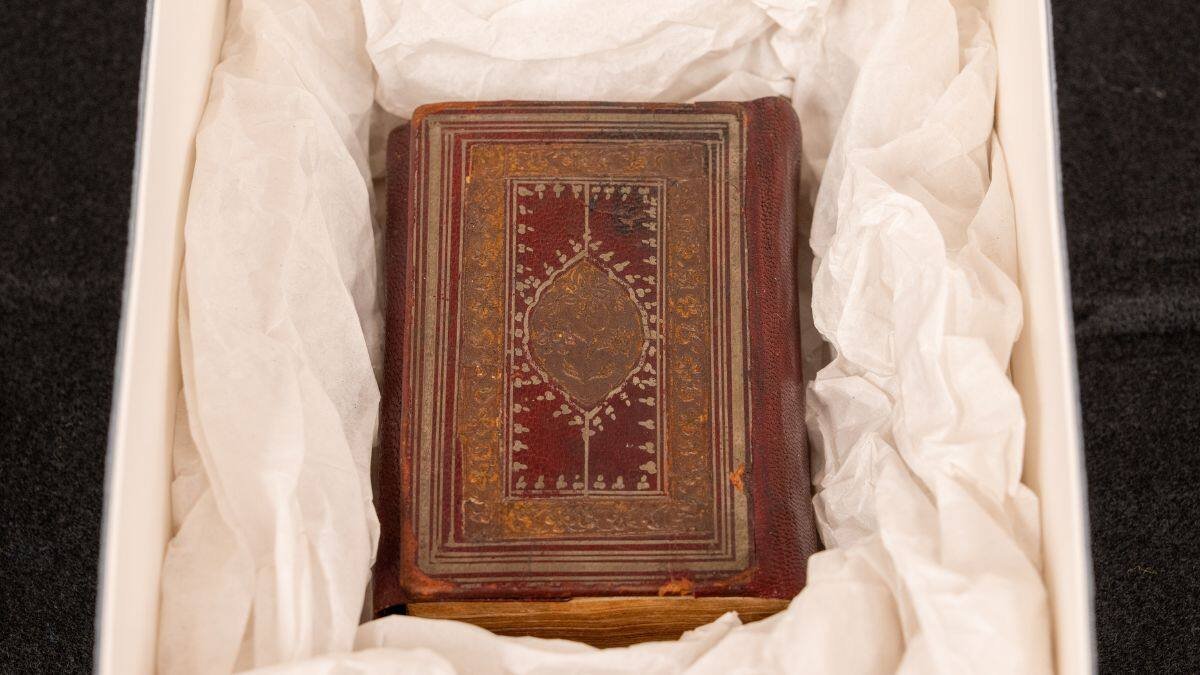
The second was a small, historic manuscript dating to the late 18th or early 19th century, drawn from the collections of the New York Public Library’s Schomburg Center for Research in Black Culture.
For the subsequent public ceremony at City Hall later in the day, Mamdani planned to use two family-owned Qurans — one that belonged to his grandfather and another that belonged to his grandmother.
Mamdani’s campaign did not provide further details about these heirlooms.
What we know about the Quran from the Schomburg Center
The historic Quran from the Schomburg Center has been notable not for ornamentation, but for its simplicity. Unlike lavish manuscripts produced for royal courts or wealthy patrons, this copy was created for regular use.
Bound in deep red with a modest floral medallion, the text is written in black and red ink using a straightforward, legible script.
Its design has led scholars to conclude that it was intended for ordinary readers rather than ceremonial display. Because the manuscript is neither signed nor dated, experts have relied on its binding style and script to estimate its origins.
Based on these features, it is believed to have been produced during the Ottoman period in a region encompassing present-day Syria, Lebanon, Israel, the Palestinian territories and Jordan.
Hiba Abid, the New York Public Library’s curator for Middle Eastern and Islamic Studies, emphasised that these qualities are central to the manuscript’s meaning.
“The importance of this Quran lies not in luxury, but in accessibility,” she told the New York Times.
What we know about Arturo Schomburg
The Quran’s journey to Mamdani’s inauguration begins with Arturo Schomburg, a Black Puerto Rican writer, historian and collector whose work played a foundational role in documenting the global history of people of African descent.
Though Schomburg was not Muslim, he acquired the Quran as part of a wide-ranging archive intended to reflect the full spectrum of Black cultural, artistic and religious life.
Schomburg’s motivation was shaped in part by an experience from his youth. As a child, a teacher told him that Black people had no significant history or notable figures.
That remark became a catalyst for his lifelong effort to assemble evidence to the contrary. His collection eventually grew to more than 4,000 books, manuscripts and artifacts.
In 1926, Schomburg sold this collection to the New York Public Library, laying the groundwork for what would become the Schomburg Center for Research in Black Culture.
He died in 1938, but his archive continues to serve as one of the world’s most important repositories of Black history.
While it is unclear exactly how Schomburg came into possession of the Quran, scholars believe it reflected his interest in the historical relationship between Islam and Black communities in both Africa and the United States.
Its inclusion in his collection signalled an understanding of Islam as an integral part of global Black history.
How the Schomburg Quran connects to Mamdani
For Abid, the selection of the Schomburg Quran carried layered symbolism that extended beyond religion alone. Mamdani’s personal background — as a South Asian New Yorker born in Uganda — mirrored the manuscript’s transregional origins and Schomburg’s Afro-Latino legacy.
“It’s a highly symbolic choice because we’re about to have a Muslim mayor swearing in using the Quran, but also a mayor who was born on the African continent, in Uganda,” Abid said.
“It really brings together here elements of faith, identity and New York history,” she added.
Abid assisted Mamdani’s wife, Rama Duwaji, and senior adviser Zara Rahim in selecting the Quran for the inauguration. Duwaji herself brings transnational identity to the moment, being American-Syrian.
Where the Schomburg Quran can be accessed
Following the inauguration, the Schomburg Quran is set to be placed on public display at the New York Public Library for the first time.
The exhibition coincides with a yearlong celebration marking the 100th anniversary of the Schomburg Center. It is scheduled to open shortly after Mamdani’s swearing-in.
Abid expressed hope that the attention surrounding the inauguration — whether supportive or critical — would encourage New Yorkers to engage more deeply with the library’s archival holdings.
These collections document a wide range of Islamic life in the city, including early 20th-century Armenian and Arabic music recorded in New York, as well as firsthand accounts of Islamophobia following the September 11 attacks.
“This manuscript was meant to be used by ordinary readers when it was produced,” Abid said. “Today it lives in a public library where anyone can encounter it.”
How Mamdani’s oath invited backlash as well as support
Mamdani’s campaign and election unfolded amid heightened national attention, much of it focused on his identity as a Muslim democratic socialist.
In a speech delivered days before the election, Mamdani addressed the hostility directly, framing it as a challenge he was unwilling to meet with silence.
“I will not change who I am, how I eat, or the faith that I’m proud to call my own,” he said. “I will no longer look for myself in the shadows. I will find myself in the light.”
Alabama Republican Sen. Tommy Tuberville reacted to news of Mamdani’s oath by posting on social media, “The enemy is inside the gates.”
Criticism also emerged from outside the United States. Dutch politician Geert Wilders weighed in with his own post, stating, “Invalid oath. No Quran. USA is not Islamic. Yet. Wake up America.”
Such reactions echoed earlier controversies involving Muslim elected officials. In 2006, Keith Ellison faced condemnation from conservative commentators after choosing to use a Quran for his ceremonial swearing-in as the first Muslim member of Congress.
Mamdani’s opponents have not limited their criticism to religious symbolism. His policy platform — which included proposals such as citywide rent freezes, free child care and free public transportation — has drawn pushback from figures across the political spectrum.
Republican Rep. Mike Lawler of New York criticised Mamdani’s economic agenda during an appearance on Fox Business.
“It’s not going to work. It has never worked anywhere. It’s been tried. And there’s a reason why so many folks from around the globe have fled communism and socialism to come to the United States in search of opportunity and a better life, primarily economic opportunity through our capitalist markets,” Lawler said.
Despite such opposition, Mamdani maintained his focus on governing priorities as he approached inauguration day.
“Thank you to every New Yorker who believed in this fight for working people,” he
wrote in a post on X hours before being sworn in.
Mamdani’s swearing-in was conducted by Senator Bernie Sanders, an independent from Vermont who had backed his campaign for months. Sanders framed Mamdani’s victory as part of a broader challenge to entrenched political power.
“Zohran and his supporters showed the world that when working people stand together, we can defeat the Democratic and Republican establishments, Trump and the Oligarchs,” Sanders wrote on X.
“Best of luck to the new mayor.”
What next
Mamdani now joins a small but growing group of prominent US officials who have used the Quran during oath ceremonies.
In addition to Keith Ellison, this group includes US Rep. Ilhan Omar, who also placed her hand on the Quran when she was sworn into Congress.
At the municipal level, New York City Council member Shahana Hanif used a family Quran during her 2022 swearing-in ceremony. Reflecting on Mamdani’s decision,
Hanif pointed to the broader implications for Muslim participation in city politics.
“Let’s be honest, Muslims have not been in electoral life for decades like other ethnic groups and communities,” she said. “I think the Quran represents this example of extending solidarity to the Muslim community in New York City and, really, abroad.”
For Mamdani’s advisers, the decision to use the Quran was as much about correcting historical absence as it was about personal faith. In a statement, senior adviser Zara Rahim described the moment as long overdue.
“This moment will mark a turning point in the civic history of New York City, and it belongs to every New Yorker whose lives shaped this city quietly, without ever being reflected back to them,” she said.
With inputs from agencies
End of Article