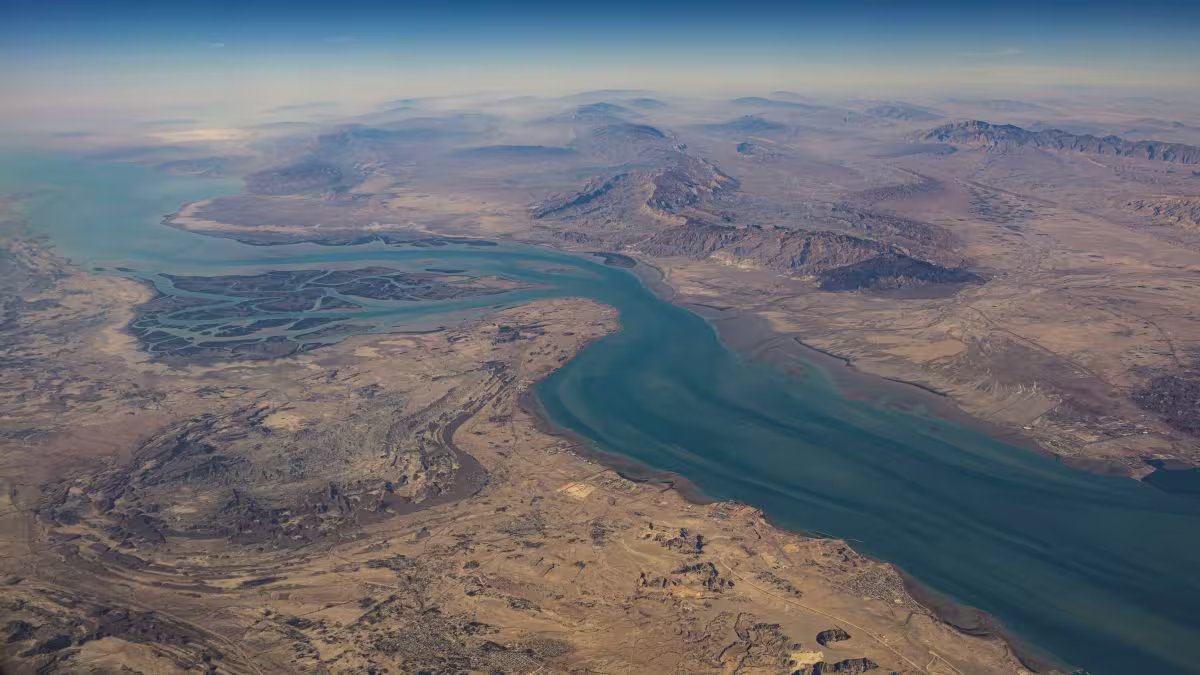
Iran’s temporary closure of parts of the Strait of Hormuz on Tuesday, thrust the world’s most critical maritime chokepoint back into focus.
The move coincided with Iranian live-fire drills and renewed indirect nuclear talks in Geneva. Though Tehran said the shutdown lasted only hours for safety, it exposed how fragile global energy routes are during regional tensions.
As the main exit for Gulf oil and gas, any restriction in the narrow strait jolts global markets, especially in Asia. Iran has harassed vessels before but has not imposed such a closure since the 1980s.
The move came amid stepped-up US military deployments, threats of force from Washington, and unrest in Iran after a violent crackdown on protests.
Why does the Strait of Hormuz matter?
The Strait of Hormuz is a narrow channel that forms the maritime connection between the Persian Gulf and the Gulf of Oman, providing onward access to the Indian Ocean and global shipping lanes.
At its tightest point, the waterway measures around 33 kilometres across. Iran and Oman control territorial waters along the strait, while international maritime law recognises shipping corridors that allow vessels from all countries to transit.
The United Arab Emirates lies close to the passage, placing major commercial hubs such as Dubai near one of the world’s most sensitive choke points.
For centuries, the route has served as a commercial artery linking the rest of Asia with region. Historical trade flows through the region included ceramics, ivory, silk and textiles transported from China across maritime routes that passed through the strait.
In the contemporary era, the passage has become indispensable to the global energy system. Tankers transporting crude oil and natural gas from Saudi Arabia, Kuwait, Iraq, Qatar, Bahrain, the UAE and Iran rely on the strait to reach international markets.
The overwhelming share of these shipments is directed toward Asian economies, reflecting the region’s growing energy demand and strategic dependence on Gulf producers.
According to data from market intelligence firm Kpler, approximately 13 million barrels of crude oil per day moved through the Strait of Hormuz in 2025. This volume accounted for around 31 per cent of global seaborne crude shipments.
Although Saudi Arabia and the UAE operate pipeline networks that allow some exports to bypass the waterway, alternative routes remain limited.
The US Energy Information Administration has stated that “most volumes that transit the strait have no alternative means of exiting the region,” pointing out how few practical options exist for rerouting shipments if the passage is disrupted.
Because of this concentration of energy flows, even the perception of instability in the Strait of Hormuz can influence oil prices and shipping insurance costs.
Past episodes of tension, including during the Israel-Iran conflict in June, have been accompanied by spikes in energy prices. Market sensitivity reflects the lack of redundancy in export routes from the Gulf and the high costs associated with any sustained disruption to maritime traffic.
What happened during Iran’s drills?
Iranian media reported that the closure was implemented for a limited number of hours to manage safety concerns during the drills.
The semiofficial Tasnim news agency, which maintains close links to Iran’s paramilitary Revolutionary Guard, said missiles launched from within Iranian territory and from coastal positions struck designated targets in the strait as part of the exercise.
The military activity followed earlier warnings issued to mariners in the region. Radio advisories indicated that Iran intended to conduct “live surface firing,” alerting commercial vessels to heightened risks while transiting the area.
Iranian authorities described the exercises as part of a drill named “Smart Control of the Strait of Hormuz,” signalling Tehran’s focus on demonstrating its ability to operate in and around the strategically vital corridor.
The temporary shutdown also came after a series of maritime encounters that had already elevated tensions between Iran and the United States. Earlier in February, a US Navy fighter jet intercepted and destroyed an Iranian drone that approached the aircraft carrier USS Abraham Lincoln in the Arabian Sea.
In a separate incident, Iranian forces harassed a US-flagged and US-crewed merchant vessel navigating the Strait of Hormuz, according to US military officials. These encounters followed Iranian naval exercises in the strait and nearby waters several weeks earlier.
The US military’s Central Command, which oversees operations in the region and commands the Bahrain-based Fifth Fleet, has previously warned Iran that unsafe conduct near American forces, allied vessels or commercial shipping increases the risk of collision and unintended escalation.
While acknowledging that Iran has a “right to operate professionally in international airspace and waters,” US officials have cautioned against actions such as aircraft or vessels approaching US warships too closely or directing weapons at them.
The USS Abraham Lincoln and its accompanying guided-missile destroyers have remained in the Arabian Sea for several weeks, positioned to support potential operations. US President Donald Trump has also announced plans
to deploy the USS Gerald R Ford from the Caribbean to West Asia, reinforcing American military capabilities in the area.
The expanded presence has been interpreted by Iran as part of Washington’s effort to apply pressure in the context of nuclear negotiations and broader regional disputes.
How are Iran-US nuclear talks faring?
Talks held in Geneva on Tuesday were mediated by Oman and involved Iran’s Foreign Minister Abbas Araqchi alongside US Special Envoy Steve Witkoff and US President Donald Trump’s son-in-law, Jared Kushner.
Following the meeting, Araqchi
indicated that the two sides had reached a broad understanding on foundational principles, while cautioning that substantial work remained before any comprehensive agreement could be finalised.
“Different ideas have been presented, these ideas have been seriously discussed, ultimately we’ve been able to reach a general agreement on some guiding principles,” Araqchi said after the talks concluded.
A US official described the discussions as yielding progress while emphasising that significant details remained unresolved. “Progress was made, but there are still a lot of details to discuss,” the official said.
Oman’s Foreign Minister Badr al-Busaidi noted that “much work is yet to be done” but said both sides were departing with “clear next steps.”
The diplomatic engagement took place amid heightened US military deployments intended to press Iran for concessions.
Oil futures prices eased following Araqchi’s remarks about progress in the talks, reflecting market hopes that dialogue could reduce the likelihood of conflict.
Iran’s leadership has reiterated that any agreement must centre on limits to its nuclear programme in exchange for sanctions relief. Tehran has rejected efforts by Washington to broaden the talks to include restrictions on its missile arsenal.
Iranian officials have maintained that uranium enrichment will not be abandoned entirely and that missile capabilities remain non-negotiable. Khamenei has restated that missile type and range are not matters for discussion with the United States.
The current diplomatic push follows a period of intense confrontation in mid-2025, when the United States joined Israel in launching strikes against Iranian nuclear facilities. American B-2 stealth bombers were used in the campaign, which Tehran says led it to halt uranium enrichment activity.
The United States and Israel argue that Iran seeks to develop a nuclear weapon, which they view as an existential threat to Israel.
Iran continues to assert that its nuclear programme is intended for civilian purposes, even as it has enriched uranium to levels close to weapons-grade purity.
Iran is a signatory to the nuclear Non-Proliferation Treaty, which grants countries the right to pursue peaceful nuclear energy in exchange for commitments not to develop nuclear weapons and to cooperate with the International Atomic Energy Agency.
Israel has not signed the treaty and follows a long-standing policy of neither confirming nor denying the possession of nuclear weapons, a stance widely interpreted by analysts as an effort to deter adversaries.
Domestically, Iran’s leadership has faced growing pressure following widespread protests over economic conditions. The unrest, which erupted in late December and January,
was met with a severe crackdown that resulted in thousands of deaths.
Economic hardship has been exacerbated by international sanctions that have constrained Iran’s oil revenues and limited access to foreign markets.
What are the risks for global markets & regional security?
Iran has previously warned that it could obstruct commercial traffic in response to external attacks, a move that would restrict a significant share of global oil flows.
While the latest closure was described by Iranian media as limited in duration, the decision highlighted Tehran’s capacity to interfere with maritime transit during periods of heightened tension.
Energy markets
have historically responded sharply to threats against the strait. Even brief interruptions or military exercises have been sufficient to unsettle traders, given the limited availability of alternative export routes for Gulf producers.
A prolonged disruption would likely affect not only oil prices but also shipping insurance premiums, freight rates and broader economic confidence, particularly in energy-importing regions of Asia.
The United States has threatened to use military force in response to Iran’s actions, including its handling of domestic protests and its nuclear programme. Trump initially warned of potential strikes following Iran’s crackdown on demonstrators before shifting to linking the threat of force to pressure Tehran into a nuclear agreement.
He has stated that he believes Iran seeks to avoid the consequences of failing to reach a deal and has indicated that he is involved indirectly in the Geneva negotiations.
Iran has responded with its own warnings, including threats to target US interests across the West Asia and Israel if attacked. Tehran maintains an arsenal of short- and medium-range missiles capable of striking neighbouring Gulf states.
During last year’s 12-day conflict, Iran launched ballistic missiles while Israel targeted Iranian military stockpiles. Despite the intensity of that confrontation, Iran did not fully close the Strait of Hormuz at the time, making the recent temporary shutdown particularly notable.
Iran’s Supreme Leader Ayatollah Ali Khamenei
issued pointed remarks directed at Washington amid the latest tensions. “The strongest army in the world might sometimes receive such a slap that it cannot get back on its feet.”
“Of course a warship is a dangerous apparatus, but more dangerous than the warship is the weapon that can sink the warship into the depths of the sea,” he said, according to Iranian state television.
With inputs from agencies
End of Article



Really interesting read! Thinking about player experience is key – a smooth signup, like with 8jl casino link, makes all the difference. Accessibility for Filipino players is huge too – good stuff! 👍