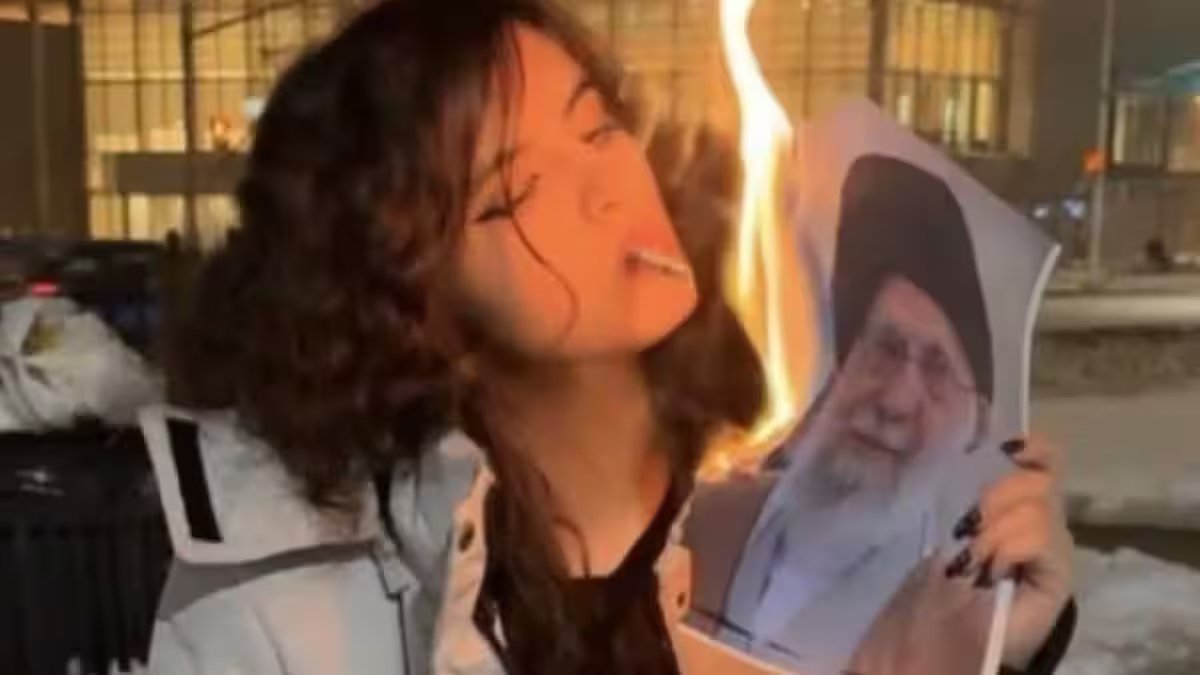
Short video clips circulating online show Iranian women burning photographs of Supreme Leader Ayatollah Ali Khamenei and using the flames to light their cigarettes.
The trend has surfaced at a time when Iran is grappling with serious economic hardship and growing public dissatisfaction which has
resulted in renewed protests, and a wider crisis of confidence in its leadership.
Why this form of protest is unique
In Iran, burning an image of the Supreme Leader is treated as a serious offence under the law. The position of the Supreme Leader holds both political and religious authority, and public acts that disrespect the office are considered a direct challenge to the state.
At the same time, women smoking in public has long been discouraged or restricted under Iran’s strict social and religious norms.
By executing both actions — setting fire to Ayatollah Khamenei’s photograph and then lighting a cigarette from the flame — Iranian women are sending a message that goes beyond words.
The act openly rejects the authority of the state while also challenging expectations placed on women’s behaviour.
👁️| The brave women of Iran (true feminists) are making it a trend to take photos of themselves lighting a cigarette with a burning picture of the terrorist Ali Khamenei during ongoing protests across the country, including the Iranian capital, Tehran. pic.twitter.com/hkaw019T2z
— militantosh⚡️ (@MilitanTosh) January 9, 2026
Observers say this kind of protest is harder for authorities to contain because it does not rely on mass gatherings that can be dispersed.
The symbolism is instantly understood, and the content spreads far beyond Iran’s borders, keeping international attention focused on the country’s internal struggles.
When Iran erupted in protests after Mahsa Amini’s death
Mahsa Amini was a 22-year-old woman who
was arrested by Iran’s Guidance Patrol in September 2022 for allegedly violating the country’s mandatory hijab law while visiting Tehran from her hometown of Saqqez.
According to eyewitnesses, she was severely beaten by officers during her detention. Iranian authorities denied these claims. Amini later collapsed, was hospitalised, and died three days after her arrest.
Her death triggered nationwide protests that continued into 2023 and were described as the most widespread challenge to the Islamic Republic since the 1979 revolution.
Around 40 civilians were reportedly killed at the time and many others were injured. During this period, the hashtag related to Mahsa Amini gained 52 million tweets, highlighting the global attention the movement received.
During those protests as well, demonstrators used a wide range of tactics with many organising small, rapid “flash mob” gatherings rather than large marches.
Drivers blocked streets with their vehicles to slow down security forces, while others used dumpsters or even overturned police cars to block roads.
Security personnel on motorbikes moved through traffic while firing at protesters. In some cases, paintball guns were used to mark demonstrators for later identification. To counter this, protesters carried extra clothes, wore masks, and removed public surveillance cameras.
Some people protested from windows or rooftops, while others staged symbolic acts. These included dyeing fountains red to resemble blood, burning hijabs in public,
and cutting their hair as a sign of defiance.
Another protest method involved knocking turbans off clerics in the street and running away, since turbans are seen as a symbol of the regime.
Support for the movement also came from universities. Several professors and teachers expressed solidarity with students by boycotting classes or resigning.
The new trend of lighting cigarettes with burning photos of the Supreme Leader fits into this broader pattern of symbolic resistance.
How current protests in Iran have been faring
Iran is facing high inflation, rising food prices, and a sharply weakened currency. The falling value of the rial has reduced purchasing power and added pressure to daily life for ordinary citizens.
Frustration over the economy has fuelled fresh protests in cities across the country. The latest unrest began in Tehran, particularly in the Grand Bazaar, where shopkeepers expressed anger over the currency’s decline.
From there, demonstrations spread to other areas, eventually reaching all 31 provinces.
The US-based Human Rights Activists News Agency (HRANA) reported that at least 34 protesters and four members of the security forces were killed during the recent unrest. The agency also said around 2,200 people had been arrested.
Analysts describe the protests as a sign of deeper disillusionment with Iran’s political and religious establishment.
Iran’s authorities have have stated that economic grievances are legitimate and should be addressed through dialogue. At the same time, security forces have used tear gas and force in confrontations with demonstrators, especially when protests have turned violent.
How the current protests are threatening Khamenei’s rule
Iran’s
regional position has weakened in recent months. Israel has carried out attacks against Iranian-backed groups, including Hamas in Gaza, Hezbollah in Lebanon, the Houthis in Yemen, and militias in Iraq.
In addition, the removal of Syrian leader Bashar al-Assad, a close ally of Tehran, has reduced Iran’s influence in the region.
Khamenei, now 86 years old, has ruled Iran for decades and holds ultimate authority over the country’s political system. In response to the growing protests and foreign pressure, Khamenei vowed that Iran “will not yield to the enemy.”
Former Iranian officials have said there is no simple solution to the challenges facing the leadership.
They argue that long-standing policies — including reliance on regional proxies, efforts to bypass sanctions, and the pursuit of nuclear and missile programs — are becoming harder to sustain.
Exiled opponents of the Islamic Republic, though divided among themselves, believe the current unrest could create an opportunity to weaken the establishment. However, it remains unclear how much support these figures have inside Iran.
Also Watch:
With inputs from agencies
End of Article