The rupee is down 3.6% since the start of 2025 and over 6% in the last one year. Notably, in Nov 2024, the Indian rupee was considered overvalued. Therefore, some of the fall was due.
While exporters may see some benefit, equity markets may have to wait longer for the return of foreign investments. They will wait for the rupee to find a floor before making new bets because they make more money when the rupee is on a gaining trajectory.
A profit of say, ₹1,000 crore— $112 million at current exchange rates— will be worth $14 million more if encashed at 80 rupees to the dollar. That’s a more than 10% addition to the profit just on account of exchange rates.
A weaker rupee is a cushion for exporters
For now, the biggest challenge facing the Indian economy is the US tariff, and the subsequent trade negotiations. Exporters have the most at stake, and therefore, they are the most vulnerable too. The government and the Reserve Bank of India (RBI) seem focussed on them.
Chief Economic Advisor Anantha Nageswaran believes the current fall in the rupee is not ‘excessive’. You can watch the full conversation here.
Letting the rupee slide a bit may have softened the blow already. Data at the end of Aug 2025, from the Bank of International Settlements, shows that the rupee’s real effective exchange rate (REER)— which shows how competitive the currency is in global trade— is at a level last seen in Feb 2019.
It’s important to note that the recent softness in inflation may have helped push the REER. Any spike in inflation may change the context and therefore, the argument made here. For now, the forecast for crude oil prices and inflation aren’t alarming.
Not just exporters, it also makes some local manufacturers more competitive because the imported alternative becomes more expensive when the rupee weakens. Part of the rally in steel stocks this week is attributable to this phenomenon.
The upside of being the worst performing EM currency
The Indian rupee is the worst-performing emerging market (EM) currency this year, after its peers in Argentina and Turkey, countries where the inflation rate is running well above 30%,. Comparatively, India’s retail inflation rate in August was 2.07%.
Bulk of the rupee depreciation is driven by foreign portfolio investors dumping Indian stocks, to the tune of $15.6 billion this year so far, and over $21 billion in the last 12 months.
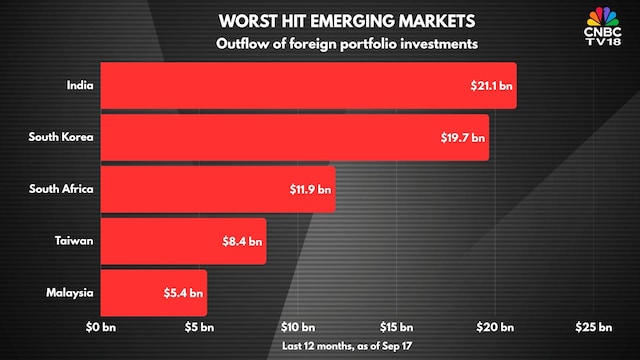
While the rupee has lost its sheen, most other EM currencies have rallied hard and that’d help India reclaim some of its lost advantage due to the exorbitant US tariff on its exports.
Take Brazil for example. It’s faced with the same 50% tariff as India on the goods exported to the US. However, the currency is up over 16% this year so far. That’s a loss of competitive edge in India’s favour.
For the same reason, the gains in Rand have eroded more than half of the advantage South Africa had over India.
| EM Currency | YTD change vs USD | US Tariff advantage over India |
| Rand (South Africa) | 8.9% | 20% |
| Baht (Thailand) | 7.3% | 31% |
| Peso (Philippines) | 0.89% | 31% |
| Ringgit (Malaysia) | 6.2% | 31% |
| Peso (Mexico) | 13% | 25% |
| Remnibi (China) | 2.4% | -4% |
| Won (South Korea) | 5.6% | 35% |
| Real (Brazil) | 16.8% | 0 |
| Rupiah (Indonesia) | -3.3% | 31% |
| Rupee (India) | -3.5% | NA |
Data as of 4 pm IST on Sep 24
A weaker rupee also affects India’s positioning in its trade talks with the US
The Trump administration has been forcing countries that export to the US to reduce the value of their currency to reduce the trade deficit and increase America’s competitiveness as a destination for manufacturers.
Europe and Japan folded without a fight and the economies may pay the price over the long term.
Assuming India is also forced to concede some ground to the US during the negotiation, the starting point of the rupee’s value before the appreciation becomes important.
The other variables at play
The most important bit to note is that the dollar is in its worst year so far in over 30, triggered by a loss of faith in the US due to policy uncertainty.
The uncertainty could end in two ways. The best case scenario is that the US reclaims its lost reputation by Trump bringing more certainty to his trade and foreign policies. The resulting capital flows may prop up the dollar.
A reduction in tariffs on Indian exports will improve the sentiment and the earnings prospects for Indian equities, drawing more money into India, which would, in turn, shore up the rupee.
The worst case scenario is a US recession, which hasn’t been ruled out. Some experts believe that the American currency may be, once again, seen as a safe haven, which would also lead to an increase in the value of the dollar.
Either way, some of the rupee’s fall may get reversed.
Read more: Trump choking H-1B visas may just be what a $60 billion industry in India needed
Indian stocks have risen faster than earnings estimates
One number that may bring foreign investors back into the Indian stock market
