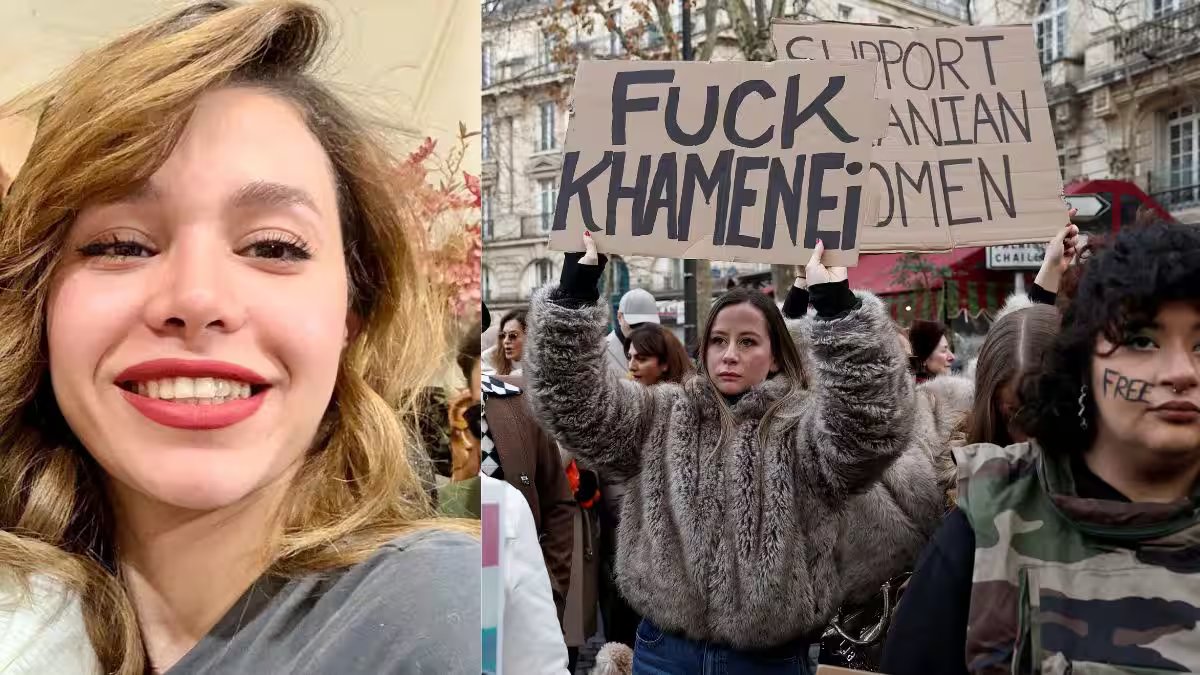
Rubina Aminian, a young Iranian student, became one of the few identified victims of Iran’s latest wave of anti-government protests after she was fatally shot in Tehran last week.
Who was Rubina Aminian
Rubina Aminian was a 22- or 23-year-old Kurdish student originally from Marivan, a city in Iran’s Kurdistan Province. Her family lived in Kermanshah, in western Iran.
She was studying textile and fashion design at Shariati Technical and Vocational College for Girls in Tehran, a women-only higher education institution offering programmes in technical fields, engineering, art, and architecture.
The college is located in the Khani Abad-e Now area of the capital, near Shahid Tondguyan Highway and Bahman Square.
Rubina was described by people who knew her as a young woman with a deep passion for fashion and clothing design.
Rubina Aminian, a 23 years old student was killed on the evening of Thursday, January 8, after leaving the college and joining protest gatherings in Tehran.⁰“The family was taken to a location near the college where they were confronted with the bodies of hundreds of young… pic.twitter.com/1YTcK7mBiy
— Mahmood Amiry-Moghaddam (@iranhr) January 10, 2026
Sources close to her family said she was “a young woman full of joy for life and passionate about fashion and clothing design, whose dreams were buried by the violent repression of the Islamic Republic.”
Her social media activity reflected this side of her personality, with videos showing her trying on jewellery, applying lipstick, and blowing kisses to the camera.
Her uncle, Nezar Minouei, told CNN that Rubina was “a strong girl, a courageous girl, and she was not someone you could control and make decisions for.”
He added, “She fought for things she knew were right and fought hard. She was thirsty for freedom, thirsty for women’s rights, her rights.”
How Rubina Aminian was killed
Rubina was killed on the evening of Thursday, January 8, 2026, after leaving college and
joining anti-government protest gatherings in Tehran. Human rights organisations say she was shot at close range in the back of the head.
According to Iran Human Rights, “Sources close to Rubina’s family, citing eyewitnesses, told Iran Human Rights that the young Kurdish woman from Marivan was shot from close range from behind, with the bullet striking her head.”
Another source said that most victims during the protests were young people between 18 and 22 years old who had been shot in the head or neck by government forces.
The Hana Human Rights Organisation also confirmed that Rubina was killed during the protests in Tehran and has opened an investigation into her case, citing “credible information” about the circumstances of her death.
Rubina is among the few protest victims whose identity has been publicly confirmed.
Human rights groups estimate that
more than 500 people have been killed in the nationwide unrest, including hundreds of protesters and dozens of security personnel.
The US-based Human Rights Activists News Agency (HRANA) has estimated that at least 538 people were killed, including 490 protesters and 48 members of the security forces. The group also reported that more than 10,600 people had been arrested.
How the family recovered her body
After learning of Rubina’s death, her family travelled from Kermanshah to Tehran to identify her body. What they encountered during this process has raised serious concerns about the scale of violence used against protesters.
According to sources close to the family, they were taken to a location near Rubina’s college where they were confronted with the bodies of dozens, and in some reports, hundreds of young people who had been killed during the protests.
One source told Iran Human Rights, “The family was taken to a location near the college where they were confronted with the bodies of hundreds of young people killed during the protests. Most of the victims were young people between 18 and 22 years old, who had been shot at close range in the head and neck by government forces. At first, the family was not allowed to identify Rubina’s body, and later they were not permitted to take her body with them.”
Rubina’s mother reportedly said, “It wasn’t just my daughter; I saw hundreds of bodies with my own eyes.”
Another source added, “The family was forced to search among the bodies themselves to identify their daughter, and they undoubtedly saw many of the bodies of young people killed during the protests.”
Only after persistent efforts were Rubina’s relatives allowed to confirm her identity and retrieve her body. They then rushed back to Kermanshah in an attempt to avoid further interference from security forces.
How the family was forced to bury her by the roadside
When Rubina’s family returned to Kermanshah with her body, they found their home surrounded by intelligence and security forces. According to human rights groups, the family was not allowed to hold a public funeral or mourning ceremony.
One source said, “After much struggle, Rubina’s family eventually managed to retrieve her body and return to Kermanshah. However, upon arrival, they found that intelligence forces had surrounded their home and that they were not allowed to bury her.”
Under heavy security pressure, the family was forced to bury Rubina along the road between Kermanshah and the nearby city of Kamyaran, instead of in a proper cemetery. Reports say the grave was shallow and located by a deserted roadside.
Attempts to hold mourning ceremonies were also blocked. When the family approached mosques in Marivan, they were reportedly told that such gatherings were not permitted.
The Hana Human Rights Organisation said the family was “forced under intense security pressure to bury their daughter without holding any mourning ceremony or allowing free public participation.”
The group described these actions as violations of human dignity and the right to mourn according to cultural and religious traditions.
Hana also stated that withholding bodies, confronting families with multiple victims, applying security pressure, and preventing mourning ceremonies “are clear examples of inhuman and degrading treatment” and may form part of a systematic pattern of human rights violations.
How Iran is faring under massive protests
Rubina Aminian’s death has become a symbol of the broader and increasingly violent response by Iranian authorities to mass protests across the country.
The demonstrations, which initially began over rising living costs, have grown into a nationwide movement against the political system that has ruled Iran since the 1979 revolution.
The unrest is described as the largest since 2009, when
a communications blackout preceded the killing of hundreds of protesters.
Doctors and activists have reported that hospitals in Tehran were overwhelmed with the dead and wounded. One doctor said six hospitals recorded at least 217 deaths in a single night.
A surgeon claimed
they treated six patients with gunshot wounds to the head after a protest in Tehran, and none survived.
Medical staff also reported that an eye hospital had been pushed into “crisis mode” because so many patients had lost one or both eyes during the unrest.
Opposition activist Masih Alinejad said she had been told by sources inside Iran that “hundreds of protesters have been killed by security forces,” adding, “The regime has shut down the internet to cover up a massacre.”
Reports have also said that US President Donald Trump
had been briefed on possible military options, while Iran’s parliament speaker Mohammad Bagher Qalibaf warned that the US and Israel would be “legitimate targets” if strikes were carried out against Iran.
With inputs from agencies
End of Article