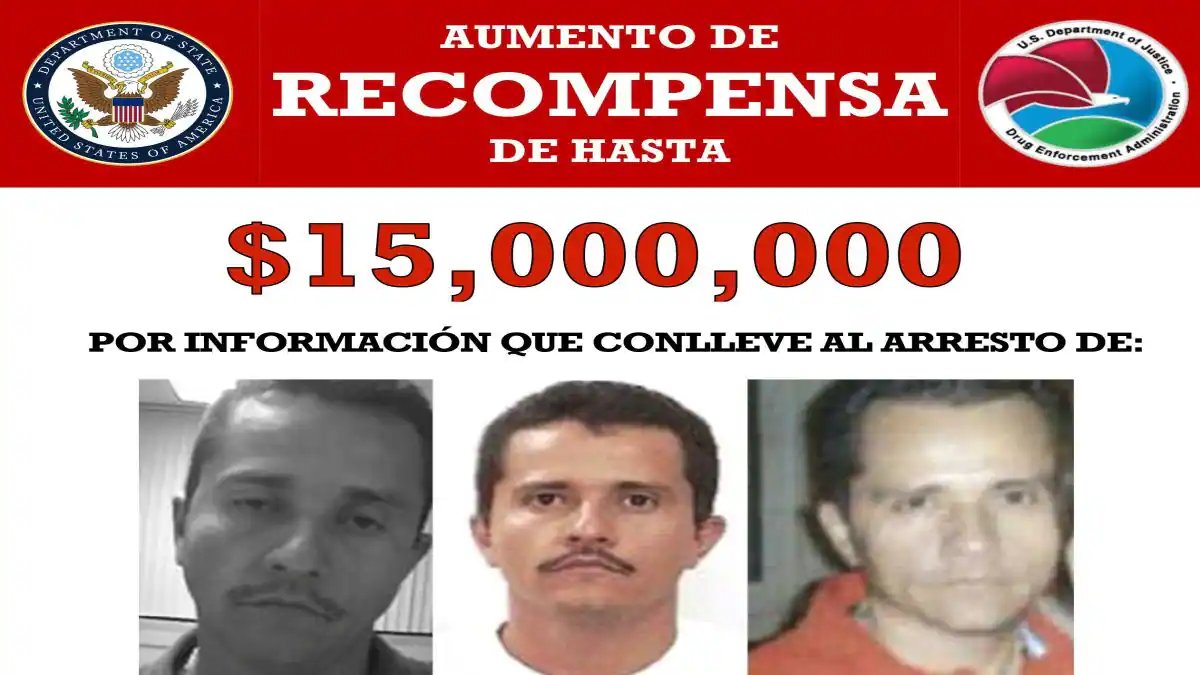
Nemesio “El Mencho” Oseguera Cervantes, Mexico’s most powerful cartel leader and one of America’s most wanted fugitives, was killed in a military operation to arrest him on Sunday (February 22). He died in Jalisco state after being seriously injured in clashes between his supporters and the Mexican army.
El Mencho was the leader of the dreaded Jalisco New Generation drug cartel, known by its Spanish acronym CJNG. His killing is the highest-profile blow against these syndicates since the recapture of former Sinaloa cartel boss Joaquín “El Chapo” Guzmán a decade ago.
Four CJNG members were killed in the town of Tapalpa, the central-western Jalisco state and three army personnel were also injured, reports the BBC.
Violence erupted in several states across Mexico after security forces carried out the operation. The Jalisco set cars ablaze, built roadblocks and attacked security forces in eight states to retaliate against the killing.
Who was Nemesio Oseguera Cervantes, aka ‘El Mencho’?
Oseguera Cervantes was one of the world’s most-wanted traffickers. A former police officer, he led the Jalisco New Generation Cartel, known by its Spanish acronym CJNG, as it became one of the “most powerful and ruthless criminal organisations” inside Mexico, according to the US Drug Enforcement Administration (DEA).
He and CJNG have been accused of trafficking large quantities of fentanyl and other drugs into the US. At the time of his death, the US State Department was offering a $15,000,000 (Rs 136 crore) reward for information leading to his arrest.
Oseguera Cervantes was born in 1966 in a poor village in the mountains of the rugged and notoriously lawless western state of Michoacan. There, cultivation of opium poppies and marijuana has competed with avocado production for decades.
As a boy, he worked the fields, and later went to seek his fortune in the US, where prosecutors said he got into the heroin trade. After a few years, he was arrested and served time in an American prison, reports Reuters.
He was deported back to Mexico, where he joined the police. In 1996, he married Rosalinda González Valencia, the niece of a powerful gang leader, Armando Valencia, alias “Maradona”. Oseguera Cervantes joined Valencia’s Milenio Cartel, a satellite of the Sinaloa Cartel. Eventually, he became a top enforcer after stints as a sicario, or cartel assassin.
After a failed attempt at taking over this cartel, Oseguera Cervantes struck out alone, declared war on Sinaloa, and founded the CJNG in alliance with a local gang of money launderers around 2009. The cartel is named for the western state of Jalisco, home to one of Mexico’s largest cities, Guadalajara.
El Mencho diversified into rackets such as stolen fuel, forced labour and human trafficking. He went on to become Mexico’s most influential crime boss after
“El Chapo” Guzman, who is now in a US prison.
However, unlike Guzman, who became a media celebrity, El Mencho preferred to remain in relative obscurity. He achieved notoriety for expletive-laden recordings leaked on social media in which he threatened enemies and officials.
Oseguera Cervantes was also known for evading capture in spectacular fashion. In May 2015, as Mexican forces closed in on him, his tipped-off henchmen shot down a military helicopter with a rocket-propelled grenade to give their boss time to escape.
For years, Oseguera paid off police to cover his back as he operated with near-total impunity inside Jalisco. He also sought political protection.
“El Mencho’s Jalisco New Generation Cartel was one of the biggest buyers of politicians and political campaigns, which has given it an enormous social base,” said Edgardo Buscaglia, an organised crime expert at Columbia University.
Noting El Mencho’s ability to win public support, Buscaglia pointed to footage broadcast during the 2020 coronavirus pandemic of people lining up for CJNG-stamped food packages handed out by cartel gunmen, not government workers, to help cushion the economic blow of lockdowns. “Compared to the Mexican government,” said Buscaglia, “he was the least bad option.”
What is Jalisco New Generation?
The Jalisco New Generation Cartel grew to become one of Mexico’s most dominant drug trafficking organisations. It move sythentic drugs – cocaine, methamphetamine and, in recent years, fentanyl — into the United States and other countries. In recent years, fentanyl has been linked to hundreds of thousands of overdose deaths.
The CJNG mixed Sinaloa-style drug trafficking and community outreach with the ultra-violent methods of the Zetas cartel, a gang that used paramilitary tactics to diversify into criminal enterprises such as extortion and kidnapping.
According to the US National Counterterrorism Guide, CJNG was the main competitor of the Sinaloa cartel. It grew in size and influence by joining hands with smaller local gangs in Mexican states Jalisco, Nayarit, and Colima.
The group comprises 15,000 to 20,000 members, according to US government estimates, reports the New York Times (NYT). Apart from drug trafficking, the gang is involved in extortion, fuel theft, kidnapping, illegal logging and mining, and migrant smuggling.
El Mencho’s gang routinely employed beheadings and other gory means of intimidation. In one six-week period in 2015, it killed two dozen police in western Mexico as a warning to authorities. It conducted public executions and put bodies on display, and often used social media to publicise the violence. The cartel earned a reputation for brazen attacks on Mexican security forces.
The CJNG did not hesitate to take on the most powerful people in Mexico, attacking and assassinating law enforcement officers, judges and politicians. In 2020, Mexico City’s then chief of police, Omar Garcia Harfuch, survived an assassination attempt that killed two of his bodyguards in an attack authorities blamed on the Jalisco cartel. Harfuch is now the country’s security chief and helped oversee the operation against Oseguera Cervantes.
Who will take over CJNG after El Mencho’s death?
It’s not clear who will succeed Oseguera Cervantes, or if any one person can.
The Jalisco cartel has a presence in at least 21 of Mexico’s 32 states and is active in almost all of the US, according to the DEA. But it is also a global organisation and the loss of its leader could be felt well beyond Mexico.
“El Mencho controlled everything, he was like a country’s dictator,” Mike Vigil, former chief of international operations for DEA, was quoted as saying by AP.
His absence could slow the cartel’s rapid growth and expansion and leave it initially weakened against the Sinaloa cartel on several fronts where they or their proxies are fighting. The Sinaloa is locked in its own internal power struggle, however, between the sons of “El Chapo” and the faction loyal to Ismael “El Mayo” Zambada, who is in US custody.
Vigil said Mexico should seize the moment to launch “an effective frontal assault based on intelligence.” “This is a big opportunity for Mexico and the United States if they work together,” he said.
Security analyst David Saucedo said that if relatives of Oseguera Cervantes take control of the cartel, the violence seen Sunday could continue. If others take power, they could be more willing to turn the page and continue operations.
The greatest fear would be that the cartel turns to indiscriminate violence. They could decide to “launch narcoterrorism attacks … and generate a scenario similar to what Colombia lived in the 1990s,” a full-on attack against the government “car bombs, assassinations and attacks on aircraft”.
However, the elimination of the cartel boss is a big victory for Mexico. It could give the government some advantage in its dealings with the US Trump administration, which has been threatening tariffs or unilateral military action if Mexico does not show results in the fight against the cartels.
With inputs from agencies
End of Article