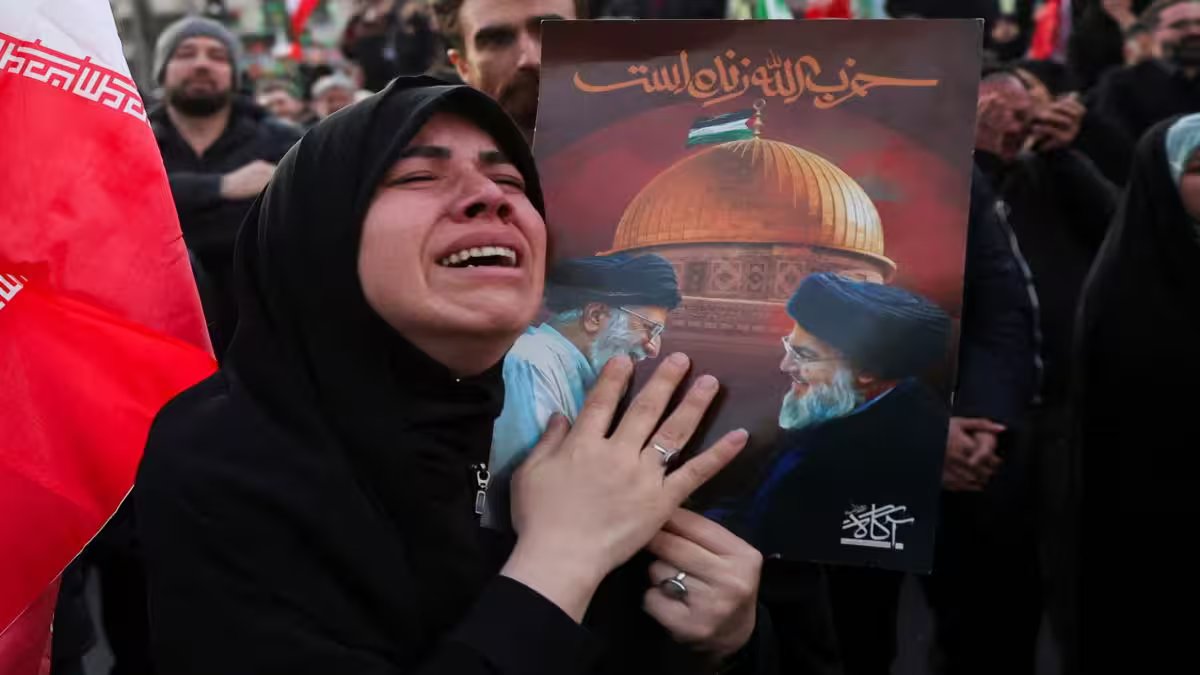
“Khamenei, one of the most evil people in history, is dead,” wrote US President Donald Trump on Saturday (February 28), hours after America and Israel carried out a joint operation against Iran, striking many major cities, including Tehran.
At first, Trump’s post was met with scepticism, but Iranian television has also confirmed the demise of the 86-year-old Supreme Leader. A presenter on state television announced Khamenei’s death at 5:00 am (0130 GMT), as the channel broadcast archive images with a black banner as a sign of mourning.
This marks a pivotal moment for Iran and the world; Ayatollah Ali Khamenei ruled the country since 1989. It has also resulted in one question being asked — who shall replace Ayatollah Ali Khamenei.
Who was Ayatollah Ali Khamenei?
The
86-year-old leader dominated Iran for the last three-and-a-half decades since taking on the post for life in 1989 as leader of the Islamic republic following the death of revolutionary founder Ayatollah Ruhollah Khomeini.
In his tenure, Khamenei ruled with an iron fist and refused calls for change, crushing dissent and ordering the killing of protesters who challenged his rule in the street. He saw off the 1999 student demonstrations, 2009 mass protests sparked by disputed presidential elections and 2019 demonstrations that were brutally suppressed. He also survived the 2022-2023 Woman, Life and Freedom movement sparked by the death of Mahsa Amini as well as the 12-day war against Israel last year.
Khamenei, the most powerful man in Iran, worked with six elected presidents, including more moderate figures such as Mohammad Khatami.
Khamenei was also responsible for Iran’s nuclear programme; it was under his rule, Israel and the West became convinced that Tehran had sought to secretly develop a nuclear weapons capability.
And he has remained defiant on it ever since; even during the ongoing talks with the US, Khamenei refused to abandon uranium enrichment. “The Americans should know that if they start a war, this time it will be a regional war,” he had warned at the end of January 2026.
How was Iran’s Ayatollah Ali Khamenei killed?
However, it seems that his time was up on Saturday when the US and Israel launched strikes, taking aim him at his compound among other targets. In the immediate aftermath of the strikes, Israeli officials stated that the airstrikes targeted Iran’s top leadership, including Khamenei.
Satellite images showed black smoke rising from the
supreme leader’s compound in the capital, Tehran. The images appear to show that several buildings in the compound were severely damaged by strikes. The Wall Street Journal reported that Israeli aircraft dropped 30 bombs on Khamenei’s headquarters.
As per a report by Iran’s Fars news agency, Khamenei was killed “in his office in the household of the leader” while “carrying out his duties” at the time of the attack early on Saturday.
Later, US President Donald Trump declared Khamenei’s death, writing on Truth Social, “This is not only justice for the people of Iran, but for all great Americans, and those people from many countries throughout the world, that have been killed or mutilated by Khamenei and his gang of bloodthirsty thugs.”
Shortly later, Iranian media also confirmed the news of Khamenei’s death, announcing 40 days of mourning.
However, not everyone was saddened by the news of Khamenei’s death. Cheers broke out in the streets of Tehran with many Iranians celebrating the news — social media was flooded with visuals of Iranians blaring music, cheering, clapping and honking their car horns to celebrate the news.
Scenes of celebration emerging from #Iran after the death of Iranian Supreme Leader #Khamenei
— Arjun (@ArjunxTweets) February 28, 2026
How will Iran replace Ayatollah Ali Khamenei?
With Khamenei’s death, there’s one question looming: Who shall be the next leader of Iran?
The constitution of Iran states that Khamenei’s successor must be selected by the same body that chose him: the Assembly of Leadership Experts. This is an 88-member clerical body elected by the public but vetted by the Guardian Council. Members of the Guardian Council are either directly or indirectly appointed by the supreme leader.
If the supreme leader dies or becomes incapacitated, a temporary leadership council assumes authority until a successor is formally appointed.
The Assembly of Experts is responsible for selecting the next leader. The constitution allows for either a single supreme leader or a leadership council. Analysts say, however, that the process could be heavily influenced by the
Islamic Revolutionary Guard Corps (IRGC). The IRGC “could try to supplant the entire process given the emergency situation in the country,” said Jason Brodsky, policy director at the Washington-based United Against Nuclear Iran, to Al Arabiya English.
And until the time a new leader isn’t chosen, the president, the head of judiciary and a cleric member of the powerful Guardian Council assume the leader’s responsibilities.
Who could be Ayatollah Khamenei’s successor?
While the final say is with the Assembly of Leadership Experts, Ayatollah Ali Khamenei had named three candidates who could be appointed in his place last June while he was in hiding during the 12-day war with Israel.
The first contender is
Mojtaba Khamenei, the second son of Ayatollah Ali Khamenei. The 56-year-old known to wield significant influence and has strong links with the Islamic Revolutionary Guard Corps (IRGC) as well as its Basij volunteer paramilitary force.
However, many have pointed that it is unlikely that he is appointed the next supreme leader because father-to-son succession is frowned upon. Also, the CNN reports that Mojtaba is not a high-ranking cleric and has no official role in the regime.
The other contender is Alireza Arafi, who is an established cleric and confidant of Khamenei. He is currently the deputy chairman of the Assembly of Experts and also wields significant power over the Guardian Council. He is also head of Iran’s seminary system.
There’s also Mohammad Mehdi Mirbagheri. The 60-year-old hardline cleric is strongly opposed to the West and believes a conflict between believers and infidels is inevitable. He currently heads the Islamic Sciences Academy in the northern holy city of Qom.
Apart from these, other possible replacements are Hassan Khomeini, who is the grandson of the Islamic Republic founder, Ayatollah Ruhollah Khomeini. Currently, the custodian of the Khomenei mausoleum, he doesn’t hold any public office and has little influence in the country’s political circles or security apparatus.
Last but not the least, there’s Hashem Hosseini Bushehri. A senior cleric closely linked to the institutions that manage succession, particularly the Assembly of Experts, he serves as first deputy chairman. Bushehri said to have been close to Khamenei but has a low profile domestically and isn’t known to have strong ties to the IRGC.
The next few days bring a whole lot of uncertainty; but one thing is certain — who fills the power vacuum is not just a life-and-death matter for the people of Iran, but for the prospects of peace across the broader West Asia.
With inputs from agencies
End of Article