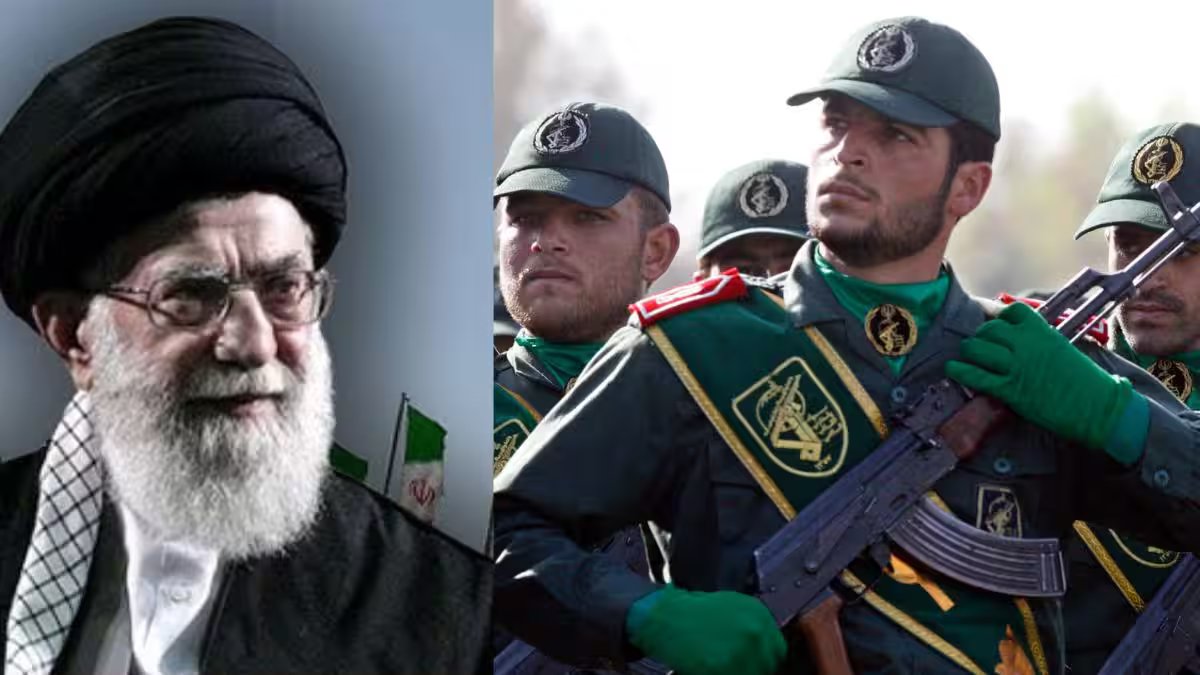
As rumours of regime change and leadership transitions swirl, the Islamic Revolutionary Guard Corps (IRGC) has accelerated its takeover of Iran’s political and economic systems, moving toward a military dictatorship.
As Iran confronts one of the most turbulent political moments in decades, the question of who truly holds power in Tehran has acquired renewed urgency. While Supreme Leader Ayatollah Ali Khamenei remains the public face of authority, a growing body of analysts argue that the Islamic Revolutionary Guard Corps (IRGC) has emerged as the decisive force shaping the Islamic Republic’s future even as talk of regime change swirls amid economic woes, mass protests and anxieties about succession.
Emerging from its origins in the 1979 revolution, the IRGC has evolved from an elite military arm into a sprawling organisation with influence across Iran’s political, economic and security spheres. Its tightening grip on power and the implications for both internal governance and any potential political transition is now a core lens through which experts view Iran’s unfolding crisis.
The institutional takeover: A state within a state
The IRGC’s rise has been gradual but relentless. Initially designed as a counterweight to Iran’s regular armed forces, it has expanded into a sprawling entity with its own land, naval and aerospace divisions, a powerful intelligence wing and extensive regional operations through the Quds Force. Over time, this institutional footprint has allowed the Guards to operate with a degree of autonomy unmatched by any other arm of the state.
Crucially, the IRGC’s influence is no longer confined to security matters. Former commanders now occupy senior roles across parliament, state-linked foundations, strategic industries and media organisations. This elite circulation has blurred the distinction between civilian governance and military authority, ensuring that the Guard’s worldview permeates formal decision-making structures. In practice, many government policies now reflect IRGC priorities long before they are debated publicly.
This integration has also altered Iran’s internal balance of power. While the presidency and cabinet retain administrative authority, strategic direction increasingly flows from institutions aligned with the Guards. For critics, this has hollowed out elected politics; for supporters, it has created a more disciplined system capable of resisting both domestic unrest and foreign pressure.
Succession fears and the limits of street power
Iran’s economic malaise has intensified scrutiny of this power shift. Years of sanctions, inflation and unemployment have weakened public confidence and periodically fuelled nationwide protests. Younger Iranians, in particular, show little attachment to the ideological foundations of the Islamic Republic. Yet despite repeated uprisings, the system has proved remarkably durable.
A major reason is the looming question of succession. With Khamenei approaching 90, uncertainty over his eventual departure has cast a long shadow over Tehran’s elite politics. Analysts argue that this is precisely where the IRGC’s importance peaks. As clerical authority risks fragmentation, the Guards are seen as the only institution capable of maintaining order and continuity.
This has reframed talk of “regime change.” Rather than envisioning a sudden democratic transition driven by popular pressure, many observers now anticipate an internal reconfiguration of power. In such a scenario, authority would shift further from religious institutions towards a security-dominated hierarchy, less a collapse of the system than its militarised evolution.
That prospect does little to reassure Iranians who associate the IRGC with repression and coercion. Yet its command over force, intelligence networks and economic resources gives it a decisive advantage over fragmented opposition movements and weakened political factions.
Economic muscle and Iran’s future trajectory
The Guards’ dominance is reinforced by their economic reach. Through conglomerates such as Khatam al-Anbiya, the IRGC controls vast segments of Iran’s infrastructure, energy and construction sectors. Sanctions, rather than curbing this influence, have often deepened it, sidelining private competitors and concentrating rents within Guard-linked networks.
In parallel, the IRGC has spearheaded sanctions-evasion mechanisms from shadow oil exports to increasingly sophisticated use of digital assets, allowing it to finance operations independently of the formal budget. This financial autonomy ensures that even a major political transition would leave the Guards as Iran’s most powerful stakeholders.
Internationally, this reality complicates engagement with Tehran. From nuclear negotiations to regional conflicts, IRGC interests are now inseparable from Iranian state policy. Any attempt to alter Iran’s behaviour abroad must contend with an institution that thrives on confrontation and strategic ambiguity.
As Iran navigates economic strain, social discontent and inevitable succession, the contours of power are becoming clearer. The future of the Islamic Republic may hinge less on who occupies senior political offices, and more on how firmly the Revolutionary Guards continue to anchor themselves at the centre of the state. In today’s Iran, real authority increasingly flows from those who control the guns, the balance sheet and the system’s survival instincts.
End of Article