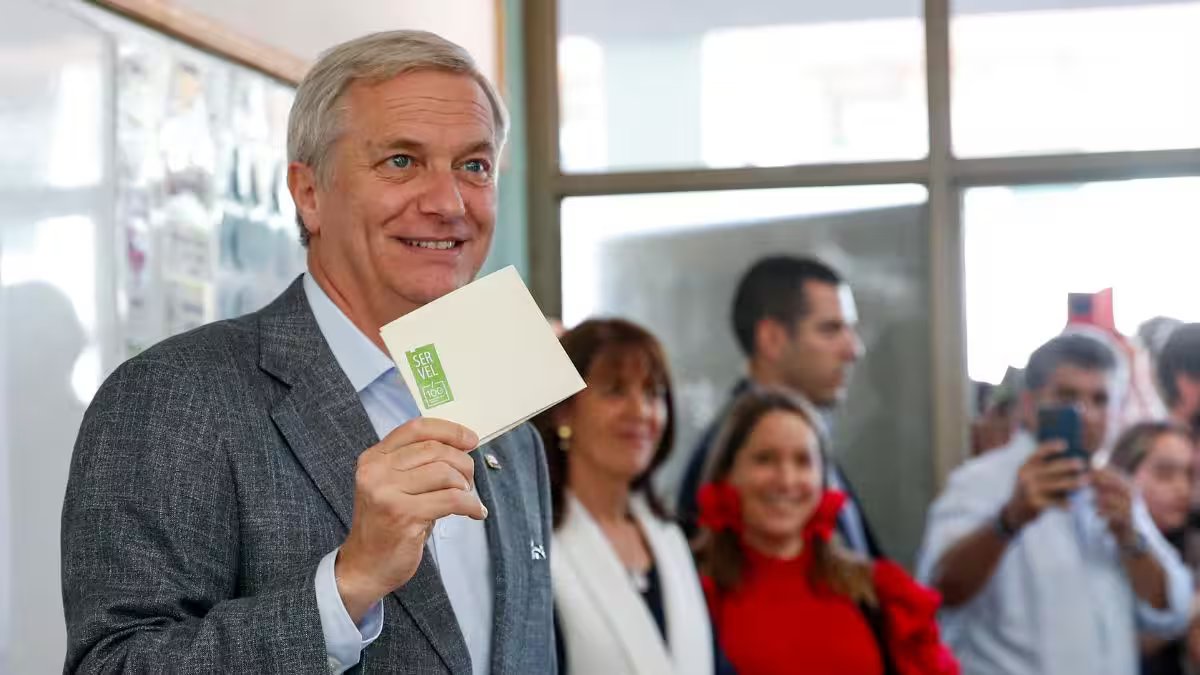
Jose Antonio Kast’s election as Chile’s next president signals a departure from centre-left and centre-right coalitions, since more than three decades after the fall of military rule.
.Kast’s victory was the product of years of political persistence and a regional environment increasingly receptive to hardline messages on security, borders and economy.
His ascent places a far-right figure at the helm of Chile for the first time since the return to democracy in 1990, setting the stage for profound changes in Chile’s role in Latin America.
Third time’s the charm
Kast’s triumph came on his third attempt at the presidency. Previously, he had failed to persuade Chilean voters that his uncompromising positions were suited to the moment.
In 2021, when he lost to Gabriel Boric, the political climate was shaped by mass protests against inequality, the social and economic shock of the Covid-19 pandemic, and widespread support for drafting a new constitution.
At that time, Kast’s focus on authority, social conservatism and state power appeared misaligned with an electorate seeking reform and protection.
Four years later, the mood had changed dramatically.
Kast
secured roughly 58 per cent of the vote in the runoff election, defeating Jeannette Jara, the candidate backed by the centre-left governing coalition, who garnered about 41 per cent.
Although Chile remains among the safer countries in Latin America, organised crime has become more visible and more violent. Kidnappings, assassinations and other high-profile crimes have unsettled communities unaccustomed to such incidents.
At the same time, an influx of undocumented migrants, most notably from Venezuela, has strained public services and fuelled debate over borders, state capacity and national identity.
These developments have coincided with slower economic growth.
Kast framed his campaign around restoring authority and reversing what he characterised as years of mismanagement. As the election approached, he accused the outgoing administration of undermining stability.
“This government caused chaos, this government caused disorder, this government caused insecurity,” he said during the campaign’s closing stages. “We’re going to do the opposite. We’re going to create order, security and trust.”
That message resonated with a broad and diverse electorate, ranging from business leaders attracted by his free-market instincts to middle-class families fearful of rising crime, and even to activists on the extreme right who openly celebrate Chile’s military past.
What we know about Jose Antonio Kast
Jose Antonio Kast was born in Santiago and raised in a large family as the youngest of ten siblings.
His parents were German immigrants who established a successful sausage-making business south of the capital, in the town of Paine.
He studied law at Chile’s Catholic University, an institution closely associated with conservative elites, and entered politics early.
Over the course of roughly three decades, Kast built a reputation as a disciplined and relentless figure, even as his legislative achievements remained limited.
During his time in Congress, he was involved in passing laws that included provisions for constructing statues, regulating lotteries and granting Chilean citizenship to a nun.
A devout Catholic, Kast is the father of nine children and has been married for more than 30 years to Maria Pia Adriasola, a lawyer who frequently appeared alongside him during the campaign.
His opposition to abortion is absolute, extending even to cases of rape. He is also against emergency contraception, divorce, same-sex marriage and euthanasia.
In earlier years, he said he would repeal Chile’s existing abortion laws and ban the morning-after pill, although he placed less emphasis on these issues in his most recent campaign, aware that public opinion overwhelmingly supports maintaining current reproductive rights.
Kast’s conservatism extends into his personal life. He has previously said that he forbade his wife from using birth control pills.
How Kast broke with the mainstream right
For much of his career, Kast was affiliated with the Independent Democratic Union, one of Chile’s main conservative parties. However, he became increasingly dissatisfied with what he saw as its moderation and willingness to compromise.
In 2016, he broke away to establish the Republican Party, positioning it as a more uncompromising alternative on issues such as national identity, law enforcement and social values.
His initial presidential run as an independent was unsuccessful, yielding less than 10 per cent of the vote.
The turning point came as public frustration with crime and migration heated up. In the 2021 election, running under the Republican Party banner, he gained significantly more support, setting the stage for his eventual victory four years later.
Throughout the latest campaign, Kast deliberately downplayed some aspects of his conservative agenda. Analysts noted that he focused relentlessly on security and migration while avoiding prolonged discussion of abortion, same-sex marriage and other divisive topics.
This strategy allowed him to broaden his coalition without formally abandoning his long-held positions.
What we know about Kast’s link to Pinochet
Few aspects of Kast’s biography generate as much controversy as his family’s links to Chile’s military dictatorship and to Nazi Germany. His father was a registered member of the Nazi Party and fought in World War II before fleeing to South America.
Kast has repeatedly stated that his father’s involvement was the result of forced conscription and that he did not subscribe to Nazi ideology.
The issue remains sensitive in a country deeply conscious of historical trauma. Kast’s eldest brother, Miguel Kast, served as a minister and later as president of the central bank during the early 1980s under Pinochet.
Miguel Kast was one of the so-called “Chicago Boys,” economists who implemented sweeping deregulation and privatisation policies during the dictatorship.
Kast himself was politically active during that era. As a law student, he campaigned for the “yes” option in the 1988 referendum that would have allowed Pinochet to remain in power.
The proposal was rejected by voters, paving the way for a transition to democracy. Kast has also expressed admiration for Pinochet, a stance that has drawn condemnation from human rights organisations and political opponents.
The dictatorship’s legacy looms large in Chilean memory. More than 40,000 people were executed, detained, disappeared or tortured between 1973 and 1990.
Kast’s critics argue that his rhetoric and policies risk rehabilitating an authoritarian mindset.
How Kast built a campaign on border control
Security was the central pillar of Kast’s campaign, eclipsing social and cultural issues that had previously defined his political persona.
He promised a sweeping crackdown on crime, vowing to strengthen the powers of the police and armed forces while offering greater legal protections to officers who use force in the line of duty.
His proposals include expanding the military’s role in internal security and increasing the state’s capacity to detain and isolate organised crime figures.
Kast has repeatedly pointed to El Salvador as a reference point. He visited
the country’s vast prison complex, built under President Nayib Bukele, and praised its harsh approach to gangs.
Drawing on that model, Kast has proposed constructing more maximum-security prisons in Chile and introducing stricter regimes inside detention centres, including limiting inmates’ contact with the outside world to disrupt criminal networks.
Migration policy formed the second core of his platform. Kast has pledged to deport hundreds of thousands of people living in Chile without legal status, the majority of whom are Venezuelan nationals.
He has promised to create a specialised police force focused exclusively on tracking down and expelling undocumented migrants, an institution explicitly inspired by US Immigration and Customs Enforcement.
Physical barriers are also part of his plan: walls, ditches and other infrastructure along Chile’s northern frontier aimed at deterring irregular crossings.
His rhetoric on immigration has been stark. At rallies and public events, he has warned migrants that their presence will no longer be tolerated. “Pack your things and leave,” he said during the campaign.
He has also claimed that uncontrolled immigration is not merely a policy failure but a deliberate strategy by political opponents. According to Kast, borders were left open by design, with the result that Chileans can no longer feel safe even in their own homes.
“They told us that they can’t close the borders and now we can’t open our windows for fear of violence,” he said.
While crime statistics do not always support the scale of alarm reflected in public discourse, Kast’s supporters argue that perception matters as much as data.
His promise of a “firm hand” appealed to voters who felt the state had grown hesitant and ineffective in the face of new challenges.
What Kast has promised
Beyond security and migration, Kast has laid out an ambitious economic agenda. He has pledged to cut billions of dollars in public spending over a short period by shrinking the state payroll and dismantling certain ministries, while insisting that social benefits would be preserved.
Economists have questioned the feasibility of these plans, warning that such reductions could be difficult to implement without affecting public services.
Kast has also promised to lower corporate taxes, relax labour regulations and reduce red tape, arguing that these measures will revive the rapid growth Chile experienced in the 1990s.
His supporters see this approach as a return to policies that once made Chile a regional model of stability and prosperity. Critics argue that the social and economic context has changed, and that aggressive austerity could exacerbate inequality.
Implementing his agenda will require negotiation. Kast’s Republican Party does not control a majority in either chamber of Congress.
To pass legislation, he will need to work with traditional centre-right parties that may resist some of his more radical proposals.
How Kast and Jara reacted after election night
As results were announced, scenes of celebration erupted among Kast’s supporters. Streets filled with cheering crowds, honking car horns and chants of his name.
In Santiago, some attendees at his victory speech carried framed photographs of Augusto Pinochet, former leader of the military junta in Chile.
In his address after the win, Kast adopted a noticeably more restrained tone than during much of the campaign. He spoke at length about restoring order and values, but avoided personal attacks.
When supporters began booing his defeated rival, he intervened sharply, telling them, “Respect!”
Kast described the outcome as both an endorsement and a responsibility. He said the margin gave him a “broad mandate” while also constituting “a tremendous responsibility.”
Framing his presidency as a collective endeavour, he added, “We are inviting you on a journey to recover values for a proper and healthy life. It won’t be easy. It requires everyone’s commitment.”
Jeannette Jara, speaking shortly after conceding defeat, urged her supporters not to lose faith. “It is in defeat that we learn the most,” she said after congratulating Kast by phone.
Jara’s candidacy, rooted in her role as labour minister under Boric and her lifelong membership in the Communist Party, had represented a stark contrast to Kast’s vision.
Argentina’s President Javier Milei, a radical libertarian often compared to Kast, was among the first to offer congratulations. Posting a map of South America highlighting recent right-wing victories, he declared, “The left recedes.”
From Washington, US Secretary of State Marco Rubio welcomed the result, saying the United States was confident that under Kast’s leadership Chile would advance shared goals such as improving public security, curbing illegal immigration and revitalising trade ties.
With inputs from agencies
End of Article