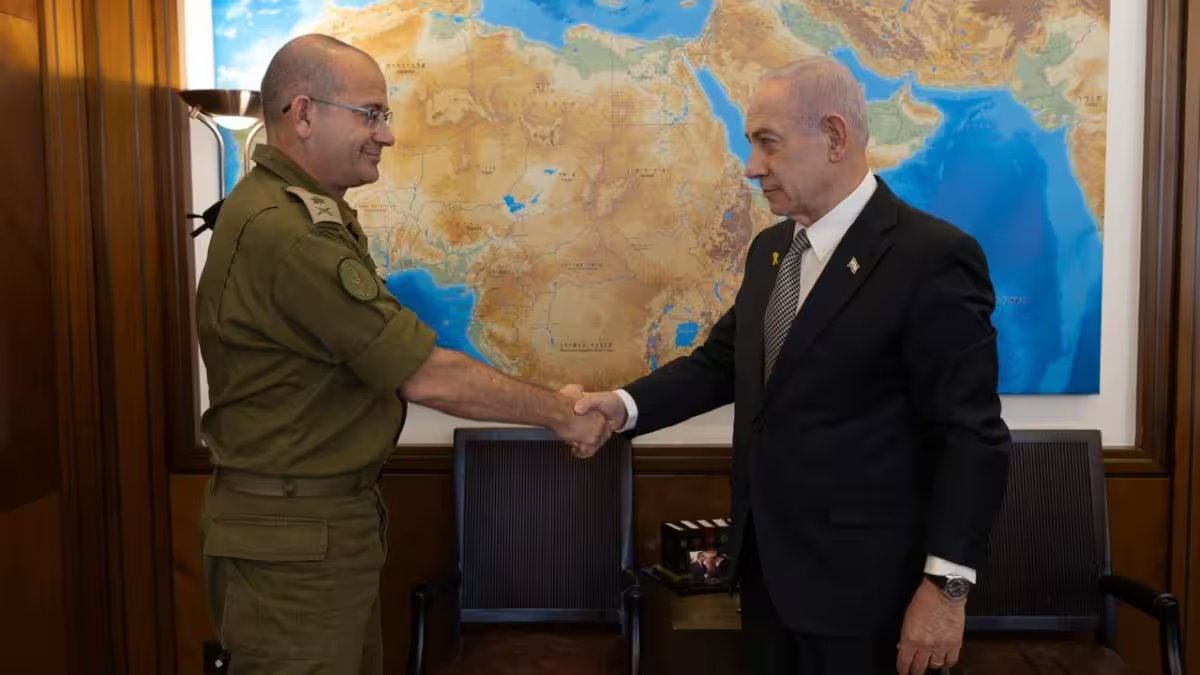
Israeli Prime Minister Benjamin Netanyahu has taken an unusual step in selecting the next director of Mossad, choosing a senior military commander with no experience inside the intelligence community to lead one of the world’s most recognised spy agencies.
Major General Roman Gofman — a long-serving Israel Defense Forces (IDF) officer who has occupied a wide range of battlefield and command positions — is set to take over from Mossad chief David Barnea when his term ends in June 2026.
The appointment, announced on Thursday comes as Israel continues to grapple with the aftermath of
the October 7, 2023 Hamas assault and the multifront regional escalation that followed.
After months of discussions regarding who should succeed Barnea, Netanyahu opted for the man who has served as his military secretary since 2024.
While Mossad has occasionally been led by individuals who came from military careers rather than internal intelligence ranks, Gofman has not previously worked within the organisation he is now preparing to direct.
Why Netanyahu selected Roman Gofman
Roman Gofman’s path to leading Mossad is unusual but not entirely without precedent.
He was born in Belarus in 1976 and moved to Israel with his family in 1990 at the age of 14.
Five years later, he joined the IDF Armoured Corps, beginning a long trajectory through field commands, operational headquarters, and divisional responsibilities.
Over three decades in the military, he held an array of roles ranging from tank commander and battalion leader to brigade commander and later division chief in northern and southern sectors.
Netanyahu’s office accompanied its announcement with strong praise for Gofman’s service and abilities, highlighting his performance during wartime.
In its statement, the office declared, “Gofman is an officer of great merit,” and pointed to his conduct during the Gaza conflict as evidence of his capability, noting that his role as military secretary to Netanyahu “proved his exceptional professional capabilities.”
The statement also emphasised qualities that Netanyahu sees as crucial for the head of Mossad, describing his “creativity, initiative, ingenuity, deep knowledge of the enemy, complete discretion, and strict confidentiality.”
Gofman, widely regarded as close to Netanyahu after nearly two years working alongside him, played a central role in coordinating the prime minister’s directives with the IDF and other security bodies during the war in Gaza.
The PMO highlighted that he maintained continuous liaison with intelligence services, including Mossad, throughout that period.
After interviewing various candidates, Prime Minister Benjamin Netanyahu has decided to appoint his Military Secretary, Maj.-Gen. Roman Gofman, to the position of Director of the Mossad of the State of Israel.
Further information >>https://t.co/6eLuWHoUck pic.twitter.com/9Is1ywlOIT
— Prime Minister of Israel (@IsraeliPM) December 4, 2025
Despite the unusual nature of the appointment, it has triggered relatively little institutional controversy. That stands in contrast to the storm that followed
Netanyahu’s choice of Major General David Zini to lead Israel’s domestic security agency, Shin Bet.
Zini’s nomination led to weeks of legal challenges and political criticism before he was eventually sworn in.
How Gofman rose through Israeli military ranks
Gofman began as a young conscript in the Armoured Corps, later becoming a tank commander in the 188th Armoured Brigade.
His career progressed steadily, leading to command of the 7th Armoured Brigade’s 75th Battalion in 2011 and serving as operations officer for the 36th Division two years later.
His experience in the West Bank came into focus during his time as head of the Etzion Regional Brigade, where he oversaw operations during a period marked by repeated terror attacks.
In 2017, he returned to the Armoured Corps to lead the 7th Armoured Brigade, one of the IDF’s most storied units.
Gofman drew national attention in 2018 during a speech before Israel’s top military leadership, stating, “There is one problem, you’re not deploying us. Over time, a very troubling pattern is developing here, and at its core is avoiding the use of ground forces.”
Perhaps one of the most controversial moments of his career came during his leadership of the 210th “Bashan” Regional Division in the Golan Heights. During his tenure, a social media influence initiative involved the distribution of sensitive information to a teenage online personality.
The teenager, Ori Elmakayes, was later arrested and detained for 18 months for disseminating classified material. Gofman maintained that he believed only unclassified content had been approved for release and that he had not known the teen’s age.
Charges were later dropped when investigators determined that Elmakayes had been acting with authorisation.
In 2022, Gofman took charge of the Tzeelim training facility in the south. His time there was cut short by the events of October 7, 2023.
How Goman was injured on October 7
At the start of the Hamas assault — an attack that led to the worst mass casualty event in Israel’s modern history — Gofman raced to the Gaza border from his command post.
Fighting broke out near Sha’ar Hanegev Junction, just outside Sderot, where he was seriously wounded during clashes with heavily armed militants. His role that day was repeatedly cited by Israeli leaders as evidence of his resolve and front-line commitment.
Netanyahu later praised his actions publicly, saying, “He was wounded there, recovered, and has been doing tremendous work for Israel’s security.”
After recovering, Gofman was briefly assigned to a senior position at the Defence Ministry’s Coordinator of Government Activities in the Territories (COGAT).
Before eventually assuming the job of military secretary to the prime minister, he authored an internal classified paper arguing that Israel should retain military control over the Gaza Strip after defeating Hamas.
The IDF clarified that this document represented only his personal perspective and not its official policy.
How Gofman became close to Netanyahu
Although Gofman does not present himself outwardly as religious — he does not wear a yarmulke — he studied at the Ely Yeshiva in the West Bank, an institution aligned with religious Zionist ideology.
His ideological leanings, along with his close relationship with Netanyahu, have been cited by commentators as key factors behind his rise.
Haaretz columnist Uri Misgav voiced criticism of the appointment, arguing that the general’s lack of intelligence credentials made him “unfit to head Mossad,” and claiming that Netanyahu selected him primarily on the basis of loyalty.
Still, such criticism has been limited compared to the fierce political resistance that accompanied the Shin Bet nomination earlier in the year.
The IDF’s top brass have expressed their support for the transition. During their meeting following the announcement, IDF Chief of Staff Lt. Gen. Eyal Zamir stated that cooperation between the military and Mossad remains essential and affirmed the military would provide whatever assistance was necessary for Gofman to succeed.
Though Mossad has historically been led by intelligence veterans, military figures have occasionally stepped into the role. Meir Dagan and Danny Yatom, both former major generals, led the agency in earlier decades after long careers in the IDF and service as military secretaries to prime ministers.
What Mossad inherits
Under outgoing director David Barnea, Mossad executed several high-profile operations that cemented its reputation.
Barnea, who is the only senior security chief to retain his position after the October 7 intelligence failures, played a central role in Israel’s regional and clandestine responses since 2020.
Among the notable missions during his tenure was Israel’s
targeted killing of senior Hezbollah operatives in 2024 and actions that contributed to strikes against Iranian forces during the 12-day conflict between Israel and Tehran.
Barnea was also linked to efforts to recruit Iranian dissidents to undermine Iran from within. His background includes participating in Operation 2020, which resulted in the assassination of Mohsen Fakhrizadeh, a key figure in Iran’s nuclear weapons programme.
Mossad’s reputation remained largely undamaged after October 7 because responsibility for monitoring Hamas activities in Gaza falls more directly on the Shin Bet and Aman (military intelligence).
Both those organisations saw their chiefs resign after admitting they bore responsibility for failures that preceded the attack.
By contrast, Mossad increased its operational tempo after the war began, focusing on theatres beyond Gaza — in Lebanon, Iran, and elsewhere — where its foreign intelligence mandate is concentrated.
With inputs from agencies
End of Article