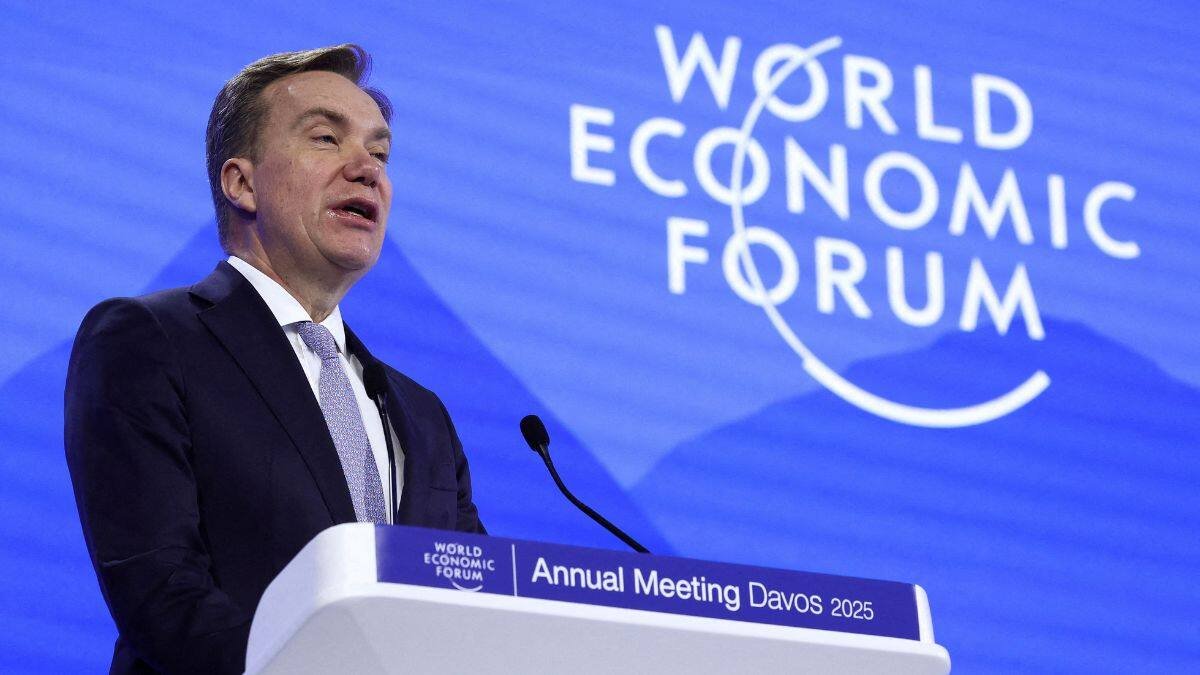
Børge Brende has resigned from the top job at the World Economic Forum (WEF).
His departure on Thursday, followed weeks of scrutiny after the release of a vast cache of documents by the US Justice Department concerning the late financier Jeffrey Epstein.
The disclosures drew Brende into
a widening circle of high-profile figures whose past interactions with Epstein have come under renewed examination.
Who is Børge Brende?
Born on September 25, 1965, Børge Brende built his career in Norwegian public life before moving into global policy circles. He is affiliated with Norway’s Conservative Party and served in multiple ministerial roles across different governments.
Between 2001 and 2004, he was minister of the environment, followed by a term as minister of trade and industry from 2004 to 2005. He later became minister of foreign affairs from 2013 to 2017.
In parallel with his ministerial work, Brende represented Sør-Trøndelag region in the Norwegian parliament from 1997 to 2009. His academic background includes degrees in economics, law and history from the Norwegian University of Science and Technology in Trondheim.
Brende’s association with the WEF began well before he assumed its top role. In January 2008, he joined the organisation as managing director with responsibility for relations with governments and civil society.
A year later, he took on the position of secretary general of the Norwegian Red Cross, where he served from 2009 to 2011. He then returned to the forum in 2011 as a managing director, deepening his involvement with the institution’s global initiatives.
On September 15, 2017, it was announced that Brende would become president and CEO of the forum from mid-October that year.
His appointment placed him at the helm of an organisation best known for convening political leaders, corporate executives, civil society representatives and academics at its annual meeting in Davos, Switzerland.
During his tenure, Brende advocated for new formats of international cooperation, including the idea of closer strategic coordination among China, India and the United States in 2023.
By early 2026, Brende had led the WEF for more than eight years. His period in office coincided with internal reforms at the organisation and efforts to address criticisms about governance and transparency.
Those reforms gained additional urgency after the forum’s founder, Klaus Schwab, stepped down as chair of the board in April 2025 following internal scrutiny prompted by whistleblower allegations and questions about governance.
André Hoffmann and Larry Fink were appointed as co-chairs in August 2025 to guide the forum through a reform process.
How was Brende involved with Epstein?
The chain of events that culminated in Brende’s resignation began with the release of more than three million pages of documents by the US Justice Department last month, linked to Jeffrey Epstein.
Epstein, who was convicted in 2008 of soliciting prostitution from a minor, died by suicide in jail in 2019 while awaiting trial on federal sex-trafficking charges.
The documents detailed Epstein’s interactions with a wide range of business leaders, politicians and public figures. Among the records were iMessage exchanges and other communications involving Brende between 2018 and 2019.
The material showed that Brende and Epstein had met over three formal business dinners across two years and had corresponded multiple times by email and text message.
Their exchanges covered a range of topics, including discussions related to Davos and potential attendees, as well as Epstein’s efforts to position himself as an adviser with access to senior figures.
In one message sent after a dinner in 2018, Brende wrote, “thx for a very interesting dinner … You’re a brilliant host. Warmly, Borge,” later adding, “Missing you Sir. Borge.”
In another exchange, after Epstein described advice he was providing to a Middle Eastern leader, Brende replied, “Concur. I’m glad you’re giving him council.”
Before the release of the additional files, Brende had stated publicly in November 2025 that he had never met Epstein.
Following the disclosures, he revised his account, saying he had not been aware of Epstein’s criminal background and that the interactions were limited to three dinners over two years.
The disclosures also included a photograph sent by Epstein in April 2018 showing Brende alongside Steve Bannon and former Norwegian diplomat Terje Rød-Larsen.
Other messages cited in the files showed exchanges in which Epstein appeared to seek introductions and influence connected to the WEF, with Davos frequently mentioned as a focal point for potential access to global leaders.
Norwegian outlets questioned Brende about the discrepancies between his earlier statements and the contents of the files. The revelations also raised questions about due diligence and judgment, particularly given Epstein’s prior conviction in 2008 and the subsequent public reporting on his activities.
What was the reaction across Norway?
The Epstein files resulted responses from senior figures in Norwegian politics, including those who had worked with Brende during his time in government.
Erna Solberg, the leader of the Conservative Party and prime minister during Brende’s tenure as foreign minister, said on February 1, that she only knew what had been reported in the media and that the contacts appeared “obviously unwise”.
Guri Melby, leader of Norway’s Liberal Party described the communications between Brende and Epstein as “grotesque” and told TV2, “Brende knew exactly who Epstein was and yet sits there eagerly nodding to his visions of global power. It’s completely incomprehensible”.
Brende rejected the characterisation of the messages put forward by critics, arguing that the excerpts were taken out of context. He said he did not recall certain exchanges cited in the documents and maintained that he had been unaware of Epstein’s criminal history at the time of their interactions.
The files also included material that critics said contradicted his account, including records showing that Epstein had sent him a link relating to his criminal sentence and that Brende had responded with a thumbs-up emoji.
Brende said he was “completely unaware” of the link and that he had not opened it.
The documents also recorded messages in which Epstein and Brende ridiculed Sara Netanyahu, the wife of Israeli Prime Minister Benjamin Netanyahu, referring to her as “Miss Piggy”.
Brende said he did not remember those messages. Critics pointed to the cumulative pattern of the exchanges and to what they described as repeated revisions of Brende’s explanations as new details emerged.
The files also showed that Brende had previously stated in November 2025 that he had “nothing to do with Epstein”, despite records indicating that they had exchanged 120 messages and met on several occasions.
What next for Brende & WEF?
The WEF initiated an independent review conducted by outside counsel into Brende’s relationship with Epstein. The probe was launched earlier this month.
The forum said the review aimed to assess whether any concerns existed beyond what had already been disclosed in the public domain.
In a subsequent statement, co-chairs André Hoffmann and Larry Fink said the review had concluded and that it had not identified further issues beyond those already known.
They confirmed that Alois Zwinggi, a senior figure at the forum, would take over as interim president and CEO. The board of trustees would oversee the transition and begin a process to identify a permanent successor.
Hoffmann and Fink also issued a statement responding to Brende’s departure, saying, “We wish to express our sincere appreciation for Børge Brende’s significant contributions to the World Economic Forum. His dedication and leadership have been instrumental during a pivotal period of reforms for the organisation, leading to a successful annual meeting in Davos. We respect his decision to step down.”
Brende’s resignation statement said, “After careful consideration, I have decided to step down as President and CEO of the World Economic Forum. My time here, spanning 8-1/2 years, has been profoundly rewarding.”
He added, “I am grateful for the incredible collaboration with my colleagues, partners, and constituents, and I believe now is the right moment for the Forum to continue its important work without distractions.”
His statement did not refer to Epstein by name.
Also Watch:
With inputs from agencies
End of Article