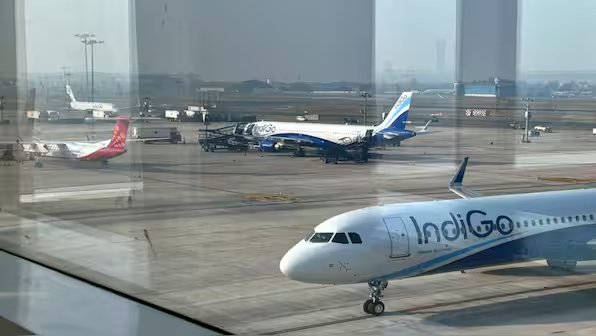
“On time. Every Time.”
That’s the tag line of IndiGo Airlines, the largest in India. However, after the last few days — starting Tuesday (December 2) — the airline must be rethinking its branding following the mass disruptions that it has experienced.
In a record for the 20-year-old airline, IndiGo cancelled over 550 flights on Thursday with cancellations already being reported at several airports across Indian even on Friday morning. The flight cancellations and delays even prompted IndiGo CEO Pieter Elbers to shoot off a letter to employees, acknowledging that the airline had failed to live up to its promise to serve customers well and provide a good experience.
“These past few days have been difficult for many of our IndiGo customers and colleagues. We serve close to 380,000 customers a day and want each of them to have a good experience. We could not live up to that promise these past days and we have publicly apologised for that.”
Here’s the latest on the turbulence that IndiGo is experiencing and how it is inconveniencing thousands and thousands of flyers.
200 IndiGo flights cancelled on Wednesday, 550 on Thursday and counting
Since Tuesday, IndiGo has been witnessing turbulence with hundreds of its flights being cancelled. On Wednesday (December 3), the airline
cancelled a whopping 200 flights while many others were delayed. Reports said that only one in five flights operated on time on that day — a dismal low for the airline that boasts of punctuality. A Times of India report stated that IndiGo’s on time performance (OTP) spiralled to 19.7 per cent on Wednesday, down from 35 per cent on Tuesday.
Thursday’s numbers weren’t any better with the airline cancelling a whopping 550 flights across the country. Out of the 550 cancellations, Delhi airport saw at least 172 flight cancellations, followed by 118 at Mumbai, 100 at Bengaluru, 75 at Hyderabad, 35 at Kolkata, 26 at Chennai, and 11 at Goa. Cancellations were also reported at other airports across the country.
And for those who hoped for a better Friday, think again. Mass cancellations of IndiGo flights have entered the fourth day, with news agency PTI reporting that 400 flights have already been cancelled at the time of writing this report. As per data available, Hyderabad has 92 flights cancelled while Bengaluru has 102 cancellations. Mumbai has 104, 34 at Jaipur, 32 in Pune, 31 in Chennai and 10 in Srinagar.
In a shocking move, Delhi as well as Chennai airport announced that all of its IndiGo flights would be cancelled until midnight and 6 pm respectively.
Passenger Advisory issued at 11:10 Hours#DelhiAirport #PassengerAdvisory #DELAdvisory pic.twitter.com/dZBdrW5aob
— Delhi Airport (@DelhiAirport) December 5, 2025
The ongoing flight disruptions have also resulted in the plummeting of the shares of IndiGo’s parent company, InterGlobe Aviation. On Thursday, the shares dropped to Rs 5,405 in the morning, its lowest level in over five months, and extended its decline for the second straight session.
The chaos and confusion prompted IndiGo to apologise, writing on X: “The last two days have seen widespread disruption across IndiGo’s network and operations. We extend a heartfelt apology to all our customers and industry stakeholders who have been impacted by these events. IndiGo teams are working diligently and making all efforts with the support of MOCA, DGCA, BCAS, AAI and airport operators to reduce the cascading impact of these delays and restore normalcy. We continue to keep our customers apprised of any changes to their scheduled flights and advise them to check the latest status at https://goindigo.in/check-flight-status.html before heading to the airport. IndiGo deeply regrets the inconvenience caused and remains focussed on streamlining its operations at the earliest.”
Reason for IndiGo’s flying woes
But what’s the reason that has caused IndiGo to ground so many flights and delay many others? The driving factor behind disruption is an acute shortage of flight crew following the implementation of stricter
Flight Duty Time Limitations (FDTL) by the Directorate General of Civil Aviation (DGCA). The latest phase of these norms came into force on November 1, following a Delhi High Court mandate and years of complaints from cockpit crew over fatigue.
The revised rules sharply reduce the number of hours a pilot can fly, increase mandatory weekly rest periods to 48 hours, and restrict night landings to only two per week instead of six. They also cap flying time at eight hours per day, 35 hours per week, 125 hours per month and 1,000 hours per year, with compulsory rest equal to twice the duration of flight duty and a minimum of 10 hours’ rest in any 24-hour window.
These changes have had a direct impact on IndiGo’s ability to crew its dense flight schedule, particularly its large number of overnight and high-frequency services.
Passengers share their IndiGo woes
So what does it mean when India’s largest airline cancels flights in the hundreds? It means thousands and thousands of flyers being inconvenienced and struggling to make their journey.
Visuals showed passengers struggling to get their luggage for over 12 hours, no food, no water, and IndiGo’s vacant counters. On social media, people shared their horror stories of trying to get their flight.
For instance, one passenger at Delhi Airport told NDTV: “I’m here for over 12 hours. Every time they are telling us one-hour delays, two-hour delays. We were going to a wedding, and we didn’t even have our luggage. IndiGo staff is not telling us anything. Worst airlines right now. I don’t understand why they are taking new passengers and stocking up luggage.”
Another passenger said he had been waiting at the airport since Wednesday afternoon. “They kept delaying the flight. We have no clarification from IndiGo,” he said.
“It’s very stressful. It’s been 14 hours since I’ve been sitting here at the airport. There are no coupons for food or anything. My connecting flight got cancelled. People are shouting and howling, but the staff is not giving any clarification. The staff is not trained at all to handle such emergencies,” another flyer was quoted as telling NDTV.
Similar scenes and complaints came from IndiGo passenger at Mumbai. One told Indian Express, “I’ve been here since early morning, waiting for my flight to Lucknow. It was supposed to take off this morning, but now they’ve pushed it to tomorrow. There’s been no food, no water and no accommodation from IndiGo. We’re just sitting here with no basic support.”
Another passenger at Delhi airport told PTI, My flight was last night, and when we reached the Delhi IGI Airport, check-ins were happening, but none of the IndiGo counters were working. Multiple flights were delayed and some were cancelled, but the passengers had not received their baggage yet… People were shouting. When we arrived, the airline staff checked in our luggage. However, our flight was rescheduled three times, and then finally, at 6 am, the IndiGo app showed that our flight had been cancelled… Even the staff seemed very confused.”
DGCA steps in; IndiGo’s future plan
IndiGo’s flight disruptions resulted with India’s aviation body, the Directorate General of Civil Aviation (DGCA), summoned airline officials on Thursday. At the meeting chaired by Civil Aviation Minister K Ram Mohan Naidu, IndiGo informed that it would
reduce its flight operations to minimise disruption from December 8 while assuring that normalised and stable operations will be fully restored by February 10 next year.
The airline admitted that the disruptions since Tuesday was a result “primarily from misjudgement and planning gaps” in implementing Phase 2 of the FDTL (Flight Duty Time Limitations) norms. IndiGo accepted that the actual crew requirement for the new norms exceeded their anticipation. The carrier also requested the DGCA for exemptions from some night operations-related changes in the new Flight Duty Time Limitation (FDTL) norms for pilots until February 10.
Meanwhile, the issue has also turned political. Congress MP Rahul Gandhi said on X that the ongoing IndiGo disruptions are a result of the government’s monopoly model. He added that ordinary Indians are bearing the brunt through delays, cancellations, and helplessness, and emphasised that India needs fair competition in every sector rather than monopolistic practices.
With inputs from agencies
End of Article