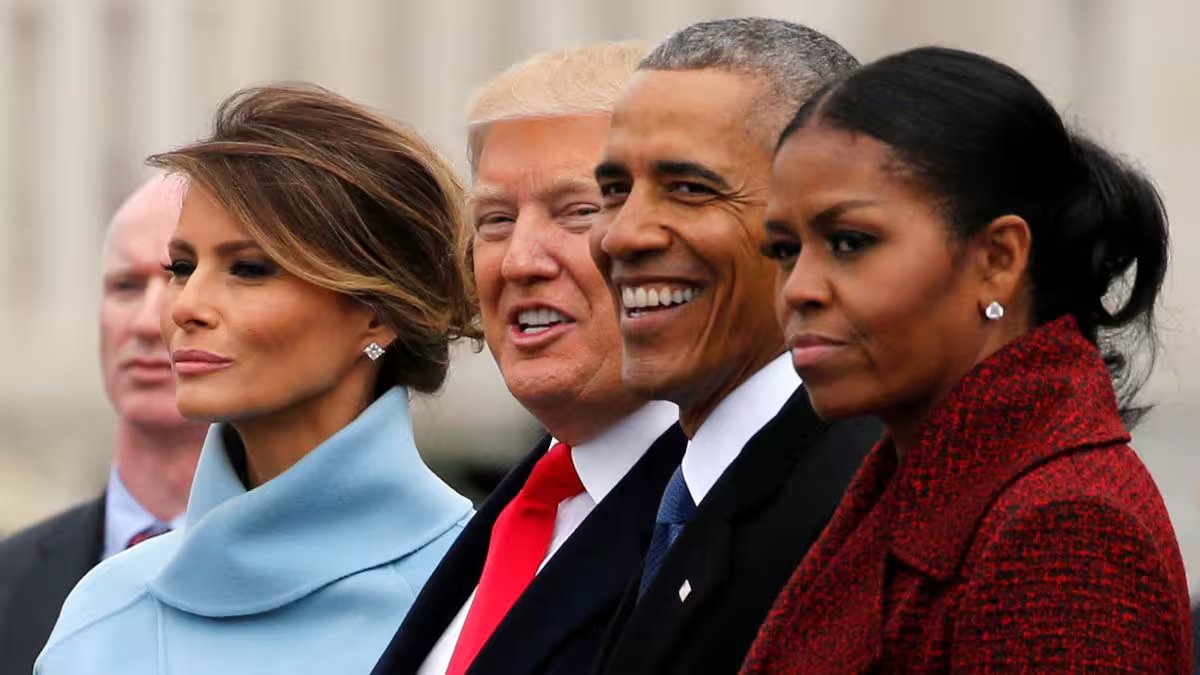
United States President Donald Trump is facing sustained political backlash after briefly sharing — and later deleting — a video on his Truth Social account that depicted former US President Barack Obama and former first lady Michelle Obama as apes.
Trump has denied responsibility for the offensive imagery and refused to apologise.
The episode has put under the lens the persistence use of racist tropes that date back centuries — imagery that many scholars say has been central to the dehumanisation of Black Americans during slavery, segregation and beyond.
What the video showed
The video in question was shared late Thursday night on Trump’s Truth Social account and remained publicly visible for close to 12 hours before being removed on Friday, February 6.
Much of the clip promoted debunked claims about voting machine fraud related to the 2020 US presidential election.
Near the end of the video, however, Barack and Michelle Obama appeared briefly,
with their faces digitally placed onto the bodies of apes standing in a jungle setting.
As the images appeared — reportedly for about one second — the opening notes of the song “The Lion Sleeps Tonight” played in the background.
The imagery immediately evoked a racist trope that has historically compared Black people to monkeys or apes, a practice widely classified by historians and civil rights organisations as explicitly racist rather than ambiguous or coded.
The clip featuring the Obamas appeared to be spliced into a longer video that had circulated earlier online. The imagery originated from a video shared on X in October, captioned “President Trump: King of the Jungle,” which portrayed several prominent Democrats as animals, including the Obamas.
The same user had previously posted other viral videos amplified by Trump, including one depicting the president wearing a crown and flying a fighter jet dumping what appeared to be waste on protesters at a “No Kings” rally.
How Trump defended himself
After the video triggered outrage, the White House initially sought to distance Trump from the post. An official told CNN shortly before noon on Friday that “A White House staffer erroneously made the post. It has been taken down.” Earlier statements had characterised the criticism as overblown.
Later that day, Trump addressed the controversy while speaking to reporters aboard Air Force One. In doing so, he
acknowledged for the first time that he had watched part of the video before it was posted, though he maintained he had not seen the racist imagery at the end.
“I looked at the beginning of it. It was fine,” Trump said, referring to the portion of the video focused on election-related claims. “It was a very strong post in terms of voter fraud.”
Trump insisted that neither he nor his staff were aware of the offensive content until after it was posted. “Nobody knew that that was in the end. If they would have looked, they would have seen it, and probably they would have had the sense to take it down,” he said.
According to Trump, after watching the first segment, he forwarded the video to a staffer, who then shared it without reviewing the entire clip. “Somebody slipped and missed a very small part,” he said.
When pressed repeatedly on whether he would apologise, including amid calls from Republican lawmakers to do so, Trump declined. “No,” he said. “I didn’t make a mistake.”
At the same time, Trump said he condemned the racist imagery itself. Asked whether he denounced the offensive segment, he replied, “Of course I do.”
The president also rejected concerns that the episode could undermine Republican outreach to Black voters. “I am, by the way, the least racist president you’ve had in a long time,” he said, while pointing to what he described as his achievements.
How White House reversed its position
White House press secretary Karoline Leavitt had initially dismissed the backlash, framing the clip as a harmless internet meme.
“This is from an internet meme video depicting President Trump as the King of the Jungle and Democrats as characters from the Lion King,” Leavitt said in a statement. “Please stop the fake outrage and report on something today that actually matters to the American public.”
Behind the scenes, however, the controversy sent the administration into what sources described to CNN as a defensive posture. White House officials, advisers and allies contacted lawmakers and journalists throughout Friday in an effort to argue that Trump himself had not knowingly shared the racist imagery.
One White House adviser said, “The president was not aware of that video, and was very let down by the staffer who put it out.” Another ally sought to place responsibility on a specific aide.
Sources familiar with Trump’s social media habits noted that while the president often posts personally on Truth Social — particularly late at night and early in the morning — a small circle of aides also has access to his accounts.
During the day, Trump sometimes signs posts with the initials “DJT” to signal that he authored them himself.
Aides with posting access reportedly include Natalie Harp, who occasionally types posts dictated by Trump, and Dan Scavino, a deputy chief of staff who ran Trump’s social media accounts during his first term.
How Republicans reacted
The post resulted in public criticism from several Republican lawmakers, including close allies of the US president. Senator Tim Scott of South Carolina, the only Black Republican in the Senate and the chair of the Senate GOP campaign committee, was among the first to respond.
“Praying it was fake because it’s the most racist thing I’ve seen out of this White House. The President should remove it,” Scott wrote on X.
Trump later told reporters that he had spoken with Scott on Friday morning, before the video was deleted. A GOP Senate official said that multiple Republican lawmakers had contacted Trump directly to discuss the post.
Criticism soon spread among House Republicans from politically competitive districts. Representative Mike Lawler of New York condemned the post and called for a formal apology.
“The President’s post is wrong and incredibly offensive — whether intentional or a mistake — and should be deleted immediately with an apology offered,” Lawler wrote.
Another New York Republican, Representative Nick LaLota, also urged Trump to take the video down. In the Senate, two close White House allies — Senator Pete Ricketts of Nebraska and Senator Roger Wicker of Mississippi — publicly joined the calls for an apology shortly before the post was removed.
“This is totally unacceptable,” Wicker wrote. “The president should take it down and apologize.”
Despite the growing criticism, Senate Republican leaders John Thune and John Barrasso declined to comment.
South Carolina preacher Mark Burns, a longtime Trump ally who has served as an informal spiritual adviser, said he spoke with the president about the video and urged decisive action.
“The President made it clear to me that this post was made by a staffer and not by him,” Burns wrote. “My recommendation to the President was direct and firm. That staffer should be fired immediately, and the President should publicly condemn this action.”
How Democrats reacted
House Minority Leader Hakeem Jeffries, the only Black party leader in Congress, addressed the controversy in an Instagram video. “F**k Donald Trump and his vile, racist, and malignant behavior. This guy is an unhinged bottom feeder,” Jeffries said.
Former US Vice President Kamala Harris criticised the administration’s shifting narrative, writing on X, “No one believes this cover up from the White House, especially since they originally defended the post. We are all clear-eyed about who Donald Trump is and what he believes.”
The office of California Governor Gavin Newsom
also condemned the video, posting on X, “Disgusting behaviour by the President. Every single Republican must denounce this. Now.”
The racist clip was one of many posts shared by Trump’s account late Thursday night and into early Friday morning. During that period, Trump amplified several videos and posts praising him and attacking Democrats.
Among them were repeated shares of an eight-minute video claiming the Republican Party was founded “for one primary, but moral reason, and that reason was to stop the expansion of slavery.”
Another post shared around the same time featured a TikTok video accusing Democrats of being “anti-Black folk.”
Several other posts promoted false claims about interference in the 2020 election, including one that appeared to accuse Michigan’s secretary of state of ballot stuffing.
What history tells us
Historians and civil rights scholars have long argued that portraying Black people as monkeys or apes is inseparable from America’s legacy of racial oppression.
The association emerged from pseudoscientific eugenics theories that claimed Black people were biologically inferior or less human — ideas that were later discredited and widely condemned, particularly after being used to justify atrocities during the Holocaust.
These beliefs were not confined to academic circles. They were actively disseminated through popular culture and public spectacle. One of the most notorious examples occurred in 1906, when the Bronx Zoo exhibited a Congolese man named Ota Benga in its primate house.
Contemporary coverage reflected the prevailing racism of the era. The New York Times wrote that “it is probably a good thing that Benga doesn’t think very deeply,” while suggesting that visitors who felt discomfort may not have understood that his race was “not highly rated among humans.”
Legal scholars Gregory Parks and Danielle Heard, writing in a 2009 Cornell Law Faculty Working Papers publication, examined the enduring harm of such imagery.
“The development of the cultural myth of Black subhumanity served as the justification for Jim Crow segregation and acts of vigilante justice against Blacks in the form of lynching in the US South,” they wrote.
They also noted that even after the civil rights era, monkey and gorilla imagery continued to reinforce stereotypes of Black people as violent or beast-like.
Civil rights groups and historians have consistently classified such depictions as overtly racist rather than ambiguous or satirical.
The Obamas have repeatedly been subjected to racist primate imagery over the years.
According to the Jim Crow Museum, Barack Obama was depicted as a monkey on multiple occasions during the 2008 presidential campaign. In one instance, a West Virginia town faced controversy after a Facebook post referred to Michelle Obama as an “ape in heels.”
In 2009, a New York Post cartoon showed two police officers shooting a chimpanzee, accompanied by a caption implying the animal represented Obama as the author of the stimulus bill. The cartoon sparked national outrage.
Over the past four decades, such depictions have generally resulted in swift professional and political consequences when they entered the mainstream.
In 2018, ABC cancelled the television show “Roseanne” within hours after Roseanne Barr tweeted that former Obama adviser Valerie Jarrett looked like she was from “Planet of the Apes,” calling the comment “abhorrent.”
In 2022, then-Los Angeles City Council president Nury Martinez resigned after leaked audio captured her referring to a colleague’s Black child as a “little monkey.”
In 2011, California GOP official Marilyn Davenport faced formal reprimand and political isolation after forwarding an email depicting Obama as a chimpanzee.
Similar fallout followed earlier incidents involving public figures. In 1999, MLB pitcher John Rocker was disciplined after referring to a Black teammate as a “fat monkey” in a Sports Illustrated profile.
In 1983, ABC sports broadcaster Howard Cosell faced intense backlash after calling NFL player Alvin Garrett a “little monkey” on live television, an episode that eventually contributed to his departure from “Monday Night Football.”
What Trump’s history of controversial social media posts tells us
The current episode is not the first time Trump has faced criticism for sharing racist or inflammatory content online. Last year, he
posted an apparent AI-generated video depicting Barack Obama being arrested in the Oval Office.
Trump and members of his administration also shared digitally altered images of
Hakeem Jeffries wearing a sombrero and fake mustache — imagery Jeffries publicly described as racist.
Trump has a long record of amplifying conspiracy theories and false claims, particularly regarding elections and immigration.
He has previously said that unauthorised immigrants were “poisoning the blood of our country,” language that critics noted echoed Nazi-era rhetoric, and has amplified false claims
that Haitian migrants in Ohio were eating pets.
It is also unusual for Trump to delete social media posts, and rarer still for him to issue apologies or accept responsibility for content that offends large groups of people.
One notable exception dates back to October 2015, during his first presidential campaign, when Trump retweeted a post questioning the mental fitness of Iowans.
After the post was deleted, Trump blamed a junior staffer, saying, “The young intern who accidentally did a Retweet apologizes.” Trump later lost the Iowa caucuses.
With inputs from agencies
End of Article


Totally agree! A product purchased popup improves conversion confidence.