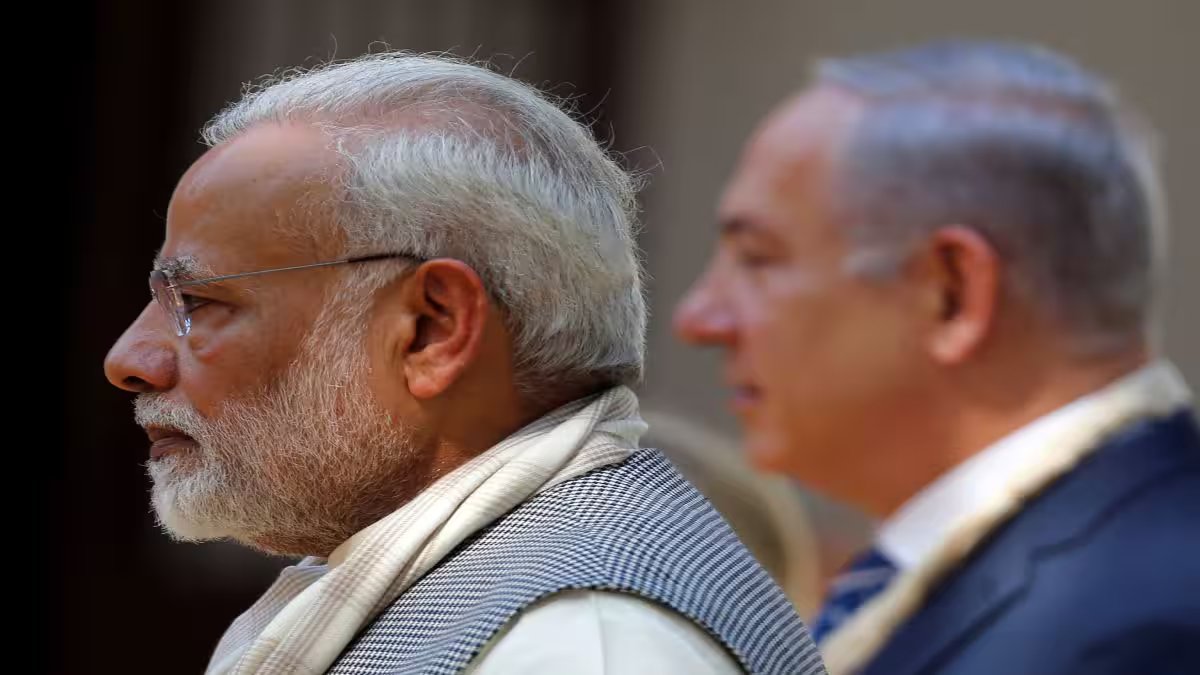
Ahead of Prime Minister Narendra Modi’s visit to Israel, beginning on February 25, Benjamin Netanyahu said that Israel is looking to form a hexagon of alliances, which will ‘counter the radical Shia axis’. The Israeli PM has proposed that India join the six-sided alliance along with other African and Arab nations
It’s a big week for India. Prime Minister Narendra Modi will be travelling to Israel this Wednesday (February 25) for a two-day visit during which he will hold a discussion with Israel’s Benjamin Netanyahu on an array of topics.
Ahead of the visit, the Israeli prime minister described Modi as a “dear friend” and highlighted the growing strategic alignment between the two countries. “This morning, at the opening of our Cabinet meeting, I spoke about the historic visit of my dear friend, Prime Minister Narendra Modi, to Israel this coming Wednesday,” he wrote on X. Calling the relationship a “powerful alliance between two global leaders,” Netanyahu said Israel and India are partners in innovation, security and a shared strategic vision.
Netanyahu also announced that Israel plans to build a network of allied nations — titled the
Hexagon of Alliances — in or around West Asia to collectively stand against what he called “radical” adversaries.
As we gear up for Modi’s “historic” visit to Israel, here’s a better understanding of what is this new alliance and why it is significant.
What is the Hexagon of Alliances?
>> According to Netanyahu, the hexagon of alliances is a six-sided alliance with countries from in and around West Asia.
>> The countries that Netanyahu sees being a part of the hexagon of alliances is India, Greece, Cyprus and other unnamed Arab, African and Asian countries.
>> “In the vision I see before me, we will create an entire system, essentially a ‘hexagon’ of alliances around or within West Asia,” Netanyahu said, according to the Times of Israel. “The intention here is to create an axis of nations that see eye to eye on the reality, challenges, and goals against the radical axes, both the radical Shia axis, which we have struck very hard, and the emerging radical Sunni axis.”
>> Netanyahu, however, did not clarify what he meant by “emerging radical Sunni axis”.
>> As per a PTI news report, this alliance would be similar the vision of
IMEC, India- Middle East-Europe Economic Corridor, which aims to bolster economic development by fostering connectivity.
>> The hexagon of alliances would coordinate across three aspects — economic cooperation, diplomatic alignment and security collaboration.
>> Netanyahu perceives the bloc to be a counterweight to Iran and its network of proxies, which is often referred to as the ‘resistance of axis’.
>> “All of these nations share a different perception, and our cooperation can yield great results and, of course, ensure our resilience and our future,” he asserted.
> Hamas spokesperson Hazem Qassem rejected Netanyahu’s ‘hexagon of alliances’ plan, calling the proposal “a direct threat to their strategic interests.” “What is happening is an attempt to reshape the region in a way that serves only the interests of the occupation. These moves are based on the weakness that afflicted Arab nations during the war in Gaza. We call on Arab states to recognise the danger of these schemes and their repercussions on the region’s security and stability,” Qassem was quoted as saying by i24News.
What do we know of Modi’s visit to Israel?
Prime Minister Narendra Modi will visit Israel this Wednesday — a second since 2017. It comes months after the ceasefire between Israel and Hamas in Gaza after two years of war.
Special attention will be paid on the relationship between the two prime ministers, with Netanyahu referring to Modi as his “personal friend” and stating that they have spoken frequently on the phone and have visited each other.
During the two-day visit, PM Modi is expected to address the Knesset, Israel’s parliament — a rare honour. The two countries are also expected to deepen the cooperation by signing agreements in sectors such as technology cooperation, security collaboration, artificial intelligence, agriculture, water management, and trade.
There are also talks that India is looking at joint development of
anti-ballistic missile shields, laser weapons, drones and long-range stand-off missiles, alongside expanded cooperation on advanced systems like Iron Dome, David’s Sling and Arrow.
Later, on Sunday, PM Modi thanked Netanyahu on X, saying “Thank you, my friend, Prime Minister Netanyahu.” “I fully agree with you on the bond between India and Israel as well as the diverse nature of our bilateral relations. India deeply values the enduring friendship with Israel, built on trust, innovation and a shared commitment to peace and progress. Looking forward to our discussions during my upcoming Israel visit.”
With inputs from agencies
End of Article