The 62nd Munich Security Conference (MSC 2026) is taking place from February 13 to 15, 2026, in Munich, Germany.
Hosted primarily at the Hotel Bayerischer Hof, this year’s gathering is unfolding amid warnings that the international system established after the Second World War is facing mounting pressure from within and beyond the West.
With more than 1,000 participants expected, including upwards of 50 heads of state and government and over 100 foreign and defence ministers, the conference once again positions itself as one of the most consequential annual forums on international security.
Roughly 450 representatives from global politics, academia and the defence industry are also in attendance.
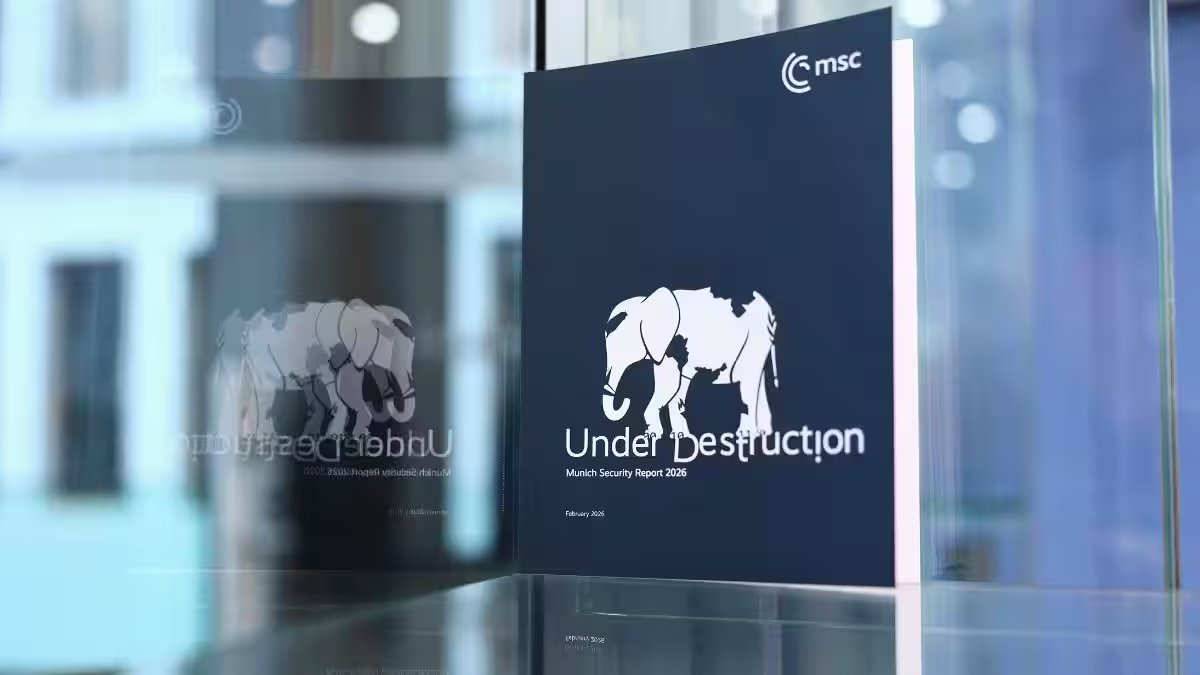
At the heart of MSC 2026 lies the newly released Munich Security Report 2026, titled Under Destruction, which sets the framework for the discussions in Bavaria.
The document presents a sobering assessment of the state of global governance, transatlantic relations, and public confidence in political leadership.
Everything at the 62nd Munich Security Conference
The conference runs from Friday through Sunday. The Bayerischer Hof remains the principal venue, continuing a long-standing tradition of hosting world leaders in the heart of Munich. Selected high-level sessions and side events are being held at the Rosewood Munich.
Leadership of the conference remains under Ambassador Wolfgang Ischinger, who chairs the MSC and authors the foreword to this year’s security report.
Under his stewardship, the event has evolved into a hybrid platform combining plenary debates, closed-door consultations, bilateral meetings and thematic panels structured around multiple “security dimensions.”
Organisers have described the 2026 edition as unfolding at a “fundamental inflection point” for global security.
Security in Munich has been tightened considerably. Authorities have established an extensive perimeter around key venues, and a protest rally anticipated to draw up to 100,000 people is scheduled at the Theresienwiese on Saturday.
Significant travel disruptions in central Munich are expected as a result of these arrangements.
“Under Destruction”: The 2026 Security Report’s core message
The
Munich Security Report 2026 forms the intellectual backbone of the conference. Its title, Under Destruction, signals the gravity of its conclusions. The document argues that the international order shaped by the United States and its allies after 1945 is confronting structural challenges that go beyond policy disagreements.
In his foreword, Wolfgang Ischinger writes that “rarely in the conference’s recent history have there been so many fundamental questions on the table at the same time”.
He identifies critical areas of concern including Europe’s security architecture, the durability of the transatlantic partnership, and the capacity of the international community to manage what he describes as an increasingly “complex and contested” global environment.
One of the report’s defining statements reads, “The world has entered a period of wrecking-ball politics.”
The report contends that the United States, once the principal architect and guarantor of the post-war order, is now perceived as playing a transformative — and potentially disruptive — role. “More than 80 years after construction began, the US-led post-1945 international order is now under destruction,” the document states.
It describes US President Donald Trump as “the most powerful of those who take the axe to existing rules and institutions” and identifies him as one of the most prominent “demolition men.”
The report warns that his approach could lead to “a world shaped by transactional deals rather than principled cooperation.” The analysis points to challenges directed at long-standing norms governing international organisations, trade regimes and alliances among democratic states.
Institutions such as the United Nations and the World Trade Organisation are cited in the broader context of eroding multilateralism.
The crisis of confidence ahead of MSC 2026
The report incorporates findings from public opinion surveys conducted across multiple countries. These surveys reveal
widespread scepticism about governments’ capacity to address pressing economic and social challenges.
In France, 60 per cent of respondents believe that current policies will leave future generations worse off. Comparable figures stand at 53 per cent in the United Kingdom and 51 per cent in Germany. In the United States, 45 per cent of respondents share that outlook.
The report describes this trend as “a growing sense of growing individual and collective helplessness and doom.” Issues such as affordability pressures, inequality, limited social mobility and stagnating or declining living standards are cited as contributing factors.
When asked whether the US president’s policies are beneficial for the world, half or more of respondents in the US, Canada, France, Germany, Italy, Japan, the UK, Brazil and South Africa indicated that they slightly or strongly disagreed.
US-Europe ties at the forefront
The state of relations between the United States and Europe is one of the dominant themes at MSC 2026. European governments, long reliant on American security guarantees through Nato, are reassessing the reliability and direction of US policy.
“Transatlantic relations are currently in a significant crisis of confidence and credibility,” Ischinger said in comments ahead of the conference. Nevertheless, he expressed hope that the presence of senior US officials and lawmakers could contribute to a more constructive tone.
US Secretary of State Marco Rubio is leading a sizeable American delegation to Munich. The US State Department has not provided detailed information about the substance of his engagements during the two-day stop before he travels onward to Slovakia and Hungary.
US Vice President JD Vance’s participation was initially confirmed but later withdrawn. His address at the previous year’s conference remains a reference point in discussions about transatlantic relations.
That speech was widely described as a “reckoning with Europe” and prompted criticism from German Chancellor Friedrich Merz and German Defence Minister Boris Pistorius.
Recent developments have also heightened European concerns. Statements by Trump regarding potential US control over Greenland —
a territory of Nato member Denmark — as well as tariffs imposed on European allies, have fuelled debate about the durability of American commitments.
At the conference’s precursor, US Ambassador to NATO Matthew Whitaker pushed back against suggestions that Washington intends to weaken the alliance. “That’s the first thing I reject; we’re trying to make Nato stronger, not to withdraw or reject Nato, but make it work like it was intended as an alliance of 32 strong and capable allies,” he said.
He also pointed out that European members must
increase defence expenditures and meet newly agreed spending targets.
Trump himself is not attending MSC 2026.
What Berlin is planning at MSC 2026
As host nation, Germany occupies a central position in this year’s proceedings. Chancellor Friedrich Merz is leading the German delegation and is scheduled to open the conference with a keynote speech outlining Berlin’s foreign policy direction in an era defined by great-power competition and strained alliances.
A German government official previewing the speech stated, “The chancellor has repeatedly made clear that he is not among those who say we are in a situation in which we must — or even can – write off the United States.”
The official added, “I expect he will outline what he sees as a path forward for transatlantic relations.”
On the margins of the conference, Merz is expected to hold talks with US Secretary of State Marco Rubio, Chinese Foreign Minister Wang Yi and Ukrainian President Volodymyr Zelenskyy.
Who else is attending and not attending
Nato Secretary General Mark Rutte and European Central Bank President Christine Lagarde are among the prominent European figures present. Finnish President Alexander Stubb and Foreign Minister Elina Valtonen are attending with a focus on “comprehensive security.”
India’s External Affairs Minister S Jaishankar is also participating. Announcing his attendance, conference organisers said, “We are honoured to announce that @DrSJaishankar will be joining us at #MSC2026 in Munich.”
From West Asia, senior delegations from Israel, Palestine, Egypt, Qatar, Saudi Arabia and Turkey are expected. Discussions involving these actors will centre on efforts to implement a Gaza peace plan and to address broader regional stability.
Ukraine remains a central subject. Deliberations will address the ongoing war with Russia, prospects for diplomatic resolution and the sustainability of military and financial support for Kyiv. European concerns about US policy toward Russia form part of this debate.
In a notable diplomatic development, the Iranian government has reportedly not been invited to this year’s conference.
Instead, Reza Pahlavi, son of the last Shah of Iran, has received an invitation. The decision reflects the conference’s stance regarding
recent domestic developments in Iran.
Canadian Prime Minister Mark Carney was scheduled to attend, but
cancelled his trip in wake of a deadly school shooting in British Columbia.
What else will be focused on at MSC 2026
In addition to transatlantic relations
and Ukraine, European strategic autonomy is a major focus. With US security assurances perceived by some as fluctuating, discussions include strengthening Europe’s independent capabilities, enhancing military mobility and examining deterrence options.
Panels are also addressing artificial intelligence-enabled systems, drone warfare and the strategic implications of cis-lunar space — the region between Earth and the Moon.
The European Space Agency’s (ESA) Director General Josef Aschbacher is highlighting space as a foundational element of Europe’s security architecture.
Economic security and climate-related challenges are also on the agenda. Participants are examining the security implications of trade restrictions and what the report describes as the “geo-economisation” of development assistance.
Running in parallel has been the Munich Cyber Security Conference (MCSC), which is concluding under the theme “Command Control, Really?” The focus has been on digital resilience and the integration of artificial intelligence into cyber defence strategies.
With inputs from agencies
End of Article