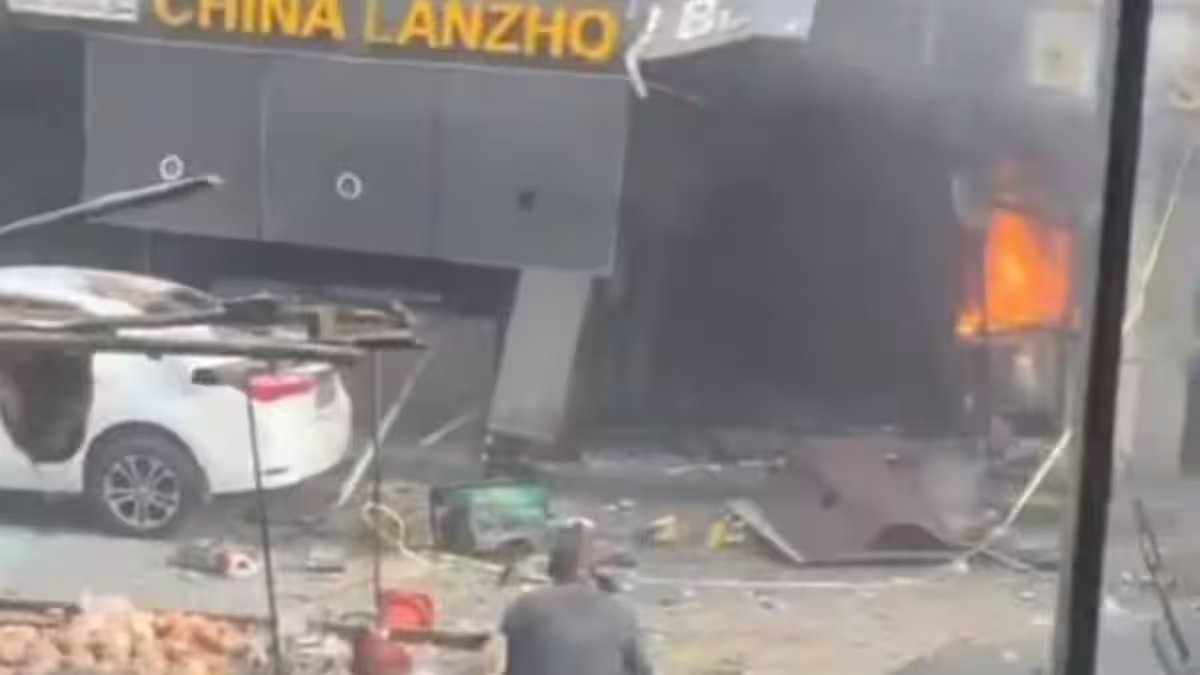
An explosion tore through a Chinese-run restaurant in the heart of Kabul on Monday, January 19, killing at least seven people and injuring several others, including women and a child.
The attack occurred in Shahr-e-Naw, a commercial district long considered one of the Afghan capital’s safest areas.
The Afghan branch of the Islamic State has claimed responsibility for the incident, which appears to be part of a broader pattern of assaults targeting Chinese interests in Afghanistan.
Authorities have confirmed
the deaths of one Chinese national and six Afghan citizens.
Emergency responders rushed to the scene, while nearby hospitals treated dozens of wounded victims. Investigations are ongoing to determine how the blast was carried out and whether additional suspects were involved.
What do we know about the blast in Kabul’s Shahr-e-Naw?
The explosion took place inside a Chinese noodle restaurant located within a hotel in Kabul’s Shahr-e-Naw neighbourhood.
This part of the city is known for its embassies, office buildings, shopping complexes, foreign-owned restaurants, and antique shops.
Because of the concentration of diplomatic and commercial establishments, Shahr-e-Naw has long been viewed as one of the most secure zones in the Afghan capital.
According to police spokesman Khalid Zadran, the restaurant was situated on Gulforoshha Street and was frequented by members of the Chinese Muslim community living and working in Kabul.
The blast occurred near the restaurant’s kitchen, causing extensive damage to the front of the building and sending debris across the street.
Footage shared on social media showed smoke rising from the structure, shattered glass, and rubble scattered across the roadway. Videos also captured crowds running away from the area as emergency services arrived.
The explosion today in a Chinese restaurant in Kabul was horrific, killing and injuring civilians. If it is confirmed as a terrorist attack, we all know who is behind it and why. Team 93k cannot tolerate Afghanistan’s progress or its independent relationships with other… pic.twitter.com/9CgXacMCKt
— Fazal Afghan (@fhzadran) January 19, 2026
Firefighters were seen clearing debris, while ambulances transported the injured to nearby hospitals. Police officers sealed off the surrounding streets, and flower sellers who typically work in the area were forced to evacuate.
Who ran the restaurant and who did it serve?
The targeted restaurant was jointly operated by a Chinese Muslim man named Abdul Majid, his wife, and an Afghan business partner, Abdul Jabbar Mahmood.
According to police, the establishment mainly served Chinese Muslims living in Kabul, as well as visiting Chinese nationals.
The eatery was located inside a hotel that catered to foreign visitors and business travellers.
Its presence in Shahr-e-Naw reflected the growing footprint of Chinese commercial activity in Afghanistan since the Taliban returned to power in 2021.
What do we know about the victims?
Authorities have confirmed that at least seven people were killed in the blast. Among the deceased was a Chinese national identified as Ayub, along with six Afghan citizens.
Several others were wounded, including four women and a child.
The humanitarian organisation EMERGENCY, which operates a surgical centre close to the blast site, said it received 20 casualties following the explosion.
Its Afghanistan country director, Dejan Panic, said in a statement, “So far, we have received 20 people at our hospital. Among the wounded are four women and a child … Unfortunately, seven people were already dead on arrival.”
He also described the injuries suffered by survivors, adding, “The wounded, some of whom are being assessed for surgery, have suffered lacerations and bruises.”
Chinese state broadcaster CCTV reported that two Chinese nationals were seriously injured in the blast. It also said that a security guard was killed.
Taliban officials confirmed that multiple people had died and others were hurt, but said it was initially difficult to provide precise casualty figures due to the condition of the victims and the ongoing investigation.
One Taliban official told The Telegraph, “The number of casualties is not yet clear since several bodies are shattered and the investigation is going on – I can tell you the target was Chinese workers.”
Interior ministry spokesperson Abdul Mateen Qani also commented on the incident, saying, “According to preliminary reports, several people were killed and injured,” but declined to release further details while inquiries continued.
What can we understand from the scene?
Videos and images from the site showed a large hole in the front of the restaurant building, with smoke billowing into the street. Pieces of concrete, glass, and metal were scattered across the road, while emergency responders worked to clear the wreckage.
🚨🔥Deadly blast rocks Kabul.
An explosion ripped through a hotel in Shahr-e-Naw, killing several and injuring many, Taliban officials confirm. Local reports say the blast struck outside a Chinese restaurant, plunging the area into chaos.#Afghanistan #Kabul pic.twitter.com/jv0NPfTxjG— Rizwan Shah (@rizwan_media) January 19, 2026
Footage aired by local broadcaster Tolo News, filmed through a car windshield, showed people walking and running through clouds of dust as sirens sounded in the background. At least one person was seen lying motionless on the ground.
Social media clips also captured panicked crowds fleeing the area, highlighting the scale of disruption caused by the blast in what is usually a busy commercial district.
Who has claimed responsibility for the blast?
The Afghan branch of the Islamic State, also known as ISIL or ISIS, later claimed responsibility for the attack. In a statement, the group said the explosion had been carried out by a suicide bomber.
Its media outlet, Amaq news agency, stated that Chinese citizens had been placed on the group’s list of targets, citing “growing crimes by the Chinese government against Uighurs.”
Rights groups have long accused Beijing of serious human rights abuses against Uyghurs, a Muslim ethnic minority of about 10 million people living in China’s Xinjiang region.
China has consistently denied these allegations, accusing Western nations of spreading false information and interfering in its internal affairs.
While Afghan authorities did not immediately confirm the method used in the attack, Pakistan’s President Asif Ali Zardari described the incident as a bomb blast when condemning the violence.
The Taliban government has repeatedly stated that it does not allow Afghan territory to be used as a base by terrorist groups. However, attacks claimed by Islamic State have continued since the Taliban took control of the country in August 2021.
How has Pakistan reacted?
Zardari “strongly condemned the bomb blast at a Chinese restaurant in Kabul,” according to his office.
He accused Afghanistan’s Taliban government of failing to honour ceasefire agreements, “particularly the obligation to prevent the use of Afghan soil for the export of terrorism,” adding that “no terrorist groups should be allowed safe havens in Afghanistan.”
Zardari also said that “terrorists operating out of Afghan soil” had affected other neighbouring countries, including Tajikistan.
His comments followed an incident in which Tajik border guards killed four gunmen who crossed into the country from Afghanistan overnight. Tajik authorities said the men were armed militants, while Afghan officials claimed they were drug smugglers.
Relations between
Pakistan and Afghanistan have been strained in recent months. In October, the two sides came close to a wider conflict after cross-border clashes left dozens of people dead. The fighting ended only after Qatar helped broker a ceasefire.
What does this mean for China?
The Kabul restaurant blast is the latest in a series of violent incidents targeting Chinese citizens and businesses in Afghanistan and along its borders.
Over the past few months,
multiple Chinese nationals have been killed and several others injured in armed attacks carried out inside Afghanistan or launched from Afghan territory.
In 2022, the Islamic State group claimed responsibility for
a deadly assault on a Kabul hotel popular with Chinese guests. That incident had already raised alarms about the safety of Chinese nationals in the country.
Since the Taliban returned to power in 2021, China has emerged as one of the group’s most important international partners. Beijing was the first country to restore ambassador-level diplomatic relations with the Taliban.
China has also signed several economic agreements with Afghanistan, particularly in the mining sector. The country is seeking access to Afghanistan’s vast mineral resources, estimated to be worth around $1 trillion.
These include lithium, copper, iron, and cobalt — materials considered crucial for modern technology and renewable energy industries.
Hundreds of Chinese nationals now work in Afghanistan as traders, investors, engineers, technical experts, and advisers. Chinese business visitors have increasingly travelled to the country since 2021, despite ongoing security concerns.
Beijing has also provided economic assistance to the Taliban government and included Afghanistan on its list of nations eligible for tariff exemptions on commercial goods.
China shares a rugged 76-kilometre border with Afghanistan and has close ties with the Taliban authorities.
What do we still not know?
Despite the Islamic State’s claim of responsibility, several key questions remain unanswered:
-
How did the attacker access a supposedly secure district?
-
Was the explosion caused solely by a suicide bomber?
-
Were additional suspects involved?
-
Were specific Chinese individuals being targeted?
Afghan authorities have said investigations are continuing, but no further details have been released.
With inputs from agencies
End of Article