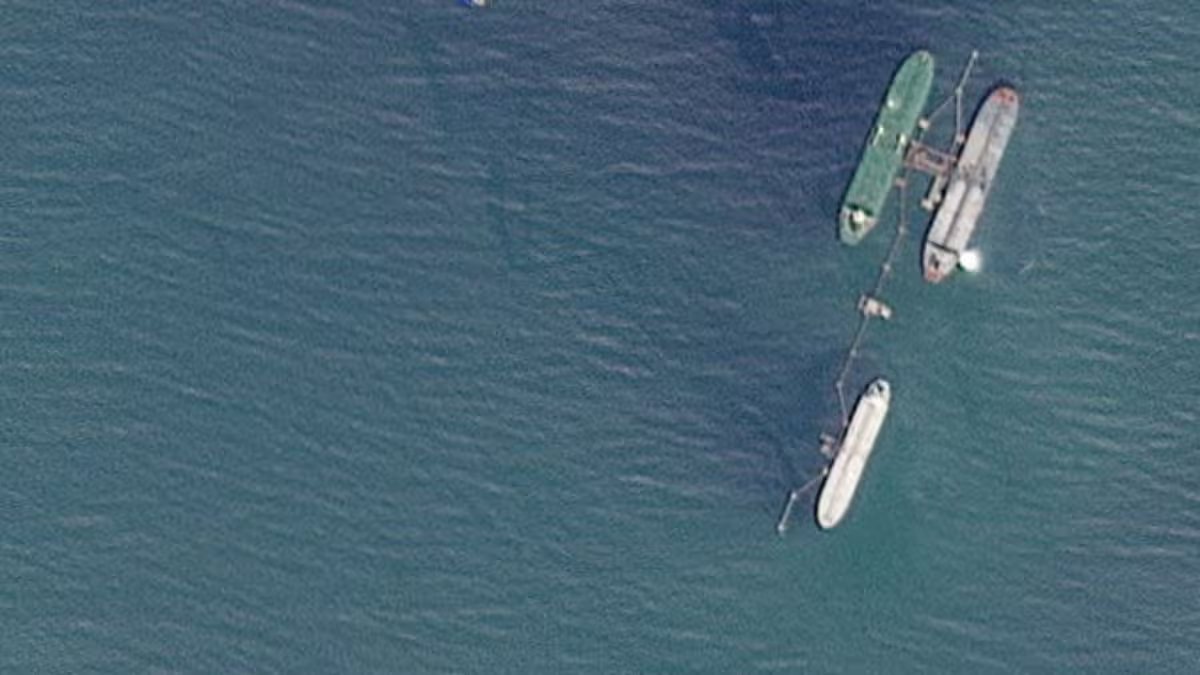
The United States’ forcible takeover of a Venezuelan-linked oil tanker this week has heightened tensions in the Caribbean.
The vessel, named Skipper, had long been part of a global network of tankers engaged in transporting crude for governments facing punitive restrictions on their oil industries.
The US action was also meant to increase pressure on Venezuelan President Nicolás Maduro’s administration.
How the Skipper was taken over by the US military
In the days before the seizure, maritime analysts observed unusual movement patterns from the Skipper as it appeared to drift near the Guyanese coastline.
The data transmitted through its automated identification system (AIS) showed erratic, zigzagging behaviour — a known hallmark of location manipulation.
Ships that face restrictions or carry sanctioned cargo frequently rely on techniques such as broadcasting incorrect GPS positions to mislead authorities.
However, satellite intelligence later confirmed that the tanker was nowhere near where the platforms indicated. Instead, the vessel was hundreds of nautical miles away, positioned far to the west and nearing Venezuelan waters.
On December 10, US military personnel deployed by helicopter carried out the operation, landing directly onto the deck
and asserting control over the 332-metre tanker — a vessel longer than many modern skyscrapers are tall.
Washington’s decision to intercept the Skipper marks a sharp escalation in efforts to squeeze the Maduro government’s oil revenue stream.
Since the re-imposition of harsh sanctions on Venezuela in 2017 and 2019, the South American nation has increasingly relied on tankers that conceal their identity, use forged paperwork, or disguise their locations to sell crude internationally.
For years, these clandestine movements allowed Caracas to generate cash despite restrictions, helping the Maduro government survive severe income losses and diplomatic isolation.
The coordinated operation to seize the Skipper suggests the US intends to challenge a fleet that has until now operated with considerable freedom in international waters.
What we know about the Skipper’s history
The Skipper was not newly implicated in sanction evasion. It was blacklisted in November 2022 under its earlier name, the M/T Adisa, because American authorities accused it of carrying crude linked to networks involving Iran’s Revolutionary Guard and Hezbollah.
That network, according to US statements at the time, was being arranged by a Switzerland-based Ukrainian trader who was also placed under sanctions.
Since that designation, the tanker had continued to operate across regions where enforcement is difficult. It reportedly moved Iranian crude to Chinese buyers, took on cargo connected to Russia, and was frequently spotted in areas where dark-fleet activity is common.
Throughout its operations, the vessel engaged in behaviour typical of illicit movements — altering its AIS data, switching its registration details, or operating without proper identification.
These tactics surged industry-wide after Western countries imposed restrictions on
Russia’s oil exports following the 2022 invasion of Ukraine.
Numerous older tankers, often owned through opaque offshore companies, entered service without standard insurance coverage, creating a loosely regulated ecosystem of vessels able to transport crude that could not be legally sold in Western markets.
The Skipper’s final route revealed additional layers of deception. As it neared the Caribbean, its AIS signals placed it next to a major offshore oil basin in Guyanese waters — a site operated by Exxon under strong US strategic backing.
It also transmitted data suggesting it was sailing under Guyana’s flag, even though registries categorised this as fraudulent.
In reality, satellite records placed the tanker near Venezuela shortly before the US Navy moved in.
How Venezuela’s shadow fleet kept its oil flowing despite sanctions
The ability of Venezuela to maintain oil exports — even as sanctions heavily restricted legal trade — has depended on fleets like the one the Skipper belonged to.
These tankers conceal locations by switching AIS systems off entirely or transmitting fabricated data that places them in faraway waters. They also take part in ship-to-ship transfers, often at night or in remote regions, to disguise the origin of the crude.
These concealment practices have coincided with a mild recovery in Venezuela’s production. OPEC records show that the country’s output has inched upwards by roughly 25 per cent in the past two years, a notable increase for a sector that collapsed under years of under-investment, mismanagement, and economic crisis.
Much of that oil was exported through complex, hidden supply chains that circumvented sanctions.
But the Skipper seizure could alter these dynamics.
Unlike previous enforcement actions, which focused largely on financial penalties or ship designations, a full physical takeover sends a far stronger deterrent signal.
Operators, insurers, and charterers now face the possibility that vessels could be militarily boarded and confiscated during sanctioned voyages.
What the Skipper was carrying
According to documents from Venezuela’s state-owned company PDVSA reviewed privately, the tanker departed Venezuelan waters with close to 2 million barrels of heavy crude.
A substantial portion of that load reportedly belonged to a Cuban state-operated oil importer.
The delivery had been arranged as part of a series of exchanges between the two governments, which depend heavily on one another for fuel, medical assistance, and other resources.
Venezuelan crude sold through covert routes trades at steep discounts.
Shipping expert Francisco Monaldi explained to AP that illicit Venezuelan shipments typically sell around $15 per barrel less than legal crude — a difference that allows middlemen, traders, and transport operators to take substantial profits while still providing revenue to Caracas.
Monaldi also indicated that the price for these secret shipments could fall further following the seizure, since buyers may now hesitate to take on oil that could be confiscated.
He added that it remained unclear whether the US intends to move toward a full-scale blockade similar to those imposed historically on other nations. “It depends if this is just a one-off event or something more systematic,” he said.
For Maduro, the stakes could not be greater. During a broadcast speech, he labelled the US operation an act of aggression.
“They kidnapped the crew, stole the ship, and have ushered in a new era — the era of criminal naval piracy in the Caribbean.”
He argued that the tanker’s crew had disappeared and that the US had taken the vessel in a manner that violated Venezuela’s rights.
Opposition leader Maria Corina Machado offered the opposite assessment, supporting the seizure and arguing that illicit oil revenues fund repression. She stated, “The regime is using the resources, the cash flows that come from illegal activities, including the black market of oil… They use those resources to repress and persecute our people.”
How Washington is only going to increase its crackdown
Less than a day after the tanker was taken, multiple sources revealed to Reuters that US agencies had begun preparing for additional intercepts.
The Skipper operation had been planned for months, according to individuals familiar with internal discussions, and was tied directly to
US President Donald Trump’s push to escalate pressure on Maduro and restrict Venezuela’s economic lifelines.
White House spokesperson Karoline Leavitt said the administration remains committed to targeting sanctioned oil shipments. “We’re not going to stand by and watch sanctioned vessels sail the seas with black market oil, the proceeds of which will fuel narcoterrorism of rogue and illegitimate regimes around the world.”
Officials are reportedly monitoring a list of tankers linked to Venezuela, Iran, and Russia. These vessels often participate in blended or sequential voyages — moving crude for multiple sanctioned countries during different legs of the same journey.
The US Treasury simultaneously imposed new sanctions on six large tankers recently loaded with Venezuelan crude and sanctioned four Venezuelan nationals, including relatives of First Lady Cilia Flores.
It remains unclear whether these newly listed vessels are among those under watch for potential seizure.
In the weeks leading up to the operation, US forces
reportedly increased patrols around Venezuelan and Guyanese waters.
At least one other ship, the Seahorse — which is listed under UK and EU sanctions for transporting Russian crude — was approached by a US warship and briefly halted before being permitted to continue to a Venezuelan port.
The US has also been conducting a separate series of strikes against maritime drug operations in both the Caribbean and the Pacific.
More than 20 attacks resulted in over 80 deaths, according to public reporting, although the legality of these counter-narcotics actions
has been challenged by experts who question their compliance with international law.
Washington describes these strikes as necessary to counter operations run by groups it designates as terrorist organisations.
How this could affect markets
The Skipper seizure instantly disrupted shipping plans. A trading company with involvement in Venezuelan crude shipments stopped at least three fully loaded vessels from departing, delaying the movement of nearly 6 million barrels of Merey crude that were destined for Asian buyers.
One executive explained that the tankers would temporarily remain near Venezuelan waters until the situation became clearer. Major concerns now revolve around whether ports will accept vessels that are candidates for seizure.
Many dark-fleet ships lack modern insurance, are of advanced age, and are controlled by shell companies — factors that make ports reluctant to permit docking even under routine circumstances.
The US expects the Skipper to sail to a port where it will undergo a legal process for confiscating its cargo, but such arrangements require careful planning.
Analysts also stress that although Venezuela’s overall contribution to global oil output is small — less than one per cent — aggressive enforcement actions introduce uncertainty.
Traders have historically reacted sharply to events that threaten supply from even minor producers, particularly when enforcement signals could extend to shipments involving other sanctioned states.
Oil prices dipped by about two per cent shortly after the operation, but industry observers warn that fluctuations could increase depending on how the US proceeds in the coming weeks.
Also Watch:
With inputs from agencies
End of Article