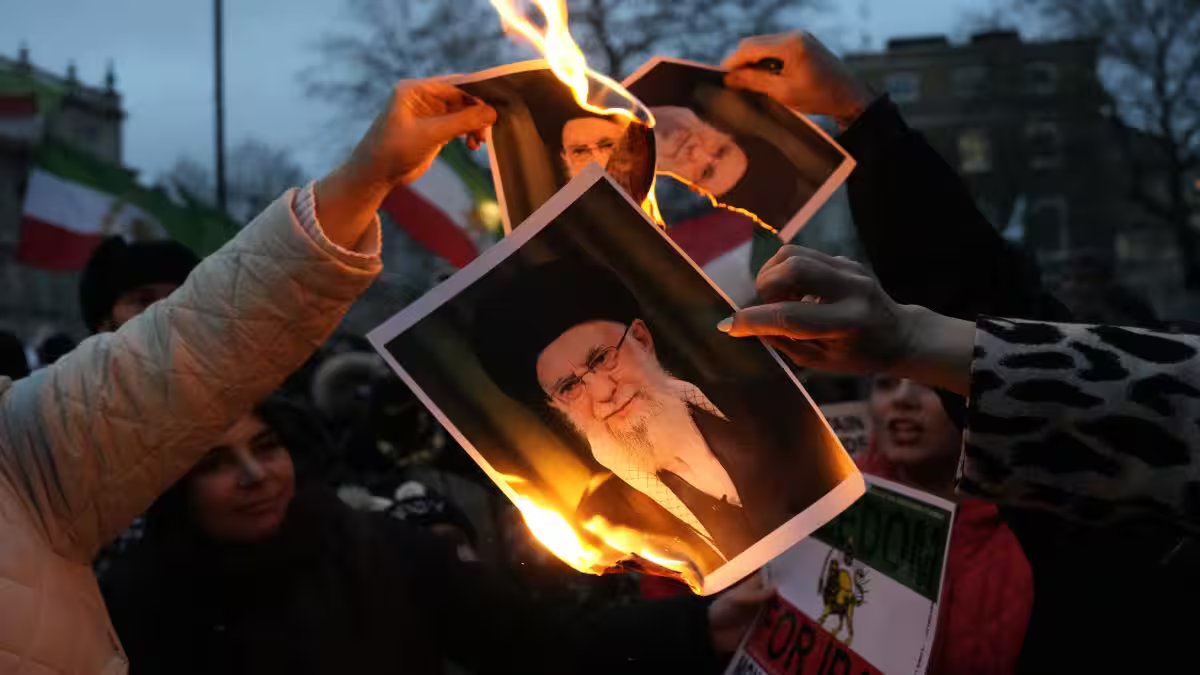
Iran’s waves of protests have thrown a familiar question back onto West Asia’s political stage: if a government falls, does economic life get better — or does it spiral?
The
unrest in Iran has been driven, in large part, by economic pain. Agencies have reported that the Iranian rial lost around half its value against the dollar in 2025, while official inflation was about 42 per cent in December.
Several accounts described the protests as initially triggered by hardship but then expanding into broader
anti-establishment demonstrations. That sequence has precedent. Since Tunisia’s uprising in 2011 toppled Zine El Abidine Ben Ali and kicked off what is commonly known as the
Arab Spring.
Several countries have since seen rulers removed or governments toppled — through revolts, coups, state collapses, or protest-driven political implosions. The economic outcomes since then are sobering: most toppled states did not enjoy a ‘revolution dividend’. Several suffered prolonged decline. Some became war economies. Only a small minority achieved stabilisation that looked like recovery.
Let’s take a look at the economic status of post-toppling countries Tunisia onwards — and explore what these countries and their economies tell about Iran’s current turmoil in that wider context.
First, the big picture: Three economic pathways after governments fall
Across the post-2011 era, most toppled states have ended up on one of three economic tracks.
First is the collapse path, where the central state has fractured or became divided. Formal taxation weakened, central banking became contested, supply chains broke down, and livelihoods shifted towards survival activity, remittances, and aid. Yemen and Sudan are among the clearest examples, while Libya and Afghanistan show elements of this pattern.
Second is the stagnation path, where the state remained intact but the growth model did not change. Productivity has remained weak, employment gains have been limited, and countries have got stuck in cycles of inflation, foreign-exchange pressure and external financing dependence. Tunisia is the standout example, with Egypt showing periodic episodes
of this stress dynamic.
Third is the resilience path, where state capacity seems to have survived transition and stabilisation looks anchored by reform credibility and access to financing. This is rare, but Sri Lanka’s post-2022 stabilisation trajectory is the clearest recent illustration of how recovery can follow toppling — if reforms hold. And a lot of credit for the island’s economic stabilisation goes to India, which — unlike Sri Lanka’s major creditor and often viewed as the main contributory reason for the island’s economic collapse — helped Colombo’s new government plan its economic reforms and efforts for revival.
The scorecard: Where toppled economies stand now
Based on the World Bank and International Monetary Fund (IMF) data sets, we have prepared a tiering-view of the economies of the countries with toppled governments post-2011 to reflect macro stability, state capacity, growth trajectory, currency and debt stress, and
investor confidence. The table gives a fair idea about whether and to what extent regime changes have helped the countries where people rose in revolt to find solutions for their economic misery.
| Country (toppling event) | Tier | Current economic position | Core constraint |
|---|---|---|---|
| Tunisia (2011) | Stagnation trap | World Bank: growth 1.4 per cent in 2024 after flat 2023; recovery remains modest and constrained | Financing constraints and low investment |
| Egypt (2011) | Stabilising but fragile | Large economy; periodic foreign-exchange shortages and inflation spikes; reforms ongoing | External financing dependence and debt/FX pressure cycles |
| Libya (2011) | Resource-rich fragility | IMF: outlook dominated by oil; political split constrains coherent fiscal policy | Fragmented governance and oil volatility |
| Yemen (2011 trajectory → war) | Collapse / war economy | World Bank: GDP projected to contract 1.5 per cent in 2025; hardship deepening | War and divided institutions |
| Sudan (2019) | Collapse / war economy | World Bank: activity contracted 29.4 per cent in 2023; further weakness afterwards | Conflict and destruction of productive capacity |
| Sri Lanka (2022) | Stabilising after default | World Bank: economy grew 5 per cent in 2024; forecasts continued growth through 2026 | Debt restructuring and reform durability |
| Myanmar (2021) | Low-confidence fragility | World Bank: projected contraction around 2.0 per cent in FY2025/26 | Conflict, uncertainty, and weak investment climate |
| Afghanistan (2021) | Aid-dependent collapse | Output depressed by aid shock and isolation; weak private sector confidence | Financial constraints and limited external integration |
| Mali (2020/21 coups) | Security-state stagnation | Growth depends on commodity flows and the security context; investment constrained | Insecurity and financing volatility |
| Burkina Faso (2022 coups) | Security-state stagnation | High security burden; development spending squeezed | Conflict dynamics |
| Niger (2023 coup) | Fragile / sanctions-hit | Investor confidence weakened; aid and financing disruptions | External financing dependence |
| Guinea (2021 coup) | Commodity-dependent | Bauxite revenues strong but governance uncertainty weighs | Concentration risk and politics |
The timeline: From toppling to today
Though the trend of the toppling of governments point to a common thread knitting all revolutions in one big string, but no two countries had exactly the same or similar economies and political set-ups. The events of transition show post-toppling states moved differently, but through recurring economic phases.
In some cases, the phase is best described as repeated debt and foreign-exchange stress. In others it is institutional fragmentation that prevents coherent budgets. And in the worst cases, it is prolonged war economy collapse.
Tunisia (2011): The transition trap
Tunisia’s early post-2011 years were shaped by political transition and demand shocks. Over the next decade the economy settled into a low-growth pattern marked by persistent unemployment, weak investment and rising fiscal strain.
The Covid-19 pandemic that stunned the world and rerouted practically every country’s economy added a further shock. As the 2020s move to the second half, Tunisia remains stuck in what many economists describe as a transition trap: politics changed, but the growth model did not.
-
2011–2013: political transition + demand shock
-
2014–2019: transition trap (low growth, high unemployment, fiscal stress)
-
2020–2022: debt/FX stress + transition trap(pandemic + financing pressure)
-
2023–2026: transition trap persists (modest growth ceiling)
The World Bank estimates Tunisia grew 1.4 per cent in 2024, after zero growth in 2023, with projected improvement but limited by a difficult financing and investment environment.
Egypt (2011): Repeated macro stress, but no state breakdown
Egypt moved through waves of macroeconomic stress without institutional collapse. After post-2011 instability and a tourism hit, Egypt entered a reform and adjustment period, then a partial recovery window.
Stress have returned in the past few years (especially after the Covid-19 pandemic) in the form of inflation spikes and foreign-exchange shortages. Yet Egypt’s scale and state continuity has given it the capacity to stabilise repeatedly, even if the economy remains vulnerable to financing cycles.
-
2011–2013: instability + tourism hit
-
2014–2016: reform push + debt/FX stress (major adjustment)
-
2017–2019: recovery window (growth improves)
-
2020–2022: shock absorption
-
2023–2026: debt/FX stress-stabilisation cycle (FX shortage-adjustment-stabilisation)
Reports suggest that falling inflation in 2025 enabled Egypt’s central bank to cut interest rates, a signal that the latest inflation spike was easing.
Libya (2011): Oil recovery without political unity
Libya’s experience after 2011 shows resource wealth may actually not substitute for institutional unity. The economy became dominated by the volatility of oil output and periodic shutdowns, while competing centres of power reduced the state’s capacity to deliver coherent fiscal and development policy.
The result has been cycles of rebound when oil flows rise, and renewed stress when politics disrupts production.
-
2011–2014: instability intensifies
-
2014–2020: fragmentation (competing authorities, oil disruptions)
-
2021–2023: recovery windo (oil-linked rebound)
-
2024–2026: fragile stability, oil-driven volatility
The IMF records that Libya’s outlook remains dominated by oil and constrained by political division.
Yemen: A permanent emergency economy
Yemen represents the most devastating economic pathway. Its 2011 transition has collapsed into civil war, a prolonged conflict. This has created a war economy that is marked by divided institutions, currency instability and extreme hardship.
Global agencies including the World Bank and the IMF continue to warn of contraction and worsening food insecurity unless a long-term political solution is not found at the earliest.
The World Bank estimated a 1.5 per cent contraction in Yemen’s GDP in 2025, and warned that its food insecurity would worsen going further.
Sudan (2019): Uprising turns into economic collapse and conflict
Sudan’s 2019 revolution opened a narrow reform window and raised hopes of stabilisation. That window later crumbled under the weight of conflict, leaving the economy in severe contraction and destroying productive capacity.
Multilateral updates suggest the country’s immediate economic challenge is no longer reform sequencing but basic recovery from conflict damage.
Gathering credible economic data from Sudan has been a challenge for all agencies. The World Bank reported economic activity contracted 29.4 per cent in 2023, with continuing deterioration thereafter.
Sri Lanka (2022): Crisis to stabilisation
Sri Lanka’s 2022 protests and political collapse followed a sovereign debt crisis, for which several experts blamed domestic political corruption, bad policymaking and China’s debt-trap diplomacy. The collapse of the government happened through popular citizen-led revolt.
Unlike many cases where toppling produced fragmentation, Sri Lanka’s trajectory quickly became a stabilisation story: default was followed by an IMF programme and disciplined adjustment. Growth returned strongly in 2024, with forecasts pointing to continued
expansion through 2025 and into 2026 — although the durability of reform remains the central risk.
-
2022: default and political collapse
-
2023: S under IMF programme
-
2024–2026: recovery window through stabilisation (recovery continues, but conditional)
World Bank data shows show the economy grew 5 per cent in 2024, with growth estimated at 4.6 per cent in 2025 and a forecast of 3.5 per cent for 2026.
Myanmar (2021): A low-trust economy after toppling by coup
Myanmar stands at a different geo-economic juncture. Its coup was led by its military junta that didn’t like the way the country’s elected government under the patronage of Nobel laureate Aung San Suu Kyi function. The country has since been in a state of civil war with various groups fighting with the military, and China’s involvement continues to be geopolitical debate.
The coup has produced a prolonged low-confidence environment. Conflict dynamics, uncertainty and weak investment conditions have prevented durable recovery. Multilateral monitoring suggests the economy remains fragile and vulnerable to renewed contraction.
The World Bank estimates a contraction of around 2.0 per cent in 2025-26 in Myanmar’s economy. This signals that the livelihoods of people are not going to improve in the country. However, this is not a country where people forced a change of government.
Afghanistan (2021): Collapse and the aid shock economy
Afghanistan’s government collapse, occasioned by chaotic withdrawal of the US forces from the country as the new Taliban swept across provinces without much fight from the then legitimate government led by President Ashraf Ghani.
The regime change produced an abrupt aid shock and financial dislocation, leaving output well below earlier development trajectories. While some basic market stabilisation occurred at a low level, structural growth remains constrained by limited financial integration and weak private-sector confidence.
The World Bank report of late-2025 projects Afghanistan’s GDP to to grow by 4.3 per cent in 2025, back on a growth of 2.5 per cent in 2024. Its political leadership is in talks with key countries for a more formal diplomatic relationship, though the official recognition of the Taliban regime is likely to take more time.
In the ranks: Winners and losers of regime change
This is a natural question that would come the mind of an observer of the historical economic paths of the nations that saw toppling of their governments. However, measuring ‘improvement’ after governments are toppled is complicated. Usually, data gathering becomes difficult as institutions collapse. Also, GDP series are revised over time, base years change, and war economies suffer data gaps.
But based on what is available in the records of the World Bank and the IMF, a rough estimate of these countries’ ranking could be made, reflecting directional change and the
prevailing macro and institutional conditions.
Most improved (relative to crisis low)
-
Sri Lanka is the clearest post-toppling stabilisation story, with growth returning strongly after default and reform adjustment. The country’s leadership has credited its northern neighbour India for its stable growth path.
-
Egypt has shown repeated macro stress, but continuing state capacity and the ability to stabilise after shock cycles.
-
Tunisia, though, not a prosperity story, but remains one of resilience. It has shown stagnation without collapse.
Most deteriorated (from toppling into long-run damage)
-
Yemen is in the middle of a prolonged conflict, and fragmentation has produced extreme economic destruction and ongoing hardship.
-
Sudan has seen a dramatic contraction and destruction of productive capacity after conflict escalation.
-
Libya looks trapped in oil volatility and institutional division, which has restricted durable development.
-
Myanmar suffers from coup-driven instability, which has locked its economy into low confidence and fragility.
-
Afghanistan has seen a collapse followed by aid withdrawal and structural constraints linked to financial isolation, but with signals of return to the path of growth.
Why the global economy made post-toppling recovery harder after 2020
Even countries with stable politics struggled after the pandemic and the global inflation cycle. The World Bank has warned that many developing economies are facing difficulty regaining their income trajectory.
For toppled states, this global squeeze reduced investor risk appetite, tightened financing, and punished policy incoherence. One reason many toppling states never recovered is that the global environment turned hostile: pandemics, inflation cycles, high interest rates, commodity shocks, conflicts.
Earlier this month, the World Bank flagged that one in four developing economies remained poorer than in 2019. This shows how weak the recovery has been for many countries — even without political upheaval. This is significant as toppling countries are competing for capital and credibility under tougher conditions than in 2011.
Iran is replaying the opening act — not the ending
While Iran’s Ayatollah regime is under severe pressure, from within and outside, especially over the geostrategic unpredictability of the US under President Donald Trump, it is not yet a country where a government has been toppled — not since 1979. The ongoing economic unrest, however, has revived the memories of the Arab Spring, and continues to threaten the sustainability of the Islamic regime.
Economically, Iran shows the same ignition conditions that have preceded major political rupture across the region: inflation-driven anger, currency credibility collapse, and protests that begin with livelihoods before broadening into political opposition.
Since 2011, West Asia and North Africa’s experience suggests that toppling can be quicker than rebuilding — and that economic legitimacy is harder to restore than political legitimacy.
Tunisia shows what happens when political change does not deliver growth. Libya and Yemen show what happens when institutions collapse. Sri Lanka shows recovery is possible, but only via painful adjustment, debt restructuring and sustained reform credibility.
For Iran, the lesson is not that protest always leads to collapse. It is that once inflation and currency weakness become political triggers, restoring household confidence becomes a far greater test than surviving any single demonstration or popular unrest.
End of Article