It seems like Pakistan is once again at odds with the United States.
In 2025, Islamabad and Washington appeared to rediscover strategic alignment under US President Donald Trump’s second administration, marked by high-profile meetings, and economic initiatives spanning crypto policy and critical minerals.
Yet, by February 2026, a sharply worded intervention by Pakistan’s Defence Minister Khawaja Asif has reopened old wounds about the costs of past alliances with Washington.
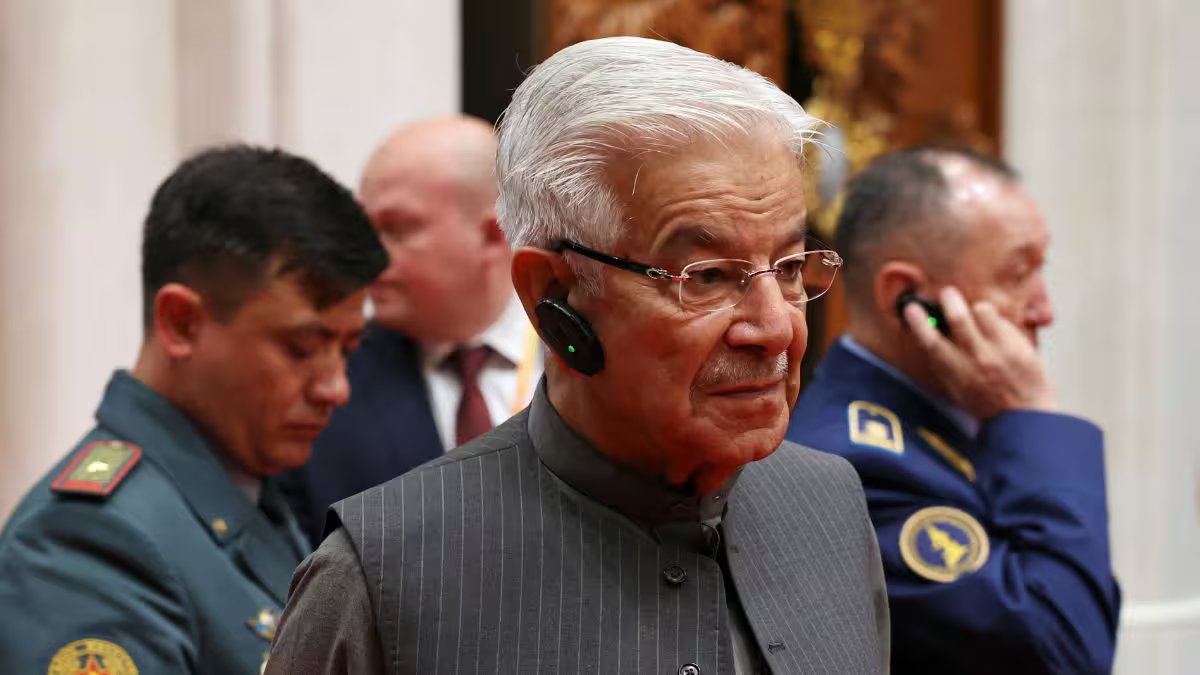
Addressing Pakistan’s National Assembly earlier this week, Asif delivered an unusually candid account of Islamabad’s role in the Afghan wars and its long partnership with the United States.
His remarks — which included a direct accusation that Washington had used Pakistan for its own purposes and then abandoned it — came at a moment when bilateral ties are facing fresh strain
following a major India-US trade agreement.
The juxtaposition is striking.
Only months earlier, Trump had repeatedly praised Pakistan’s leadership and credited himself with preventing a nuclear confrontation between India and Pakistan. Islamabad, in turn, publicly supported Trump’s claims regarding the May 2025 ceasefire and
even endorsed him for the Nobel Peace Prize.
After a year of visible diplomatic warmth, is Pakistan recalibrating its position toward the United States?
How Khawaja Asif exposed Islamabad in Pakistan’s Parliament
Khawaja Asif’s speech in Parliament stands out for its direct acknowledgment of Pakistan’s past strategic decisions and their consequences.
Speaking before lawmakers, the defence minister criticised the country’s alignment with Washington during both the anti-Soviet campaign in Afghanistan in the 1980s and the post-September 11 US-led “war on terror.”
He stated that Pakistan had repeatedly entered into conflicts that were not grounded in its own national priorities.
Referring to the military leadership during those periods, Asif said that “two former military dictators (Zia-ul-Haq and Pervez Musharraf) had joined the war in Afghanistan, not for the sake of Islam, but to appease a superpower.”
His remarks directly challenged decades of official narratives that framed Pakistan’s participation in Afghan conflicts as religiously motivated.
Khwaja Asif admits in Parliament that Pakistan rented itself out to the U.S. for war and was later discarded “like toilet paper”. Afghanistan was destroyed by policies now openly acknowledged in parliament. Millions suffered. Generations were lost. The world cannot look away now… pic.twitter.com/aEQjrm16ME
— Mariam Solaimankhil (@Mariamistan) February 10, 2026
Asif rejected the idea that the country’s involvement had been a religious obligation, acknowledging that Pakistanis had been mobilised and sent into conflict under the banner of jihad, a framing he described as misleading and damaging.
“We deny our history and do not accept our mistakes. Terrorism is a blowback of the mistakes committed by dictators in the past,” he told Parliament.
“The losses we suffered can never be compensated.” He characterised those decisions as “irreversible”.
Perhaps most pointedly, he accused the United States of exploiting Pakistan’s cooperation and then discarding it. “Pakistan was treated worse than a piece of toilet paper and was used for a purpose and then thrown away,” he said.
Beyond the battlefield consequences, Asif claimed that Pakistan’s education system had been altered to legitimise the wars, embedding ideological shifts that continue to shape society today.
The speech amounts to one of the most explicit acknowledgments by a senior Pakistani official that the country’s partnership with Washington during key historical junctures produced long-term internal instability, radicalisation and economic strain.
How Pakistan-US went from cooperation to distrust
Pakistan’s ties with the United States have long oscillated between close collaboration and deep mistrust. During the 1980s, Islamabad and Washington worked together to support the Afghan mujahideen against the Soviet Union.
Critics later argued that this period strengthened the military leadership of General Mohammad Zia-ul-Haq.
Following the September 11, 2001 attacks in the United States, Pakistan once again aligned itself with Washington. It was designated a major non-Nato ally and became central to the US-led campaign in Afghanistan.
Under General Pervez Musharraf’s rule, Pakistan turned against the Taliban and provided logistical and intelligence support to American forces.
Over time, however, the relationship deteriorated. US officials accused Islamabad of maintaining links with terror groups even while cooperating publicly in the “war on terror.”
During his first term in office, Donald Trump accused Pakistan of giving the United States “nothing but lies and deceit” and of harbouring armed groups.
Later, Joe Biden described Pakistan as “one of the most dangerous nations.”
The withdrawal of US forces from Afghanistan in 2021 reshaped the regional security landscape. Pakistan was left grappling with internal security challenges, including increased militant violence in its western regions.
Asif’s remarks explicitly linked current instability to earlier policy decisions made during both the anti-Soviet campaign and the post-9/11 alignment.
How Pakistan cosied up to Trump-led US in 2025
When Donald Trump returned to the White House in January 2025 for his second term, Pakistan initiated what observers described as a deliberate diplomatic shift aimed at aligning itself with the administration’s priorities and style of governance.
Operation Sindoor
A defining moment came in May 2025 during
a four-day armed confrontation between India and Pakistan. The brief but intense clash raised concerns about potential escalation between the two nuclear-armed neighbours.
Following the ceasefire, Pakistan publicly credited Trump with playing a mediating role in halting the hostilities.
India maintained that the ceasefire resulted from bilateral dialogue and reiterated its longstanding position that disputes between New Delhi and Islamabad must be resolved directly between the two sides.
Despite India’s position, Trump
repeatedly claimed credit for preventing a larger conflict. At a news conference in December, he declared, “We have stopped eight wars.” He continued, “We stopped a potential nuclear war between Pakistan and India.”
Referring to Pakistan’s leadership, Trump added, “The head of Pakistan and a highly respected general – he is a field marshal – and also the prime minister of Pakistan said that President Trump saved 10 million lives, maybe more.”
Asim Munir & Trump dynamic
Trump’s remarks were not isolated. Since June 2025, he has publicly praised Pakistan’s army chief, Field Marshal Asim Munir, on at least ten occasions.
At the Sharm el-Sheikh Peace Summit in Egypt in October, marking the conclusion of a ceasefire agreement between Israel and Hamas in Gaza, Trump referred to Munir
as “my favourite field marshal.”
On other occasions, he described him as “a great fighter”, “a very important guy”, and an “exceptional human being.” After their first meeting in June 2025, Trump said he was “honoured” to meet the Pakistani military chief.
Pakistan’s leadership reinforced this dynamic by endorsing Trump for the Nobel Peace Prize, citing his role in preventing nuclear escalation.
The move reportedly facilitated multiple Oval Office invitations and
a White House lunch for Munir in June 2025, making him the first Pakistani military chief to receive such repeated one-on-one engagements at that level.
US-Pakistan security cooperation
In early 2025, Pakistan assisted US authorities in capturing Sharifullah, also known as Jafar, identified as the mastermind behind the August 2021 Abbey Gate bombing at Kabul airport. The attack killed 13 US service members and dozens of Afghan civilians during the chaotic US withdrawal.
In March 2025, addressing a joint session of US Congress, Trump publicly thanked Pakistan for its role in the arrest. He described the Pakistani military as “trusted partners” once again.
In exchange for intelligence cooperation, the Trump administration
designated the Balochistan Liberation Army (BLA) as a foreign terrorist organisation — a long-standing request from Islamabad aimed at protecting infrastructure linked to the China-Pakistan Economic Corridor (CPEC).
The designation aligned US policy with a key Pakistani security objective in Balochistan, even as Islamabad simultaneously sought American investment in the same region.
Pakistan also signalled willingness to participate in a proposed US-led international stabilisation force for Gaza, part of Trump’s broader West Asian initiative.
Islamabad also joined Trump’s newly established “Board of Peace” for Gaza, a regional framework that includes Saudi Arabia, the United Arab Emirates and Turkey. Through this platform, Pakistan positioned itself as a bridge between Washington and parts of the Muslim world, particularly in relation to the Israel-Gaza peace process.
Pakistan opens its economy to the US
Seeking to align with the Trump administration’s emphasis on technology and resource security, Pakistan established a Crypto Council in 2025 and appointed a dedicated Minister for Crypto.
It signed a deal with World Liberty Financial, a company linked to the Trump family,
in an effort to position itself as a regional hub for digital assets.
In parallel, Pakistan offered the United States access to strategic mineral resources. A
$1.25 billion financing package from the US Export-Import Bank was secured for the Reko Diq mining project in Balochistan.
A $500 million framework agreement was reached with US Strategic Metals (USSM) to extract lithium and rare earth elements critical to US defence industries.
These moves coincided with trade concessions. Pakistan obtained a 19 per cent tariff rate on its exports to the US, the lowest in South Asia, while competitors such as India faced significantly higher tariffs at the time, reaching up to 50 per cent.
How domestic realities have put pressure on Islamabad
Despite the diplomatic “honeymoon” of 2025, 2026 has brought new strains.
Violence has surged across Pakistan, particularly in western provinces bordering Afghanistan and Balochistan, with casualty figures reaching the highest levels in a decade.
The most high-profile incident occurred on February 6, when a suicide bomber targeted the Khadija Tul Kubra Mosque in Islamabad during Friday prayers. The attack,
claimed by the Islamic State – Pakistan Province (IS-PP), killed 32 people and injured over 170.
This bombing was particularly jarring as it breached the high-security “Red Zone” of the capital and represented the deadliest attack in Islamabad in nearly two decades, signalling a dangerous shift in militant capability to strike the state’s core.
Simultaneously,
the province of Balochistan has experienced its most violent period in years. Starting on January 31, the Balochistan Liberation Army launched a massive, coordinated offensive across 12 districts, including Quetta, Gwadar, and Mastung.
These attacks involved suicide squads and armed assaults on police stations, military outposts, and a high-security prison. In response, the Pakistani military launched Operation Radd-ul-Fitna-1 (Countering Chaos).
According to official military statements, the operation resulted in the deaths of 216 militants, though the violence also claimed the lives of 31 civilians and 17 security personnel during the initial wave of attacks.
The security situation in Khyber Pakhtunkhwa (KP) remains equally volatile. In early January, a major security operation in the Tirah Valley led to the displacement of over 70,000 residents, sparking a public standoff between the federal government and the KP provincial leadership, who accused the centre of unilateral action.
Statistics for January 2026 alone show a 28 per cent increase in militant activity compared to the previous month, with a total of 361 deaths recorded nationwide — the highest monthly toll in years.
The country also saw widespread disruption on February 8, during a national strike organised by the Tehreek-e-Tahafuz-e-Ayeen-e-Pakistan (TTAP). Marking the second anniversary of the 2024 general elections, thousands of protesters took to the streets in major cities to demand the release of former Prime Minister Imran Khan and to protest the country’s current foreign policy alignments.
Opposition parties and rights organisations have accused the government of curbing civil liberties, restricting media freedoms and engaging in political repression.
Against this domestic backdrop,
the massive India-US trade deal may have felt like the final nail in the coffin for Pakistan.
Whether Asif’s remarks will be seen as a fundamental policy shift for Islamabad or just a personal grievance that was being aired publicly, remains to be seen.
Also Watch:
With inputs from agencies
End of Article