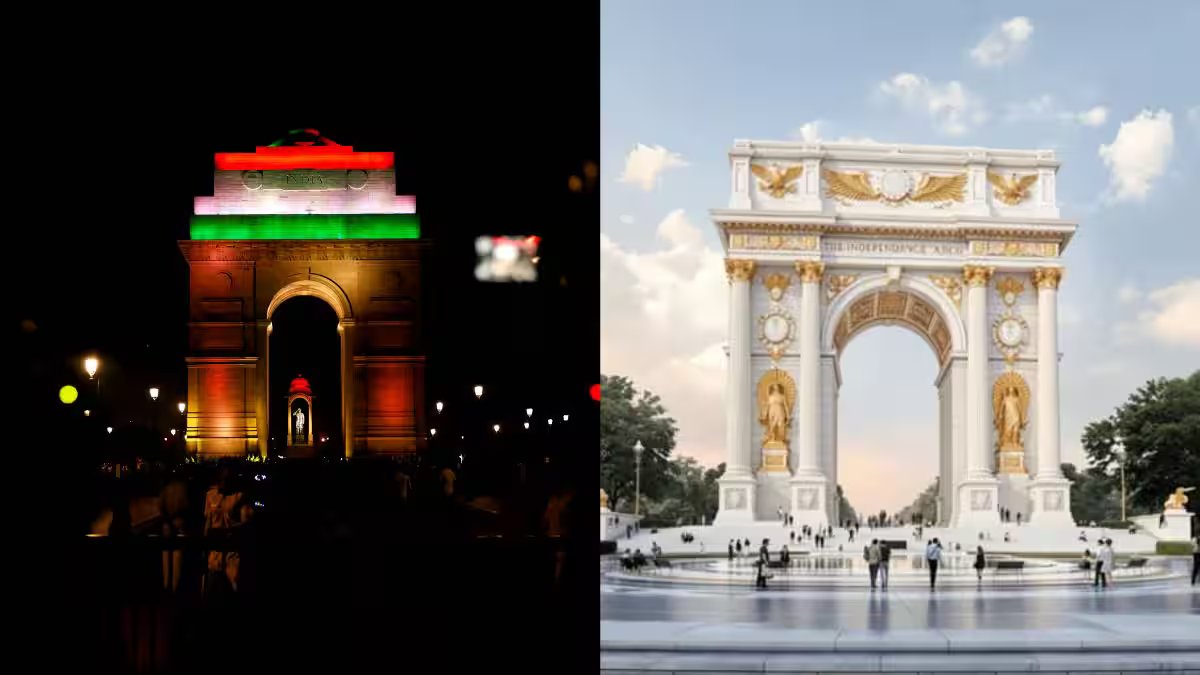
US President Donald Trump is pushing ahead with plans for a massive triumphal arch in Washington, DC — one that would dramatically reshape the city’s iconic landscape and potentially eclipse some of its most recognisable memorials.
Envisioned as part of the celebrations for America’s 250th anniversary, the proposed structure is already gaining momentum.
What are Trump’s plans for the arch?
According to people familiar with the discussions who spoke to the Washington Post, Trump has become increasingly committed to a 250-foot-tall arch overlooking the Potomac River.
If built at that scale, the structure would rise far above the White House, which stands at roughly 70 feet, and the Lincoln Memorial, which is about 100 feet tall.
It would also surpass Paris’s Arc de Triomphe, which measures 164 feet, though it would still be less than half the height of the Gateway Arch in St Louis, the world’s tallest arch.
Trump has reportedly focused on Memorial Circle, a small traffic circle near Memorial Bridge, situated between the Lincoln Memorial and Arlington National Cemetery.
The land falls under the jurisdiction of the National Park Service and occupies a historically sensitive corridor linking several major national landmarks.
Trump has previously explored scaled-down versions of the project, including designs standing 165 feet and 123 feet tall, which he shared at a private dinner in 2025.
However, aides say Trump prefers the largest option, arguing that “250 for 250” best reflects the significance of the Declaration of Independence’s 250th anniversary in July.
At a White House Christmas reception, Trump underscored his ambition by telling guests, “The one that people know mostly is the Arc de Triomphe in Paris, France. And we’re gonna top it by, I think, a lot.”
What concerns have risen as Trump pushes for the arch?
While Washington is unusual among major global capitals for lacking a triumphal arch, critics argue that placing a celebratory monument of this scale in Memorial Circle could disrupt the symbolic balance of the area.
The site sits along a solemn axis that includes the Lincoln Memorial, Memorial Bridge — conceived as a post–Civil War symbol of reconciliation — and Arlington National Cemetery.
Architectural experts have warned that a 250-foot arch could obstruct pedestrian views and alter the visual relationship between these landmarks.
The structure could also block sightlines to Arlington House, the former estate of Confederate General Robert E Lee, which overlooks the cemetery from a hillside.
“I don’t think an arch that large belongs there,” said Catesby Leigh, an art critic who initially advocated for a far smaller, temporary arch in a 2024 essay.
Leigh later suggested architect Nicolas Leo Charbonneau for the project, and Charbonneau has since been retained by the White House.
Other historians have echoed similar concerns. “It’s a very somber corridor,” John Haigh, chair of Benedictine College’s architecture programme, told the Washington Post. “We discussed the gravity of putting an arch there,” particularly one intended to be triumphal.
Calder Loth, a retired Senior Architectural Historian for the Virginia Department of Historic Resources, warned about the monument’s visual dominance, “I would be very concerned about the scale. It would make Arlington House just look like a dollhouse — or you couldn’t see it all, with the arch blocking the view.”
From across the river, the impact could be just as striking. “How does it impact the panorama of Washington?” Loth asked. “What is supposed to be doing the speaking?”
How will the project be funded?
Trump has made clear that he wants the arch to be permanent, rejecting proposals for a smaller, temporary structure.
He has also indicated that the project could be funded using leftover private donations from
his separate White House ballroom expansion, a project he has said could cost about $400 million.
That ballroom, currently under construction as part of a new East Wing, is planned to cover 89,000 square feet — larger than the White House’s existing footprint — while matching its 70-foot height.
Trump’s push for monumental scale has already led to tensions on that project, with earlier plans to further enlarge the ballroom reportedly being halted.
On January 23, Trump
posted images on his Truth Social platform showing three potential arch designs, including one featuring gold gilding, a stylistic detail associated with several of his past construction projects.
The White House has not clarified whether these images reflect new concepts or earlier proposals that included a large Lady Liberty statue.
Any arch built in Washington would need to pass through multiple review bodies and could ultimately require congressional approval under laws governing new monuments in the capital.
Trump recently appointed Atlanta-based developer and philanthropist Rodney Mims Cook Jr., president of the National Monuments Foundation, to the Commission of Fine Arts, which would be involved in reviewing the design.
Cook has a long history with similar ideas. He proposed a peace arch in Washington in 2000, though those plans were shelved after the September 11 attacks. He later built the Millennium Gate Museum in Atlanta to commemorate Georgia’s history.
Is Trump’s idea that alarming?
The idea of placing a structure at Memorial Circle is not new. City planners have examined the site for more than a century.
Early 20th-century plans linked to the Senate Park Commission appear to envision some form of monument there, and architect William Kendall presented memorial proposals to the Commission of Fine Arts in 1928.
Still, critics argue that scale and context matter more than precedent. Leigh has suggested relocating a massive arch to a less congested area of the city, such as Barney Circle in Southeast Washington, near Congressional Cemetery.
“If you’re going to build an arch that big, you should build it in another part of town and one possible site that comes to mind is Barney Circle,” Leigh said.
“There’s nothing around it competing with it.”
Despite the growing pushback, Trump has signalled urgency. He told Politico in December that he hoped to begin construction within two months.
With inputs from agencies
End of Article