Iran seems to be on the brink. The US-Israel joint airstrikes haven’t just caused significant destruction to the Islamic Republic but also brought its leadership to its knees. The attack by the US and Israel has not only killed Iran’s Supreme Leader Ayatollah Ali Khamenei, but also many senior leaders of the Islamic Revolutionary Guards Corps (IRGC).
On Saturday (February 28), it was reported that the commander of the IRGC, Mohammad Pakpour, had been killed in the airstrikes. Shortly after, it was announced that Brigadier General Ahmad Vahidi has been appointed as the new head of the crucial IRGC.
But who is he? And more importantly, what role does the IRGC play in Iran?
Who is IRGC’s new chief?
Iran has appointed Brigadier General Ahmad Vahidi as the new commander-in-chief of the IRGC to replace Mohammad Pakpour, who was killed in the US-Israel strikes on Saturday.
The appointment comes amid mounting tensions across West Asia, with Iranian officials warning of large-scale retaliation. In fact, the IRGC announced that it plans to launch what it described as the “most massive and powerful offensive operation in the history of the Islamic Republic,” targeting Israel and
US military bases across the region.
The appointment of Brigadier General Ahmad Vahidi is not surprising. He is a long-time figure within Iran’s security establishment and one of the country’s most experienced military strategists, even earning a PhD in strategic studies.
Born in 1958 in the central Iranian city of Shiraz, Vahidi joined the IRGC during the Iranian revolution in 1979. At that time, he was studying electronic engineering at Shiraz University. During his years at the IRGC, he has held several significant roles. Vahidi led the IRGC’s Quds Force, which specialises in intelligence and directs operations outside Iran, from 1988 until 1998.
From 2005, General Vahidi served as deputy defence minister, and he was appointed Defence Minister in 2009, holding the post until 2013. He was also Iran’s interior minister for three years until August 2024.
Outside of Iran, Vahidi is well-known for being a suspect in the 1994 bombing of a Jewish cultural centre in Buenos Aires that killed 85 people and wounded hundreds more. He also faces numerous sanctions from the US, Canada, the European Union, and Britain for alleged human rights violations.
But what exactly is the IRGC?
The
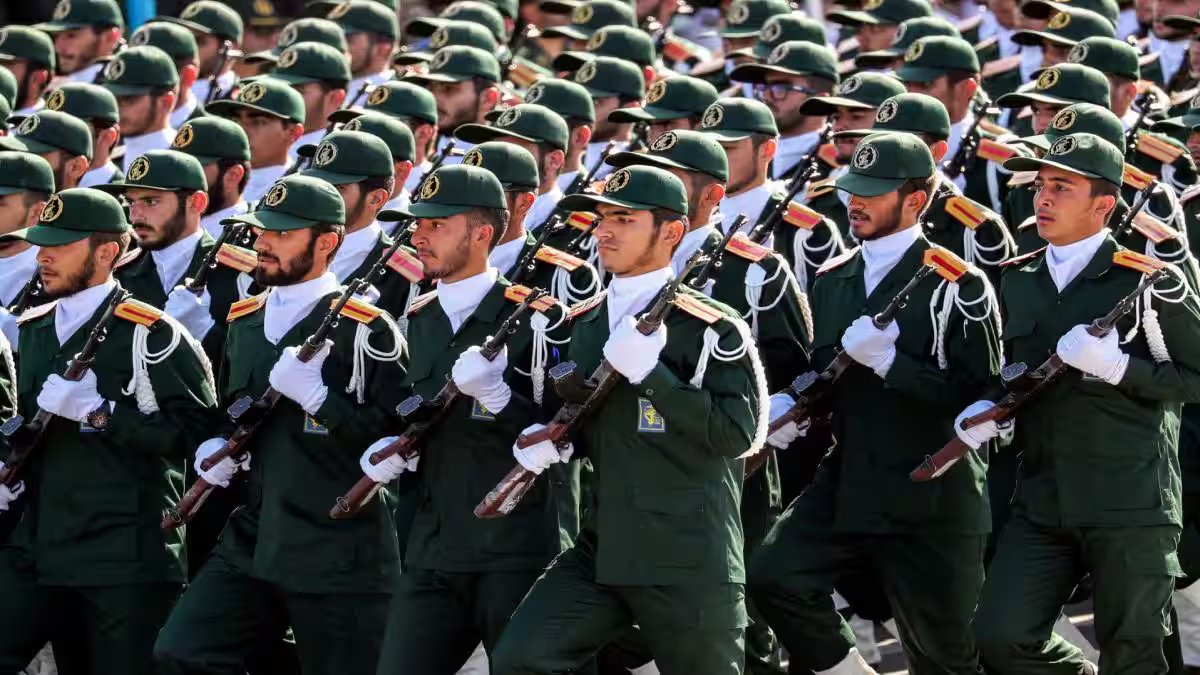
IRGC, also known as the Sepah-e-Pasdaran, emerged from Iran’s 1979 Islamic Revolution as a body tasked with safeguarding the Shiite cleric-led state and was later written into the constitution. It is not to be confused with Iran’s traditional armed forces — it is a parallel military body.
The IRGC’s main responsibility is defending the Islamic Republic against internal and external threats and answering directly to
Iran’s Supreme Leader. The force, over the years, has also become influential in domestic politics, with many senior officials having passed through its rank
Iran’s founding supreme leader, Ayatollah Ruhollah Khomeini, described the IRGC as “the soldiers of Islam”. “Wherever you be, guard yourselves against the self in you and from all the Satans around you,” he told Pasdaran after the group was founded.
Today, the IRGC is now the strongest and best-equipped section of Iran’s armed forces. It has extended its influence through the worlds of politics and business, gaining in power at home and abroad.
Over the years, the IRGC has played a significant role in Iran. Its overseas arm, which is known as the Quds Force, heavily influences Iran’s allied militias across the Middle East, from Lebanon to Iraq, Yemen, and Syria.
It supported Syria’s former President Bashar Assad, Lebanon’s Hezbollah, Yemen’s Houthis, and other allied groups. Moreover, it has trained Iraqi fighters to build and deploy highly lethal roadside bombs used against American troops.
In recent times, the IRGC has been actively involved in the tensions against Israel and the West. In April 2024, when Israel struck the Iranian consulate in Syria’s capital Damascus, it was the IRGC that launched “dozens of drones and missiles” towards military sites on Israeli territory.
Moreover, in the 12-day war between Iran and Israel, it was the IRGC that retaliated with missile strikes.
Since the early 2000s, the Guards’ economic power has also grown as its contracting company Khatam al-Anbiya, won projects worth billions of dollars in Iran’s oil and gas sector.
How is the IRGC organised?
The IRGC is a highly organised unit in Iran — it has more than 190,000 troops under its command, according to the International Institute for Strategic Studies (IISS).
The IRGC has various branches: ground forces based across Iran’s 31 provinces and Tehran and the Basij paramilitary force.
The IRGC also has a separate naval force, which is charged with patrolling Iran’s maritime borders, including the
Strait of Hormuz, an air force of 15,000 personnel, which runs Iran’s ballistic missile programme; and a cyber command, which works with IRGC-affiliated businesses on military and commercial espionage, as well as propaganda distribution, according to IISS.
What role does the IRGC play in Iran’s politics?
During the tenure of Ayatollah Ali Khamenei, the IRGC’s influence on politics has increased significantly. The Council on Foreign Relations notes that because the IRGC marches in lockstep with the supreme leader’s policy positions, its powers at times seem to outshine that of Iran’s president, who does not control any of the armed forces and has relatively few powers of his own.
Experts say the IRGC’s heavy hand in politics and its continued willingness to harm Iranians make it unpopular among the public. It has been accused of beating, assaulting and torturing Iranians who have participated in protests. In short, it has played an instrumental role in suppressing any kind of dissent against Iran’s supreme leader.
What comes next for the IRGC?
Now, with the death of Ayatollah Ali Khamenei, there are also questions about what happens to the IRGC.
According to a report published in Iran Insight last year, it was reported that Khamenei might have transferred key authority to the Supreme Council of the Iranian military, including the Islamic Revolutionary Guard Corps (IRGC).
While there was no confirmation on this then, it has raised questions if the IRGC could now take power in Iran. Some believe that the IRGC would take control of Iran. This seems difficult because as per the Constitution of Iran, the Supreme Leader cannot formally transfer political power to either the IRGC or the regular military, as he is not a governing institution in a formal constitutional sense.
However, in practice, due to the overwhelming powers of the Supreme Leader, he can empower IRGC leaders and military men by appointing them to top political, military, and economic roles.
As Jason Brodsky, policy director at the Washington-based United Against Nuclear Iran, told Al Arabiya English, “The IRGC “could try to supplant the entire process (of finding a successor to Ayatollah Ali Khamenei) given the emergency situation in the country.”
It’s now a wait-and-watch game to see how the situation unfolds. Will the IRGC rise to the very top?
With inputs from agencies
End of Article