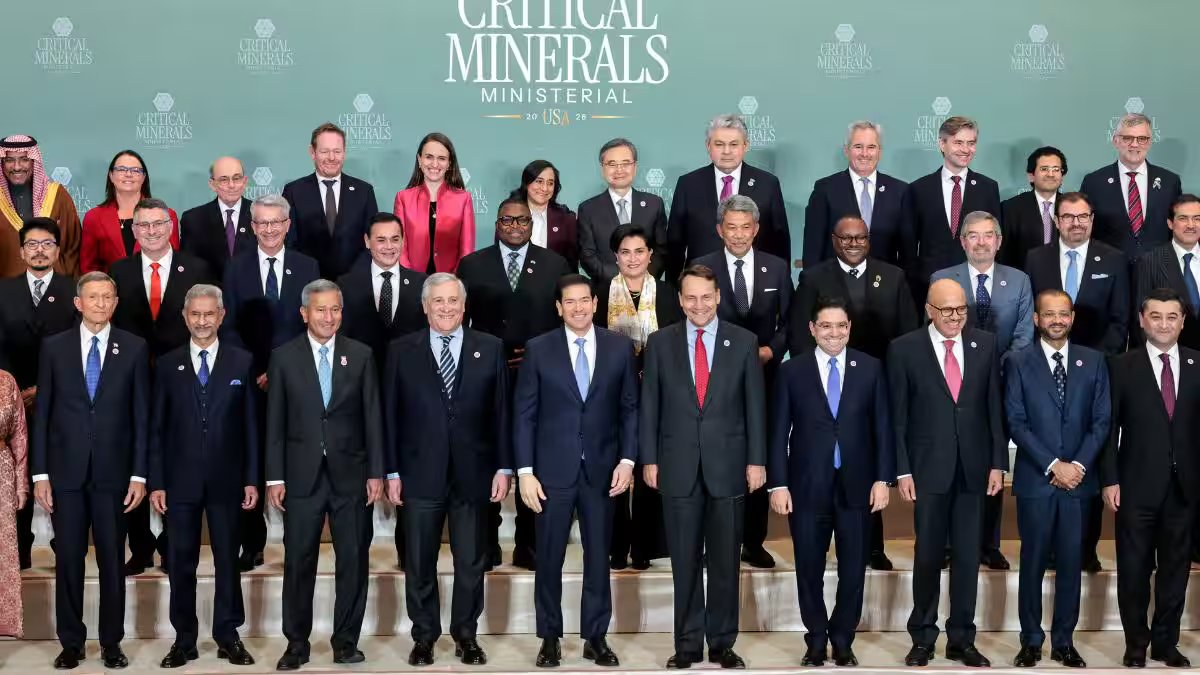
The Donald Trump administration has proposed the creation of a preferential critical minerals trading bloc among allied and partner countries.
The initiative, announced during a high-level ministerial meeting in Washington, is designed to reduce global dependence on China, whose dominance over rare earth elements and other strategic minerals has increasingly become a source of vulnerability for the United States and its partners.
The proposal, articulated by US Vice President JD Vance and supported by senior members of the administration, seeks to coordinate pricing mechanisms, trade rules, and supply chain investments across a coalition of countries with mining, refining, or processing capabilities.
India, which was among more than 50 countries represented at the meeting, has emerged as a notable participant, especially as New Delhi simultaneously accelerates its own domestic rare earth and semiconductor ambitions.
Why critical minerals are now a priority
Critical minerals such as rare earth elements, lithium, nickel, and cobalt form the backbone of modern industrial and technological systems.
They are essential for manufacturing semiconductors, electric vehicles, advanced weapons systems, smartphones, renewable energy infrastructure, and aerospace equipment.
While these materials are extracted in multiple parts of the world, China has built a commanding position over decades, controlling a majority share of global mining for certain minerals and an even larger share of processing and refining capacity.
This concentration has repeatedly disrupted global supply chains. In recent years, Beijing has used export controls and regulatory restrictions on rare earths as a strategic lever, actions that have affected industrial output in the United States and Europe.
Production delays and temporary shutdowns at automobile plants underscored how deeply Western manufacturing remains dependent on Chinese-controlled inputs.
US officials argue that China’s ability to suppress prices through scale and state-backed production has made it difficult for alternative suppliers to remain competitive, discouraging private investment in mining and processing projects elsewhere.
Addressing a gathering of visiting ministers in Washington on Wednesday, Vance framed the new proposal as a corrective to these distortions. “We want to eliminate that problem of people flooding into our markets with cheap critical minerals to undercut our domestic manufacturers,” Vance said.
What we know about the proposed trade bloc
At the core of the plan is the idea of a coordinated trading zone in which participating countries agree to shared pricing and trade mechanisms for critical minerals. According to Vance, the bloc would establish benchmark prices at different points along the production chain, from extraction to processing and refining.
“We will establish reference prices for critical minerals at each stage of production, … and for members of the preferential zone, these reference prices will operate as a floor maintained through adjustable tariffs to uphold pricing integrity,” he said.
Under this model, tariffs would be adjusted collectively to prevent prices within the bloc from falling below agreed thresholds.
The objective is not only to shield domestic producers from being undercut by cheaper supply but also to provide predictable returns that could encourage long-term private investment in mining and processing infrastructure.
The proposal marks a significant expansion of Washington’s willingness to intervene in markets.
In recent years, the Trump administration has already taken equity stakes in several mineral companies, negotiated pricing arrangements in other sectors, and deployed public funds to stabilise strategic industries.
Which countries are at the table
The ministerial meeting drew representatives from 55 countries, according to US Secretary of State Marco Rubio. Attendees included nations with established mining sectors, advanced processing capabilities, or strategic reserves of key minerals.
Countries represented included India, Japan, South Korea, Thailand, Germany, Australia, and the Democratic Republic of Congo. Some nations, such as Australia and Canada, are major exporters of raw materials, while others, including Japan and Germany, play critical roles in downstream manufacturing and technology.
Rubio said the concentration of supply had become a strategic liability. The minerals, he noted, were “heavily concentrated in the hands of one country,” adding that this imbalance had evolved into a “tool of leverage in geopolitics.”
Major US allies such as France and the United Kingdom attended the talks, although Greenland and Denmark did not, despite the Arctic island’s mineral wealth.
US Interior Secretary Doug Burgum said that 11 additional countries would be named to the critical minerals trade club within days, and added that 20 more countries had expressed strong interest in joining.
During the meeting, US Trade Representative Jamieson Greer outlined concrete steps already underway.
These included a bilateral initiative with Mexico and a trilateral framework involving the European Union and Japan, aimed at strengthening supply chains and harmonising trade policies related to critical minerals.
Governments are also exploring policy tools such as subsidies, guaranteed purchase agreements, market standards, and direct support for production capacity, all intended to reduce reliance on Chinese supply.
Where India stands
External Affairs Minister S Jaishankar attended the summit in Washington, describing it as the central purpose of his visit to the United States.
“The discussion was very good, critical minerals is a very important subject, the US has been partner for some years,” Jaishankar said during a media interaction following the meeting.
Jaishankar
also addressed the ministerial session, where he highlighted the dangers of excessive concentration in global supply chains and stressed the need for collective action to mitigate risk. He underlined the importance of international cooperation in ensuring stable access to resources that underpin economic growth and national security.
India also expressed support for the Forum on Resource, Geostrategic Engagement (FORGE), an initiative unveiled at the summit to deepen collaboration among participating countries on resource governance and supply chain resilience.
The timing of India’s involvement is significant. Just days earlier, New Delhi and Washington concluded a trade agreement that reduced US tariffs on Indian imports from 50 per cent to 18 per cent.
How India is boosting its rare earth sector
In the Union Budget for 2026-27, Finance Minister Nirmala Sitharaman
unveiled a series of measures aimed at strengthening India’s position in the critical minerals ecosystem.
Presenting her ninth consecutive Budget in Parliament, Sitharaman announced that the government would support mineral-rich states — Odisha, Kerala, Andhra Pradesh, and Tamil Nadu — in developing dedicated rare earth corridors.
These states are known for their mineral deposits, particularly in coastal and mineral belt regions, and already possess ports, industrial zones, and supporting infrastructure.
The corridors are envisioned as integrated planning frameworks rather than simple transport routes. They are intended to link extraction sites with processing plants, research institutions, and manufacturing clusters, creating end-to-end value chains for rare earth elements.
Sitharaman’s announcements build on policy decisions taken in late 2025 and align with broader manufacturing and technology initiatives introduced in the Budget.
Among them
was Indian Semiconductor Mission 2.0, designed to expand domestic chip manufacturing capacity and challenge China’s dominant position in the global semiconductor industry.
During his remarks in Washington, Jaishankar highlighted India’s efforts in this domain, pointing to initiatives such as the National Critical Minerals Mission and the proposed rare earth corridors as evidence of New Delhi’s long-term commitment.
What we know about Trump’s Project Vault
The proposed trade bloc forms part of a wider strategy by the Trump administration to secure long-term access to critical minerals. Earlier in the week, Trump announced
the launch of a strategic US stockpile known as Project Vault.
The initiative is backed by $10 billion in seed funding from the US Export-Import Bank, supplemented by roughly $2 billion in private financing. In a separate announcement, officials said nearly $1.67 billion in additional private capital had been committed.
The administration has also made direct investments in domestic producers. It recently extended $1.6 billion to USA Rare Earth in exchange for stock and a repayment agreement, marking the fourth such investment in an American critical minerals company.
Over the past year, the Pentagon has spent nearly $5 billion to accelerate mining and processing capacity.
At the legislative level, the Republican-controlled House of Representatives approved a bill to speed up mining on federal land. The measure, which faces opposition from Democrats and conservation groups, would codify Trump’s executive orders aimed at boosting domestic mineral production for energy, defence, and industrial applications.
How China has responded
China has rejected the suggestion that it has destabilised global supply chains.
Responding to questions about the Washington meeting, the Chinese embassy in the United States said, “China has long played an important and constructive role in keeping the global industrial and supply chains of critical minerals safe and stable and is willing to continue to make active efforts in this regard.”
Despite recent de-escalation in the US-China trade war, Beijing’s export controls on rare earths remain tighter than they were before Trump took office.
Those restrictions contributed to production delays and shutdowns at auto manufacturing plants in Europe and the United States and stalled plans to expand lithium production in North America.
China’s leverage was particularly evident in October, when Trump agreed to reduce tariffs on certain Chinese goods in exchange for Beijing’s commitment to hold off on imposing stricter rare earth export restrictions.
Trump, who is expected to visit China in April, said on Truth Social that he had an “excellent” call with President Xi Jinping to discuss a range of issues, including trade and security. His post did not mention critical minerals.
With inputs from agencies