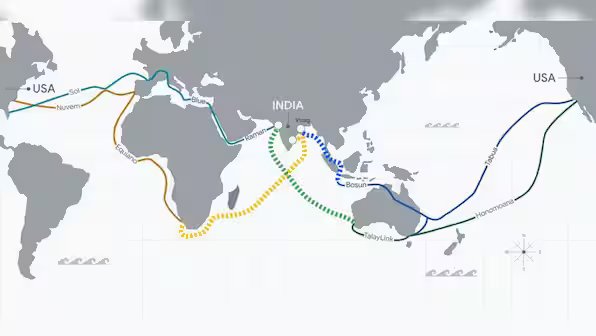
Google has rolled out a major global digital infrastructure programme that aims to reshape how high-volume data traffic moves between India, the United States, and large parts of the Southern Hemisphere as artificial intelligence becomes increasingly embedded in major economies.
The announcement was made by
Sundar Pichai in New Delhi on Wednesday (February 18, 2026), as India hosts the prominent artificial intelligence India AI Impact 2026 summit in the national capital.
The project, officially named the India-America Connect Initiative, is anchored in Google’s five-year, $15 billion investment plan focused on building AI infrastructure in India.
What did Pichai announce in New Delhi?
At the event, Pichai formally introduced the India-America Connect Initiative and positioned it as a foundational layer for scaling AI connectivity between India, the US, and multiple international destinations across the Southern Hemisphere.
“Today, we are announcing the India-America Connect Initiative, which will deliver new sub-sea cable routes to increase AI connectivity between India and the US and multiple locations across the southern hemisphere. For the opportunities this initiative creates, we should also invest in skilling, which is why we are announcing our most ambitious skilling programs here. This includes a new Google AI Professional Certificate program to master AI in their work,” he said.
#WATCH | Delhi | At a Google event, CEO Sundar Pichai says, “Today, we are announcing the India-America Connect Initiative, which will deliver new sub-sea cable routes to increase AI connectivity between India and the US and multiple locations across the southern hemisphere. For… pic.twitter.com/JhAdnsh58r
— ANI (@ANI) February 18, 2026
He described India’s position in the AI ecosystem as one that is set for rapid growth, stating that the country is on an “extraordinary trajectory” in artificial intelligence.
Placing the technology in a broader global context, Pichai said, “AI is the biggest platform shift of our lifetime,” and linked its capabilities to large-scale applications ranging from medical diagnostics to agricultural advisories delivered in real time.
Pichai also pointed to structural factors within India that make it well suited for large-scale digital innovation, citing the country’s linguistic diversity, its expansive digital public infrastructure, and the scale of its user base as elements that together form a strong base for building and deploying AI tools.
He added that the approach to adoption must be shaped by accountability and inclusion, stating, “AI must work across languages and local contexts. It must deliver real-world benefits people can rely on. Trust grows when technology is transparent, responsible, and grounded in outcomes.”
What exactly is the India-America Connect Initiative?
The India-America Connect Initiative is structured as a global digital infrastructure programme aimed at expanding high-capacity data networks between India, the United States, and multiple regions across Africa, Asia-Pacific, and the broader Southern Hemisphere.
The project is anchored in Google’s planned $15 billion AI infrastructure investment in India over five years and is designed to improve network reach, stability, and redundancy through a combination of subsea cables, terrestrial fibre routes, and international cable landing stations.
As part of the initiative, Google has committed to developing three new undersea cable corridors that will directly link India with Singapore, South Africa,
and Australia.
In parallel, four strategic fibre-optic routes are being planned to enhance capacity and resilience between the United States and India, while also strengthening links with multiple Southern Hemisphere locations.
These routes are intended to support large-scale data flows associated with cloud computing and AI workloads, which require high-bandwidth, low-latency connections.
The infrastructure plan also reflects an effort to geographically diversify India’s international connectivity.
By expanding landing points and creating alternative routes, Google aims to strengthen the resilience of India’s digital backbone and reduce risks associated with heavy dependence on a limited number of coastal hubs.
Why is Visakhapatnam being positioned as a new gateway?
A central feature of the initiative is the creation of a new international subsea gateway in Visakhapatnam (Vizag) on India’s eastern seaboard.
This move is intended to expand India’s international cable landing capacity beyond the existing concentration of infrastructure in Mumbai and Chennai.
Google is developing a direct fibre-optic route linking Visakhapatnam and Chennai, which will extend toward South Africa.
When combined with the Equiano and Nuvem subsea cable systems, this pathway will form a high-capacity route connecting the American east coast to India via Africa.
In addition, a separate direct link is being built between Visakhapatnam and Singapore. When integrated with the Bosun and Tabua subsea cable systems, this route will create a South Pacific digital corridor connecting the American west coast through Australia to India’s east coast.
These routes are designed to establish Visakhapatnam as a major international landing hub, adding geographic diversity to India’s subsea infrastructure and strengthening the resilience of the country’s international data links.
According to Google, the addition of a new gateway on the east coast is intended to enhance network redundancy for a population exceeding one billion people and contribute to improved digital reliability and economic security.
How is India’s west coast connectivity being strengthened?
Alongside the east coast buildout, Google is constructing a direct fibre-optic path between Mumbai and Western Australia.
This route will integrate with the TalayLink and Honomoana subsea cable systems, creating a South Pacific corridor that links the American west coast to India via Australia.
This west coast pathway will complement existing subsea infrastructure, including the Blue, Raman, and Sol cable systems, which together form a data corridor running from the American east coast through the Red Sea to Mumbai.
By adding new terrestrial and subsea connections, Google is expanding the number of available routes for international data traffic, thereby improving redundancy and increasing overall capacity between India and global digital networks.
How does this infrastructure tie into closing the AI divide?
Google has linked the infrastructure expansion to broader concerns about unequal access to digital resources as AI adoption accelerates. The company has stated that dependable connectivity plays a key role in preventing disparities in access to advanced technologies.
It has pointed to evidence that expanded subsea connectivity improves service reliability and affordability, while also supporting productivity gains and long-term economic growth.
The company has framed the new routes as part of a broader effort to transform traditional maritime trade corridors between the “New World” and India into digital trade pathways that bring economies closer through high-speed data exchange.
The initiative also builds on Google’s ongoing work with regional partners across Africa, Australia, and the Pacific to expand access to AI-enabled services.
Where do govt platforms come in?
Alongside the physical network buildout, Google is coupling infrastructure investments with digital skills programmes to support the practical use of AI tools.
Pichai announced expanded skilling efforts in India, including the launch of a new Google AI Professional Certificate aimed at enabling individuals to apply AI in their professional work.
The company is also collaborating with Karmayogi Bharat and Google Cloud to support Mission Karmayogi, which focuses on building digital capacity across India’s civil services.
As the primary cloud partner, Google Cloud provides secure and resilient infrastructure for the iGOT (Integrated Government Online Training) Karmayogi platform, which serves more than 20 million public servants across over 800 districts.
The platform is being supported with scalable infrastructure to ensure reliable access to training services at scale.
In addition, AI tools are being used to improve how learning content is accessed and utilised on the iGOT platform.
This includes digitising and structuring legacy training repositories into searchable knowledge assets and progressively enabling content in more than 18 Indian languages, allowing officials to access professional development resources in their preferred language.
Also Watch:
End of Article