Tensions in the United States have reached a boiling point following a series of shootings involving agents from the Immigration and Customs Enforcement (ICE), the federal agency tasked with enforcing US immigration laws.
The
fatal shooting of a Minnesota woman by an ICE officer, followed by another shooting in Oregon, has put the agency under the lens as it enjoys strong support from President Donald Trump and his administration.
These incidents have resulted in nationwide demonstrations, especially as federal deployments increase across Democratic-led cities.
What is ICE and how did it come into existence?
Immigration and Customs Enforcement, widely known as ICE, was established in 2003 as part of a sweeping overhaul of US homeland security in the aftermath of the September 11, 2001 terrorist attacks.
The agency was created to strengthen national security by consolidating immigration enforcement and investigative functions under the newly formed Department of Homeland Security (DHS).
ICE is responsible for investigating violations of federal laws related to border security, immigration, and cross-border crime. It also conducts operations to remove people who are in the United States without legal authorisation.
According to its mission, the agency focuses on identifying individuals who pose risks to public safety and those who, in its words, “undermine the integrity” of the immigration system.
The agency employs more than 20,000 law enforcement officers and support staff across the country. ICE is currently led by Director Todd Lyons, who was appointed in March 2025 by the Trump administration.
Although ICE has operated for more than two decades, its presence has become more visible in recent years due to a sharp rise in enforcement activity, particularly during Trump’s second term in office.
Immigration raids, arrests, and deportation operations have expanded significantly as part of the administration’s commitment to intensifying immigration control nationwide.
What legal authority do ICE officers have?
ICE agents operate as federal law enforcement officers and are not required to obtain judicial warrants to make arrests.
Like other officers, they can approach individuals, initiate questioning, and briefly detain non-citizens when there is reasonable suspicion that they are in the country illegally.
They also have the power to arrest individuals believed to be violating immigration laws and can detain and search people at US border crossings.
Data from 2025 shows that 66,886 people were held in ICE detention facilities during the year. The agency also carried out 527,459 enforcement and removal arrests.
Information compiled by TRAC Immigration indicates that as of November 30, 2025, 73.6 per cent of detainees had no criminal convictions.
Because ICE is part of the DHS, its officers operate independently of state and local governments. This federal authority means that governors, mayors, and state officials have no direct control over ICE’s activities, even when enforcement actions take place within their jurisdictions.
In Minnesota, both Governor Tim Walz and Minneapolis Mayor Jacob Frey have publicly criticised recent ICE operations and shootings, but neither has the authority to oversee or halt the agency’s actions in the state.
However, governors do retain control over their state’s National Guard units and can deploy them if civil unrest threatens public safety.
How has ICE’s role expanded under Trump?
Since returning to office, Trump has significantly expanded ICE’s authority and operational reach, fulfilling his campaign promise to create “the largest deportation programme in American history.”
While ICE continues to conduct routine enforcement operations similar to those under previous administrations, the scope and intensity of its activities have increased.
In July last year, the Trump administration granted ICE “total authorisation” to take whatever actions it considers necessary “to protect itself.” This directive widened the agency’s discretion during enforcement operations.
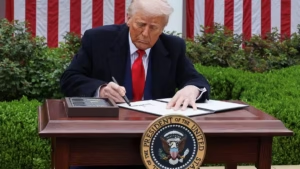
On January 20, 2025, Trump signed an executive order redefining the mission of Homeland Security Investigations (HSI), a division within ICE that traditionally focused on crimes such as human trafficking, child exploitation, and antiquities fraud.
Under the new directive, enforcing immigration laws and targeting “the illegal entry and unlawful presence of aliens” became its primary responsibility.
The administration has also encouraged ICE to be more visible in publicising its enforcement efforts. The agency regularly posts updates on social media detailing arrest numbers, along with the names and images of people taken into custody.
White House Deputy Chief of Staff Stephen Miller has said the administration wants each of ICE’s 25 field offices to make at least 75 arrests per day, “but hopefully many more.”
This expanded federal presence has been particularly noticeable in Democratic-led cities, where ICE officers have been deployed in large numbers as part of what the administration has described as the “largest DHS operation ever.”
What happened in the Minneapolis shooting?
Public scrutiny intensified after the fatal shooting of 37-year-old Renee Nichole Good in Minneapolis by
ICE officer Jonathan Ross. Good, a US citizen, was reportedly participating in a “neighbourhood patrol” that monitors ICE activity, according to one activist.
Federal officials alleged that Good attempted to run over the officer with her vehicle. Supporters of Good, however, said they believed video footage showed her steering away from him.
The shooting occurred during a large-scale federal deployment of around 2,000 officers in the Minneapolis area.
The operation was part of Trump’s broader immigration crackdown and was also linked to a politically sensitive investigation into fraud allegations involving certain nonprofit groups in the Somali community.
In the aftermath, Minnesota officials complained they were denied access to evidence, case materials, and interviews related to the shooting.
DHS Secretary Kristi Noem stated that Minnesota authorities lacked jurisdiction over the case. As a result, the Minnesota Bureau of Criminal Apprehension withdrew from the investigation.
Governor Tim Walz
placed the state’s National Guard on alert amid fears of civil unrest. Hundreds of protesters gathered in Minneapolis, chanting “shame” and “murder” at armed and masked federal officers.
Some officers used tear gas and pepper balls to disperse the crowd. Walz had previously warned that increased ICE activity could lead to violence.
“We have been warning for weeks that the Trump administration’s dangerous and sensationalized operations are a threat to our public safety, that someone was going to get hurt,” he said.
He added that the situation reflects “the consequences of governance designed to generate fear.”
Are ICE agents immune to the law?
US Vice President JD Vance described Good’s death as a “tragedy of her own making,” claiming the ICE agent involved was “protected by absolute immunity” and “just doing his job.”
He repeatedly referred to the incident as an “attack” on law enforcement and said the officer deserved “a debt of gratitude.”
Vance also highlighted a previous case involving the same officer, who was dragged by a vehicle during an arrest in June 2025.
The officer suffered injuries to his arm and hand that required 33 stitches, according to court records. The driver in that case was convicted of assaulting a federal officer.
However, former Hennepin County attorney Michael Freeman strongly rejected Vance’s claim of immunity. “The vice president is wrong. There are claims in some cases of federal immunity. I do not believe that would apply in this case,” Freeman told CNN.
He added, “We have a rogue officer acting in a malicious way that killed a 37-year-old woman in cold blood. He had no reason to fear for his life. And I believe he will be prosecuted successfully in state court.”
Freeman also disputed the federal account of the incident, stating, “This idea that she weaponized her vehicle is ludicrous.”
At the same time, he acknowledged that further evidence could emerge, saying, “Now, I will say that all I have seen is what has been shown so far on the media, and every good law enforcement official and prosecutor knows that there’s lots of other pictures and witness statements, so it is premature to make a judgment.”
He concluded, “But from what I have seen so far, I believe he should be charged.”
What happened in the second shooting in Oregon?
Just a day after the Minneapolis shooting, another incident involving federal officers occurred in Portland, Oregon. The DHS said a US Border Patrol agent
shot and wounded a man and a woman after the driver, described as a suspected Venezuelan gang member, attempted to “weaponise” his vehicle and run over agents.
DHS said “an agent fired a defensive shot,” after which the driver and a passenger fled the scene. Portland police later found two gunshot victims around two miles away and transported them to hospital.
Local officials said they could not independently verify the federal government’s account of what happened.
Oregon Governor Tina Kotek criticised the Trump administration’s approach to immigration enforcement.
“When a president endorses tearing families apart and attempts to govern through fear and hate rather than shared values, you foster an environment of lawlessness and recklessness,” she said.
Democratic governors and mayors across the country have repeatedly called for the withdrawal of federal officers from their cities, arguing that aggressive enforcement operations increase tensions and endanger public safety.
Civil rights groups have also condemned what they describe as unnecessarily provocative tactics.
Is there a pattern emerging in these ICE encounters?
The fatal shooting of Renee Good is at least the fifth death linked to the immigration crackdown launched by the Trump administration last year.
In September 2025, ICE agents fatally shot Silvergio Villegas Gonzalez during a traffic stop in suburban Chicago. DHS alleged that Villegas Gonzalez, a 38-year-old cook from Mexico, attempted to evade arrest and dragged an officer with his vehicle.
Homeland Security said the officer opened fire out of fear for his life and was hospitalised for “serious injuries.” However, body camera footage from local police later showed the agent walking normally and referring to his injuries as “nothing major.”
Two additional deaths occurred when individuals were struck by vehicles while fleeing immigration authorities. Another fatal incident involved a California farmworker who fell from a greenhouse during an ICE raid and suffered a fatal neck injury.
No ICE officers or Border Patrol agents have been charged in any of these deaths.
A non-fatal shooting in Chicago last year also drew scrutiny. Marimar Martinez survived being shot five times by a Border Patrol agent but was charged with a felony after DHS accused her of trying to ram agents with her vehicle.
The case was later dismissed after video footage emerged that Martinez’s attorneys said showed an agent steering into her truck.
Why are people protesting against ICE?
After Good’s death,
hundreds of people protested in Minnesota, chanting “ICE out of Minnesota” and blowing whistles. Demonstrations have also occurred in other cities, reflecting broader dissatisfaction with the agency’s role in immigration enforcement.
The Abolish ICE movement gained momentum in 2018 during the Trump administration’s family separation policy, which allowed migrant children to be separated from their parents or guardians at the US-Mexico border.
Since then, large-scale ICE operations in cities such as Los Angeles and Chicago have frequently been met with protests.
Los Angeles Mayor Karen Bass previously condemned immigration raids, saying, “I am deeply angered by what has taken place. These tactics sow terror in our communities and disrupt basic principles of safety in our city. We will not stand for this.”
Critics argue that the administration’s emphasis on arrests and deportations has created fear within immigrant communities across the country.
With ICE aiming for thousands of arrests each week and expanding its presence in major cities, immigration enforcement has become a central political issue.
With inputs from agencies
End of Article