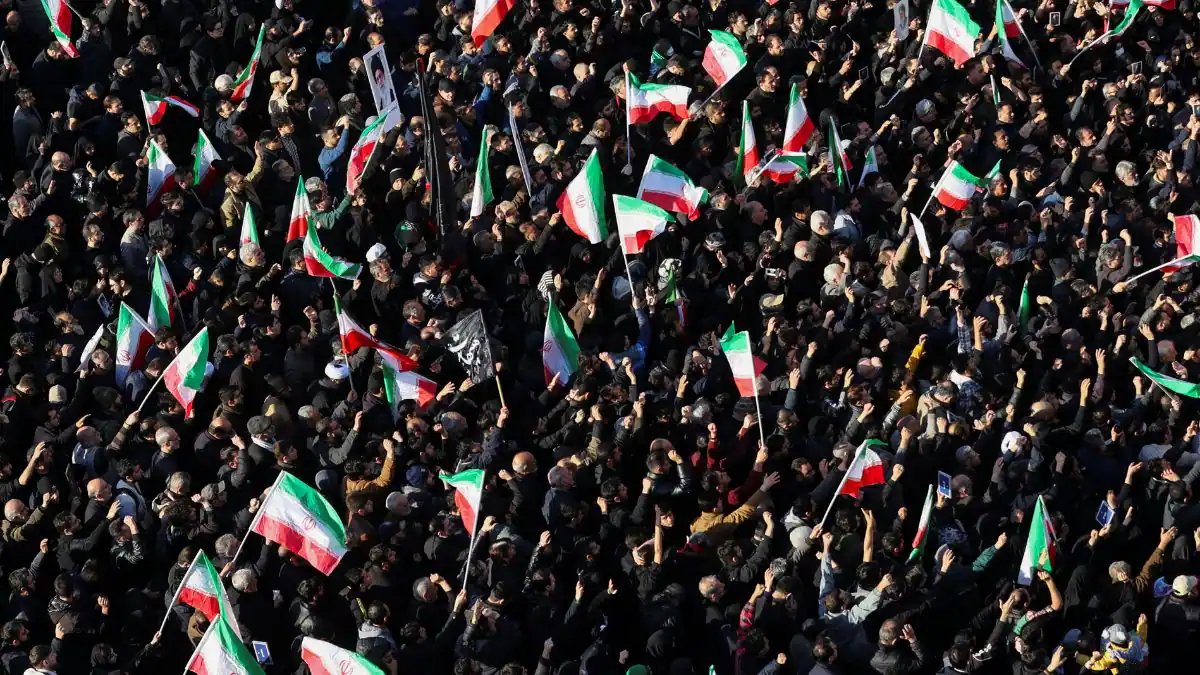
The confirmed killing of Iran’s Supreme Leader Ali Khamenei in coordinated United States and Israeli airstrikes has triggered the most serious rupture inside the Islamic Republic since its founding in 1979.
The death of the man who dominated Iran’s decision-making for more than three decades has changed power equations inside Tehran, and raised urgent questions about who controls the country’s vast military apparatus at a moment of open confrontation with Washington and Tel Aviv.
Iranian state media announced Khamenei’s death early Sunday. Reports also said that Khamenei’s body
had been located after one of the attacks, while US President Donald Trump confirmed American involvement in targeting the Iranian leader.
Tehran responded within hours by launching missile attacks against Israel and several other countries in the region that host American military facilities.
Trump warned Iran against escalating its military response in public messages posted on Truth Social after
Tehran acknowledged Khamenei’s killing and issued threats of further retaliation.
“Iran just stated that they are going to hit very hard today, harder than they have ever hit before,” he wrote. “THEY BETTER NOT DO THAT, HOWEVER, BECAUSE IF THEY DO, WE WILL HIT THEM WITH A FORCE THAT HAS NEVER BEEN SEEN BEFORE!” he wrote.
How big a void does Khamenei’s death leave?
The killing of Khamenei represents an unprecedented rupture within Iran’s political system.
Although Iran has an elected president, the office of the supreme leader sits at the apex of the state, exercising decisive influence over the military, judiciary, state media, intelligence agencies and key economic institutions.
The Islamic Republic has experienced only one previous transition of comparable magnitude, following the death of its founding leader Ayatollah Ruhollah Khomeini in 1989.
Since then, that power had been concentrated in Khamenei’s hands. His death therefore does not simply mark the loss of a head of state; it removes the central pillar holding together Iran’s clerical power structure.
Iranian law provides for a temporary leadership arrangement in such circumstances.
A
governing council has now been activated, composed of Iran’s sitting president Masoud Pezeshkian, judiciary chief Gholamhossein Mohseni Ejei, and a member of the Guardian Council selected by the Expediency Council.
This body is mandated to oversee the state while the Assembly of Experts begins the formal process of selecting a new supreme leader. The law states that the Assembly “must, as soon as possible,” appoint a successor.
However, the succession process has long been opaque, and
Khamenei’s death has left no clearly designated heir.
For several years, former president Ebrahim Raisi was widely viewed as the most likely successor, but he
was killed in a helicopter crash in 2024.
Since then, attention has turned to Khamenei’s son, Mojtaba Khamenei, a discreet figure believed to have exercised influence behind the scenes and to have been involved in managing aspects of his father’s wealth.
Despite speculation, Mojtaba is not the only figure reportedly under consideration. According to reports, Khamenei had identified three potential successors
during last year’s 12-day conflict, but their names have never been disclosed publicly.
Will the IRGC take over?
State media reported that Major General Mohammad Pakpour, who had recently assumed leadership of the Islamic Revolutionary Guard Corps (IRGC) after Israel killed its previous commander during last year’s 12-day war, was killed in the US-Israel airstrikes.
Iran’s army chief Abdolrahim Mousavi and the country’s Defence Minister Aziz Nasirzadeh has also been confirmed dead by state media.
Also reported dead was Ali Shamkhani, a long-standing figure within Iran’s national security architecture who had been wounded during the June conflict.
These losses have deepened instability within Iran’s military chain of command. The IRGC,
which has been declared a terrorist organisation by the West, plays a central role in both domestic security and regional military operations, including support for allied armed groups across the region.
But, American intelligence assessments cited by CNN before the strikes suggested that the most likely outcome of a leadership crisis in Iran would be the rise of hardline figures from the IRGC rather than a cleric with comparable religious authority to Khamenei.
In the immediate term, analysts believe that military figures may assert control to manage Iran’s armed response to the US-Israel campaign and to suppress any domestic unrest that could threaten regime stability.
Trump appeared to hint at a desired leadership transition resembling Venezuela’s political crisis, where an interim leader emerged in opposition to the existing government.
In a Truth Social post, he wrote, “Hopefully, the IRGC and Police will peacefully merge with the Iranian Patriots, and work together as a unit to bring back the Country to the Greatness it deserves.”
Such a scenario would likely consolidate power in the hands of hardline commanders and could entrench repression rather than reduce it.
The IRGC is structured as a parallel military force designed specifically to defend the Islamic Republic against both internal dissent and external threats.
It encompasses ground, air and naval units, internal security militias, and paramilitary formations, with nearly one million personnel under its command in various capacities. Its doctrine centres on confronting the United States and Israel.
Can the people of Iran challenge the regime again?
The political shock created by Khamenei’s killing comes against a backdrop of long-standing domestic unrest and economic hardship.
During his tenure, the Islamic Republic maintained strict controls over social and political life, with severe restrictions on personal freedoms, particularly for women and minority communities.
Dissent was frequently met with force, and periods of protest were followed by mass arrests and lethal crackdowns.
In recent months, nationwide demonstrations demanding systemic change had spread across Iran. Government forces responded with extensive violence. In December last year, security units
killed thousands of protesters and detained tens of thousands more.
Iran’s economy has been battered by years of international sanctions, disruptions to food and water distribution networks, and chronic shortages of essential goods.
Many Iranians face rising prices and declining living standards, deepening frustration with a leadership widely seen as prioritising ideological objectives over domestic welfare.
Trump has repeatedly called on Iranians to challenge their leadership, arguing that the current moment represents a rare opportunity for change.
In video comments announcing the strikes, he urged the population to act, saying, “When we are finished, take over your government. It will be yours to take,” and adding, “This will probably be your only chance for generations.”
He later described Khamenei as “one of the most evil people in history” and wrote, “This is the single greatest chance for the Iranian people to take back their Country.”
However, the prospect of mass mobilisation faces formidable obstacles. Iran’s internal security apparatus remains intact, and any attempt at widespread protest is likely to encounter violent repression.
With no organised opposition movement operating openly inside the country and no rival military force capable of challenging the IRGC, street protests alone may struggle to sustain momentum in the face of lethal force.
Can Reza Pahlavi come back to Iran?
Reza Pahlavi, the exiled son of Iran’s last monarch, released a statement on social media shortly after the strikes began, asserting that the Islamic Republic was in the process of collapse.
He praised Trump for what he described as a “humanitarian intervention” and later welcomed news of Khamenei’s death.
In an essay published in the Washington Post, Pahlavi elaborated on his position, thanking Trump for declaring to Iranians that “the hour of your freedom is at hand.”
He wrote that for nearly half a century the Islamic Republic had been “subverting neighbours’ sovereignty, fuelling conflicts around the world, and pursuing nuclear weapons and the long-range missiles to deliver them,” while committing its most severe abuses within Iran itself.
He also referenced “thousands of protesters who were killed during a crackdown on demonstrators in January” as evidence of the regime’s domestic record.
Pahlavi argued that any political transition should include the drafting of a new constitution approved by popular referendum, followed by free elections conducted with “international oversight.”
He framed the current moment as a historic turning point, writing, “History rarely announces its turning points in advance. But moments do come when courage, leadership and solidarity can change the course of nations.”
He also pointed out that external military action alone could not secure political change inside Iran. “However, despite the arrival of this assistance, the final victory will still be achieved by us,” he said.
“It is we, the people of Iran, who will finish this task in this final battle. The time to return to the streets is approaching.”
Despite his prominence in exile, the extent of Pahlavi’s support inside Iran remains uncertain.
Decades of repression have fragmented opposition networks, and there is no clear consensus among Iranians about alternative leadership models, including the prospect of restoring a constitutional monarchy.
Other opposition figures and groups have yet to coalesce around a single vision for the country’s future, complicating the prospect of a unified political transition.
Why did Trump decide to strike now?
The decision by Trump and Israeli Prime Minister Benjamin Netanyahu to target Iran’s supreme leader did mark a dramatic escalation in their confrontation with Tehran.
In the weeks leading up to the strikes, Trump
had repeatedly warned Tehran that the United States would protect protesters in Iran.
Failure to act, his allies argue, would have damaged his credibility and emboldened Tehran to increase repression. Trump has also cited years of attacks on Americans linked to Tehran-backed militias in Iraq as part of his rationale for confronting Iran directly.
Another factor has been past Israeli military operations which have significantly weakened Hamas and Hezbollah, groups long regarded by Tehran as strategic buffers against direct confrontation with Israel and the United States.
The erosion of these proxies has reduced Iran’s capacity to deter attacks on its own territory, contributing to the sense that the balance of power in the region has shifted.
Critics in the United States have described the strikes as unilateral and unconstitutional, arguing that they risk entangling Washington in another protracted conflict in the region.
Supporters counter that removing Iran’s top leadership could weaken the regime and open the door to change.
So, what next for Iran?
One potential outcome is that the clerical system survives under new leadership, reinforced by the IRGC and even more resistant to reform.
Another possibility is that central authority in Tehran weakens, leading to fragmentation of control over major cities and regions. In such a scenario, rival armed groups could establish competing power centres, increasing the risk of prolonged internal conflict and humanitarian crises.
Yet another scenario, however temporary, is the replacement of clerical leadership by hardline IRGC figures as the most likely near-term scenario. Such an outcome would preserve Iran’s adversarial stance toward the United States and Israel.
The absence of a supreme leader capable of restraining the military only complicates the picture more.
Analysts warn that there may now be no single authority within Iran empowered to halt retaliatory actions or impose limits on military operations. This may create the risk of sustained regional conflict even if political leaders seek de-escalation.
At home, any attempt by citizens to challenge the government is likely to encounter violent suppression by paramilitary forces tasked with defending the state.
Whether Khamenei’s death ultimately weakens Iran or hardens the Islamic Republic’s most authoritarian elements remains a leap in the dark for now.
Also Watch:
With inputs from agencies
End of Article