Has the viral video of a man brooming in front of a robot vacuum caught your attention? He is imitating curling, a popular Winter Olympics sport that goes viral every four years.
If you are active on social media, there’s a high chance you have seen the viral video of a man using a mop to guide a robot vacuum on the floor. The most famous post over that video reads just one word – Curling. For the unversed, curling is a team sport that is played on ice. And it goes viral every four years when the Winter Olympics come around.
Put simply, curlers use brooms to guide a stone across an ice sheet towards a target. In the viral video, the man does the same using a household broom, steering a robot vacuum that stands in for a granite curling stone.
Curling pic.twitter.com/ucbt6HjxyX
— Playteaux (@Playteaux1) February 9, 2026
Interestingly, curling as a sport is believed to be around 500 years old. Something similar to curling can be seen in the paintings from Flemish artist Pieter Bruegel, where a sport is being played on frozen ponds.
How old is curling and who founded it?
The first written evidence of curling comes from 1540, when it was mentioned in a book written by John McQuhin, a notary in Paisley, Scotland. The World Curling Federation, meanwhile, claims that the sport was played on frozen lochs and ponds in northern Europe from the very first.
But the sport started becoming popular when Scottish people migrated to different countries and introduced the sport to those regions.
Curling’s first codified set of rules emerged in Scotland in 1838, when they were formalised by the Grand Caledonian Curling Club, the organisation that went on to govern the sport. Five years later, the club received royal recognition and was renamed as the Royal Caledonian Curling Club after Queen Victoria developed an interest in curling following a demonstration at Scone Palace.
While teams from different countries had been competing against each other as early as the 19th century, curling’s official first match took place at the inaugural Winter Olympics in 1924 in Chamonix. Great Britain finished ahead of Sweden and host nation France, a tournament later acknowledged as the sport’s Olympic introduction.
Curling appeared intermittently at the Games over the decades, featuring as a demonstration sport in 1932, and again in 1988 and 1992, meaning medals were not on offer during those editions.
Full Olympic recognition finally arrived in 1992, when the International Olympic Committee approved medal events for both men’s and women’s curling. The sport made its permanent return to the Winter Olympics at Nagano 1998 and has remained part of the programme ever since.
Curling’s equipment and scoring rules
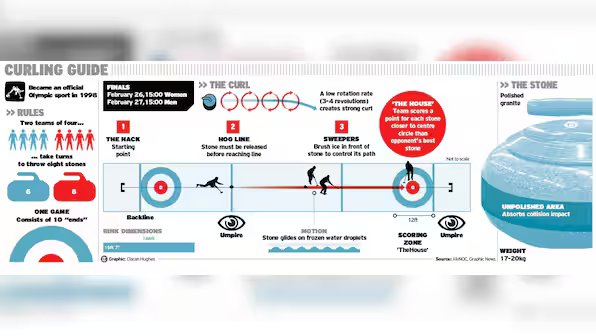
The most important equipment is the curling stone, which is made of granite and usually weighs 20 kgs. Each curler used a customised shoe. One of the shoe soles provides grip, while the other allows the curler to slide and guide the stone.
The curlers use a broom to sweep in front of the stone to warm the path, which guides the stone and also allows it to travel further. The sport is played on an ice sheet which is over 45 metres long and a maximum of five metres wide.
At both ends of the sheet, circular markings known as the house are painted onto the ice, resembling a bullseye. These rings serve as the reference point for judging how close each stone finishes to the centre.
After all stones in an end have been delivered, scoring is decided by proximity to the button. A team earns one point for every stone that lies inside or touches the house and sits closer to the centre than the nearest stone belonging to the opposition. Points in an end can only be claimed by one side; if neither team has a stone in the house, the end is recorded as a blank.
For a stone to remain valid, it must be released before crossing the hog line during delivery. Any stone let go too late is removed from play.
Matches are scheduled across 10 ends, with victory going to the team that accumulates the higher total score. While a team may choose to concede early, a full-length, top-level curling contest typically runs close to three hours.
What is the format in curling?
Curling is a team sport where typically four athletes are part of a team. It can be played in men’s, women’s or mixed format. Each curling team has a skip (a captain) and a vice-skip. The skip marshals the team with directions and stands near the house.
During a game, each player slides two consecutive stones, followed by two attempts for the opponent in each round, which is known as an end.
Each player is also assigned a pre-decided position – lead, second, third or fourth. The throwing order begins with the lead delivering the opening two stones, after which the second, third and fourth players take turns to release their pairs.
End of Article