Ghislaine Maxwell,
a former associate and partner of Jeffrey Epstein, is currently serving a 20-year federal prison sentence after being convicted in 2021 for her role in facilitating the sexual abuse of teenage girls.
During a closed-door US congressional deposition conducted via video link from a federal prison camp in Texas on Monday, she declined to respond to questions from the House Committee on Oversight and Government Reform, repeatedly invoking her Fifth Amendment right against self-incrimination.
Her decision drew criticism from both Republicans and Democrats on the committee, who said the hearing yielded no new testimony that could advance their investigation into how Epstein was able to operate for years while maintaining access to elite circles.
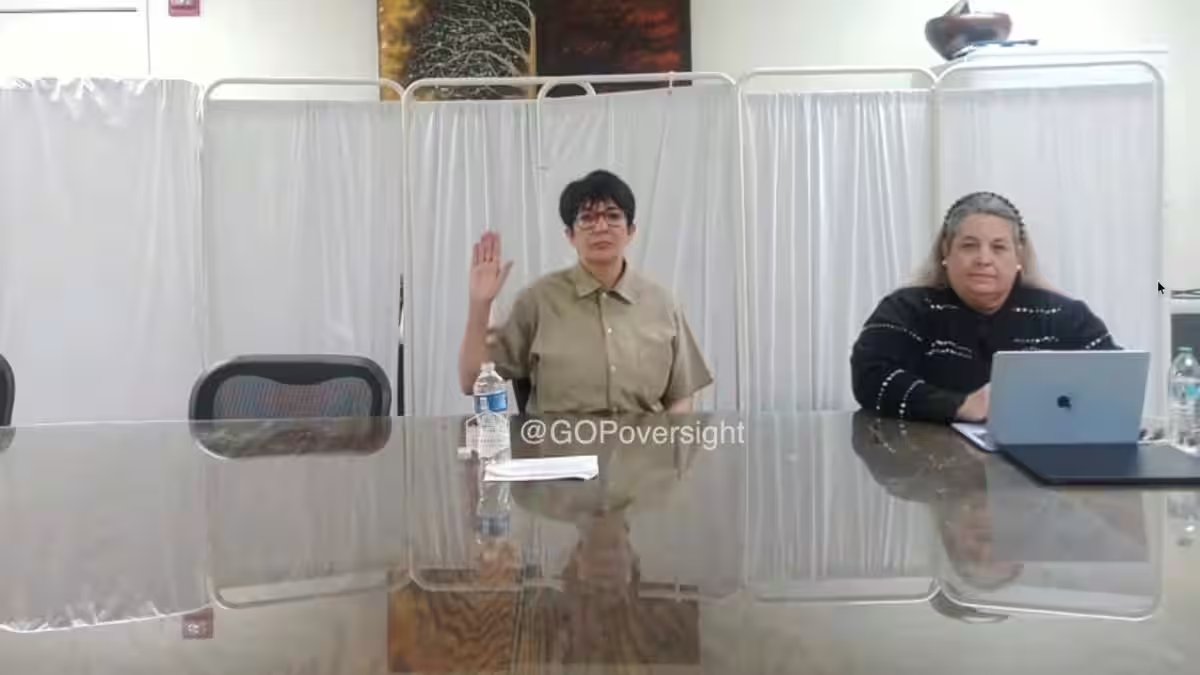
Video later released by the committee showed Maxwell seated at a conference table, dressed in a brown prison-issued uniform, with a bottle of water in front of her, as she repeatedly stated that she was asserting “my Fifth Amendment right to silence.”
The Fifth Amendment: What it protects and how it works
Ratified in 1791 as part of the Bill of Rights, the Fifth Amendment contains five distinct guarantees, including the requirement for grand jury indictments in serious criminal cases, protection against double jeopardy, due process rights, limitations on government seizure of private property, and the privilege against self-incrimination.
It is this last protection that Maxwell relied upon during her deposition.
The privilege against self-incrimination allows a witness to refuse to answer questions when truthful responses could contribute to their own criminal exposure.
Courts have long recognised that testimony does not need to amount to a direct confession to trigger this protection; even statements that could serve as a “link in the chain” of evidence may qualify.
Legal doctrine describes the Fifth Amendment as shielding individuals from what has been termed the “cruel trilemma” — the forced choice between lying under oath, refusing to answer and facing punishment, or providing information that could lead to prosecution.
Invoking the Fifth is not an all-encompassing silence.
Witnesses generally must assert the privilege in response to specific questions. Routine or non-incriminating inquiries, such as identifying oneself, typically do not qualify unless the information itself carries criminal implications.
The legal consequences of invoking the Fifth also vary depending on the setting. In criminal trials, juries are explicitly instructed that no adverse inference can be drawn from a defendant’s silence.
Civil proceedings, by contrast, may allow judges or juries to interpret a refusal to testify negatively.
Congressional hearings fall into a separate category altogether. While invoking the Fifth carries no automatic legal penalty in such forums, there are no formal restrictions preventing lawmakers or the public from forming their own conclusions.
As of 2026, the United States Supreme Court continues to require that Fifth Amendment protections be invoked clearly and explicitly. Remaining silent without asserting the right is generally insufficient under existing case law.
How the committee reacted to Maxwell’s ’testimony’
Committee chairman James Comer said the deposition fell far short of expectations. “This is obviously very disappointing. We had many questions to ask about the crimes she and Epstein committed, as well as questions about potential co-conspirators,” he told reporters after the session concluded.
Democratic members echoed that frustration while accusing Maxwell of attempting to use the congressional forum to advance her own legal interests rather than cooperate with investigators.
US Representative James Walkinshaw of Virginia said, “What we did not get were any substantive answers to the questions that were asked that would advance our investigation.”
He characterised Maxwell’s conduct as part of a broader strategy aimed at securing presidential intervention. “What we did get was another episode in her long-running campaign for clemency from President Trump. And President Trump could end that today – he could rule out clemency for Ghislaine Maxwell, the monster.”
US Representative Melanie Stansbury, a Democrat from New Mexico, offered a similar assessment, saying, “It’s very clear she’s campaigning for clemency.”
Republican lawmakers also rejected the idea outright. US Representative Anna Paulina Luna responded publicly after the deposition, writing on social media, “NO CLEMENCY. You comply or face punishment,” followed by, “You deserve JUSTICE for what you did you monster.”
What Maxwell’s legal team has said
Maxwell’s attorney, David Oscar Markus, made clear that her refusal to testify was rooted in ongoing legal challenges to her conviction. He told lawmakers that she has a pending habeas petition arguing that her trial was constitutionally flawed.
In a statement posted on X and submitted to the committee, Markus said he advised Maxwell to invoke the Fifth Amendment because the petition “demonstrates that her conviction rests on a fundamentally unfair trial.”
He also
linked Maxwell’s willingness to testify to the prospect of presidential clemency.
“If this Committee and the American public truly want to hear the unfiltered truth about what happened, there is a straightforward path. Ms. Maxwell is prepared to speak fully and honestly if granted clemency by President Trump,” Markus wrote.
In separate remarks, he asserted that both Trump and former US President Bill Clinton were not involved in wrongdoing related to Epstein. He stated that Trump and Clinton “are innocent of any wrongdoing,” and added that “Ms. Maxwell alone can explain why, and the public is entitled to that explanation.”
The White House, when questioned about Maxwell’s appeal, pointed reporters to earlier statements from Trump indicating that a pardon or commutation was not under active consideration.
Maxwell’s legal efforts extend beyond clemency. She has continued to challenge her conviction through the courts, arguing that she was wrongfully convicted.
While the Supreme Court rejected her appeal last year, her legal team submitted a new request in December asking a federal judge in New York to review what they described as substantial new evidence suggesting constitutional violations during her trial.
What next for Maxwell and Epstein files
The deposition took place amid the US Justice Department’s release of millions of internal Epstein-related records, following legislation passed by Congress last year mandating public disclosure.
The release has become a major point of contention, with lawmakers and victims’ advocates raising concerns over how the documents were handled.
As part of an agreement with the Justice Department, members of Congress were granted access to more than three million unredacted files in a secure reading room at a Washington office.
Lawmakers were limited to four computers, prohibited from bringing staff, and allowed only handwritten notes.
US Representative Jamie Raskin, the senior Democrat on the House Judiciary Committee, spent several hours reviewing the documents and said the scope of the material made comprehensive analysis daunting.
He told reporters that even if lawmakers devoted all their time to the task, “it would still take us months to get through all of those documents.”
Raskin and other Democrats criticised the Justice Department for failing to adequately protect victims’ identities, including the inadvertent release of nude photographs.
Jennifer Freeman, an attorney representing survivors, said, “Over and over we begged them, please be careful, please be more careful. The damage has already been done. It feels incompetent, it feels intimidating and it feels intentional.”
Democrats also accused the department of continuing to withhold information that could shed light on Epstein’s associates.
US Republican Representative Thomas Massie, who sponsored the disclosure legislation, said that after reviewing the unredacted files, he identified six men “that are likely incriminated by their inclusion.”
Massie said he believed those individuals should face accountability and noted that he could potentially name them during a speech on the House floor, where constitutional protections would shield him from legal action.
Massie and Democratic Representative Ro Khanna also said some records remained partially obscured, likely because the FBI provided redacted versions to the Justice Department.
Khanna said the files reinforced the conclusion that “it wasn’t just Epstein and Maxwell” who were involved in the abuse of underage girls.
The document release has triggered political fallout across the Atlantic as well, including
in the United Kingdom, where Prime Minister Keir Starmer has faced pressure following revelations that a former British ambassador to Washington had maintained close ties with Epstein.
Raskin warned that despite the scale of the scandal, accountability for US political figures remained elusive.
“I’m just afraid that the general worsening and degradation of American life has somehow conditioned people not to take this as seriously as we should be taking it,” he said.
Also Watch:
With inputs from agencies
End of Article