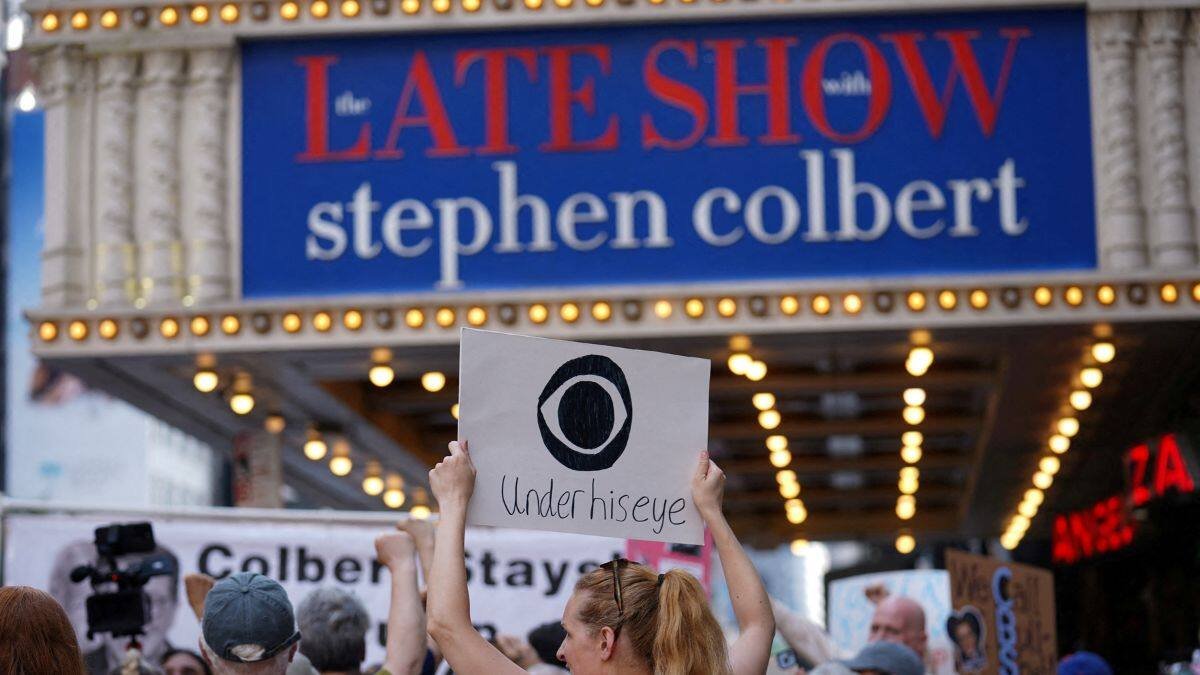
A public confrontation between Stephen Colbert and his network, CBS, has put the spotlight on shifting federal regulatory guidance during the second term of United States President Donald Trump.
The dispute revolves around CBS’ decision not to air Colbert’s interview with Texas Democrat James Talarico, who is seeking his party’s nomination for the US Senate.
While CBS insists its lawyers merely flagged potential legal exposure, Colbert has framed the move as part of a broader effort to restrict critical political speech on television.
What happened?
Colbert disclosed on air that CBS attorneys advised against broadcasting the Talarico interview, warning that featuring a declared political candidate could obligate the network to provide equivalent airtime to rival contenders under federal equal-time requirements.
He said the network’s legal team conveyed the instruction forcefully, leaving no room for negotiation about whether the segment could air on television.
Despite the broadcast ban, Colbert proceeded with a lengthy recorded conversation with Talarico and released the full exchange on YouTube, which is not subject to the same equal-time obligations that govern licensed broadcasters.
The move allowed the content to reach viewers while avoiding regulatory exposure for the network. Within days, the online Talarico interview amassed millions of views on YouTube, exceeding the nightly audience typically drawn by Colbert’s television broadcast.
By Wednesday morning following its release, the interview had crossed the five-million-view mark. Talarico reported that his campaign raised $2.5 million in the 24 hours after the interview went live online.
Colbert also told his audience that he had initially been informed he should not even acknowledge on air that the interview had been blocked.
“Then I was told, in some uncertain terms, that not only could I not have him on. I could not mention me not having him on,” Colbert said. “And because my network clearly doesn’t want us to talk about this, let’s talk about this.”
CBS countered that Colbert’s description overstated the network’s actions. The company said its lawyers offered legal advice indicating that televising the interview could trigger equal-time obligations for other candidates, including Jasmine Crockett, and outlined options for how such requirements could be met.
The network stated that the programme chose to publish the interview online with promotional mentions on air rather than navigate the regulatory complications of equal-time provisions.
Colbert later criticised the network publicly after CBS issued a statement disputing his characterisation of events. On his next broadcast, he theatrically discarded a copy of the statement, expressing frustration that the company appeared unwilling to challenge what he described as intimidation.
“We looked and we can’t find one example of this rule being enforced for any talk show interview, not only for my entire late-night career, but for anyone’s late-night career going back to the 1960s,” Colbert said.
He added that while
FCC Chairman Brendan Carr had discussed eliminating exemptions for late-night programmes, no formal revocation had occurred. “But CBS generously did it for him,” Colbert said.
Colbert also sought to distance himself from any suggestion of personal animus toward his employer, saying, “I don’t know what this is about. For the record, I’m not even mad. I really don’t want an adversarial relationship with the network. I’ve never had one.”
He added that he was troubled by what he perceived as a failure by a major media corporation to resist pressure. “I was just so surprised that this giant global corporation would not stand up to these bullies,” he said.
What do FCC guidelines say?
For decades, broadcasters have relied on a regulatory carve-out that treated certain interviews as legitimate news content, exempting them from equal-time requirements that otherwise mandate comparable airtime for opposing candidates.
That understanding traces back to rulings dating to the mid-2000s, when the FCC’s Media Bureau allowed late-night interview segments to qualify for the exemption.
Under the Trump administration, however, the FCC has signalled a narrower interpretation. In January, the agency issued guidance warning that late-night and daytime talk programmes may no longer automatically qualify as “bona fide news” interviews.
Carr has questioned whether such shows are driven by partisan motives, arguing that the exemption may be misapplied.
The FCC also announced that it was opening an inquiry into whether ABC’s daytime programme The View violated equal-time obligations following appearances by political candidates, including Talarico.
Colbert argued that CBS pre-emptively adopted the most restrictive interpretation of the guidance.
He accused the network of acting primarily out of financial caution, given the business interests of its parent company, Paramount Global, which is pursuing regulatory approvals linked to corporate transactions, including
a proposed deal involving Skydance Media and
a separate effort to acquire Warner Bros Discovery.
Democratic FCC Commissioner Anna Gomez publicly criticised CBS’ decision, asserting that the FCC lacks lawful authority to coerce broadcasters into suppressing political speech. She described the network’s move as censorship and warned against conflating corporate regulatory interests with editorial judgement.
“This is yet another troubling example of corporate capitulation in the face of this administration’s broader campaign to censor and control speech,” Gomez said.
“It is no secret that Paramount, CBS’s parent company, has regulatory matters before the government, but corporate interests cannot justify retreating from airing newsworthy content.”
What is happening in the Texas primaries?
The timing of the interview dispute coincided with the opening of early voting in Texas, where both parties are locked in competitive Senate primaries.
On the Democratic side, Talarico and Crockett are vying to avoid a runoff by securing more than 50 percent of the vote in the March 3 primary. Both candidates have built national followings through viral online clips and frequent appearances on major talk shows.
Talarico used social media to amplify the blocked interview, posting a short clip and framing the incident as politically motivated.
During a news conference in Austin after casting his early vote, he said, “The administration was playing politics and was trying to control what a late-night show puts on air, something that’s never been done before.” He added: “The executives at CBS were willing to go along with it.”
Crockett expressed scepticism about the episode, questioning the intensity of the reaction on the first day of early voting and suggesting the situation felt unusually timed. She also noted that Colbert could have mitigated regulatory concerns by offering her airtime, as he had done previously.
Speaking to reporters after voting early in Dallas, she said, “I’ve done Colbert a number of times. I’ve done ‘The View’ a number of times. I’ve done (Jimmy) Kimmel a number (of times). I’ve done all of these shows a number of times.”
On the Republican side, the primary contest features Senator John Cornyn, Texas Attorney General Ken Paxton, and Representative Wesley Hunt. Paxton intensified his previously restrained campaign with a rally in Tyler, while Cornyn held a competing event in Austin.
Hunt released a new television advertisement seeking to position himself as an alternative to Cornyn without alienating voters wary of Paxton’s legal controversies.
The Republican contest has drawn attention in Washington, where party leaders fear Paxton would be a costly nominee to defend in a general election despite Texas’ recent voting patterns.
Cornyn highlighted those concerns during his Austin rally, warning that nominating Paxton would burden down-ballot candidates. “We’ll pay the price of having an albatross like our corrupt attorney general around their neck,” he said.
Campaign spending has surged, with Cornyn and allied groups reportedly pouring tens of millions of dollars into television advertising.
Paxton has countered with ads featuring appearances alongside Trump, while Hunt’s campaign has attempted to carve out space between the two rivals. As of the reporting period, Trump had not endorsed any candidate in the Texas race.
What next for Colbert and US regulators?
The dispute over the Talarico interview comes as
Colbert approaches the final months of his tenure at CBS.
The network announced last year that The Late Show with Stephen Colbert would end in May, citing financial considerations as the rationale for shuttering a long-running late-night institution.
The timing of that decision, however, drew scrutiny after Colbert criticised a settlement involving Trump and Paramount Global related to a “60 Minutes” story just days before the cancellation was revealed. Two US senators publicly questioned whether the move was influenced by political considerations.
Colbert has been one of Trump’s most persistent late-night critics, and the president has repeatedly urged Carr to pursue enforcement actions against broadcasters he views as biased.
Carr’s earlier pressure campaign against networks over Jimmy Kimmel in September prompted warnings about potential fines and licence revocations, leading some broadcasters to temporarily pull Kimmel off the air.
Disney briefly suspended Kimmel before restoring his programme amid public backlash.
In December, Democratic Senator Tammy Baldwin of Wisconsin criticised Carr’s actions, telling him, “you used your position within the federal government to take Jimmy Kimmel off the air in a clear attempt to chill free speech.”
That episode has since been cited by media executives as evidence of heightened regulatory risk for politically charged content.
Colbert’s confrontation with CBS also echoes last autumn’s controversy when
ABC removed Kimmel following remarks about the killing of conservative activist founder Charlie Kirk, only to reinstate him after viewers and free speech advocates objected.
With inputs from agencies
End of Article