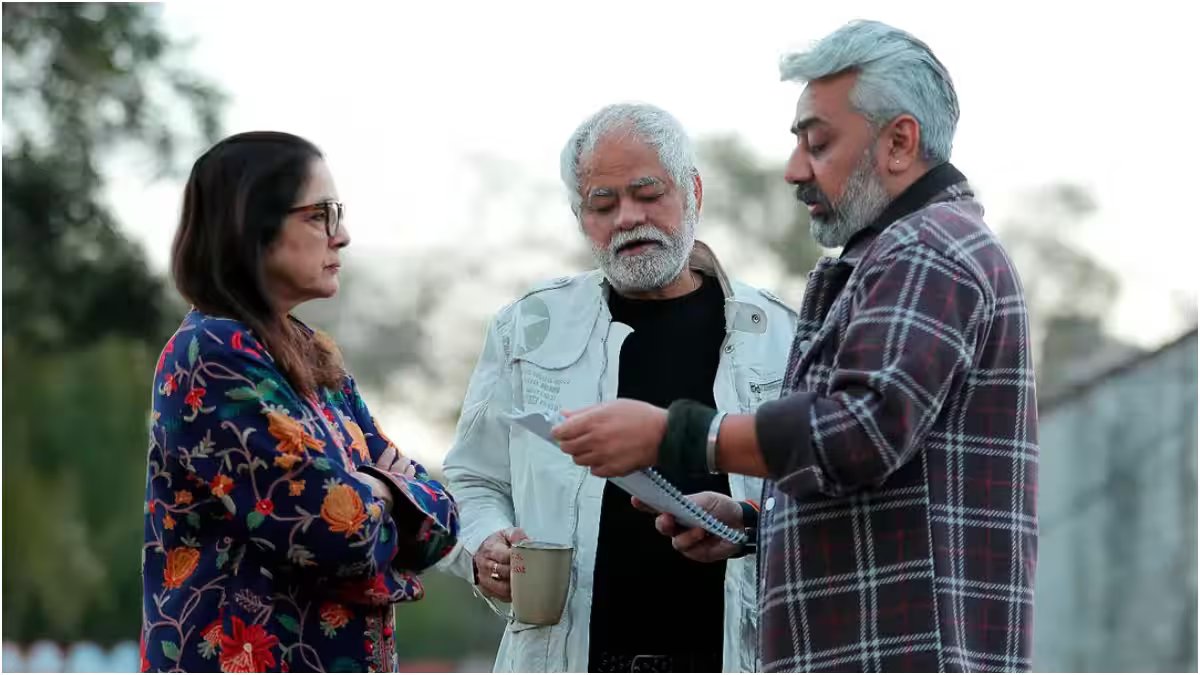
When Vadh released in theatres in the uneasy months following the pandemic, it arrived quietly, even cautiously. Cinemas were reopening, audiences were hesitant, and the fear of mass gatherings still lingered. Yet the Sanjay Mishra–Neena Gupta-led thriller went on to find its audience, slowly but decisively. That response, director and writer Jaspal Singh Sandhu says, laid the foundation for Vadh 2.
Speaking exclusively to Firstpost’s Zinia Bandyopadhyay, Sandhu reflects on why the sequel is not just a continuation, but an evolution, shaped by changing audience tastes, world cinema influences, and the responsibility that comes with unexpected success.
‘Entertainment Is Not One Genre’
Sandhu is clear that
_Vadh 2_ was never conceived as a compromise to market trends or spectacle-driven cinema.
“
_Vadh_ was also a theatrical release. It was never made for OTT,” he stresses. “I genuinely believe there is space and a target audience for every kind of film. Entertainment doesn’t mean only action. Some people find it in thrillers, some in horror, some in drama or tragedy.”
He points to Malayalam cinema as a key example. “Malayalam thrillers are watched so widely, even without action. It’s the writing, the performances, the content that people talk about. Today, world cinema is in front of everyone. Korean, Iranian films, none of them rely on larger-than-life action, yet people praise and watch them.”
For Sandhu, backing Vadh 2 was not a gamble. “It’s not an experiment. It’s an educated call.”
The Baggage of a Successful First Film
With
appreciation for _Vadh_ came pressure. Sandhu acknowledges that the sequel carried expectations, but he reframes it as responsibility rather than burden.
“There was definitely baggage,” he admits. “For me, the second part should always be better than the first. It has to be different.”
Initially, Sandhu spent months writing a direct continuation, exploring the open-ended finale of Vadh. But the idea did not excite him enough. What did was the possibility of reinvention.
“I got a little greedy as a director,” he laughs. “If I keep the same world, the same treatment, the same actors, but give them completely new characters and layer a different story, how much fun would that be?”
That decision also solved a moral dilemma. “If the same characters did Vadh again, people would start becoming serial killers,” he jokes. “So this had to be a new story.”
Why Vadh 2 Is an Emotion, Not Just a Title
The title Vadh itself emerged organically. Sandhu recalls that the working title was Gwalior, where the film was shot. It was producer Love Ranjan who pointed out that the word already existed within the film’s dialogue.
“Once Vadh happened, the name became an emotion,” Sandhu says. “Vadh 2 carries responsibility, yes, but it also promises something new.”
The IFFI Moment That Reassured Him
One of the most validating moments for Sandhu came during Vadh 2’s screening at the International Film Festival of India.
“I didn’t watch the film like a viewer,” he recalls. “I was sitting at the back, watching people.”
The screening had no interval, yet people stood through the film. “I was not waiting for that one person to clap so the rest would follow. Then, it would not have been successful. But the moment the film ended, everyone clapped together. That’s when I knew [the film will be successful].”
Without even a formal Q&A, audience members stayed back to discuss the film. “That reassured me that we were doing something right.”
Writing Vadh 2: From Linear to Layered
As a writer, Vadh 2 posed a completely different challenge.
“Vadh was very linear. Cause and effect,” Sandhu explains. “Vadh 2 has many characters and a non-linear narrative.”
Inspired by real-life personalities, Sandhu found the biggest challenge was balance. “How much weight do you give to each character in a two-hour narrative? That was tough.”
Multiple narrations and rewrites helped crack the structure. “By the third or fourth narration, when the weight distribution finally felt right, I knew the script worked.”
Working with a Powerhouse Ensemble
With an ensemble cast featuring veterans and newcomers, Sandhu relied on trust rather than table reads.
“I don’t do readings,” he reveals. “I sit individually with actors and discuss their characters.”
Once that trust is established, he says, senior actors surrender fully to the process. “They give you a one-plus. That’s when magic happens.”
The Biggest Risk: Being Better Than Vadh
For Sandhu, the biggest risk was not financial, but creative.
“My biggest risk was whether people would say Vadh 2 is made differently and that it’s better than Vadh.”
He likens filmmaking to probability. “If you wear a seatbelt, you increase your chances of survival. There’s no guarantee. But discipline, preparation and control minimise risks.”
With months of preparation, Sandhu believes the film stayed firmly under control.
A Non-Linear Shoot for a Non-Linear Story
The shoot itself mirrored the complexity of the script.
“The narrative is non-linear, and so was the shoot,” he says. “Every character is hiding something at some point. Managing silent expressions across multiple characters was the biggest challenge.”
‘Every Character Has Done It Beautifully’
As the conversation ends, Sandhu becomes visibly emotional about his cast.
“I always say Sanjay Mishra is my Anthony Hopkins,” he says. “The shades Neena ma’am brings, what Sanjay sir does, the work by Shilpa Shukla, Yogita, and the newcomers Akshay and Amit, it’s incredible.” “After every scene,” he adds, “I felt like all the sadness had gone.”
For Sandhu, Vadh 2 is not just a sequel. It is a reaffirmation that thrillers driven by writing, performance and restraint still have a place on the big screen, and perhaps, now more than ever.
End of Article