The United States trade deficit widened sharply in December, rising nearly 33% to $70.3 billion and marking the second consecutive monthly increase, according to data released by the Commerce Department’s Bureau of Economic Analysis.
The December reading capped a volatile year for US trade flows, as businesses adjusted to shifting tariff policies under President Donald Trump. While monthly deficits fluctuated widely through 2025, the annual trade gap in goods and services showed little change from the prior year.
For the full year 2025, the US recorded a trade deficit of $901.5 billion, compared with $903.5 billion in 2024. The near-identical totals suggest that despite aggressive tariff actions and supply chain adjustments, the overall imbalance remained largely intact.
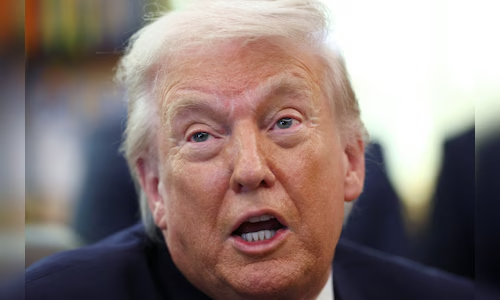
The latest data was released hours after President Trump asserted that trade deficits were already declining and predicted that the US trade balance could turn positive in 2026 — something that has not occurred in decades.
Trade patterns throughout 2025 were marked by sharp swings. Early in the year, companies ramped up imports ahead of new tariffs, temporarily widening the deficit. In subsequent months, the gap narrowed before expanding again toward year-end.
In December, exports slipped by roughly $5 billion to $287.3 billion, while imports rose by $12.3 billion to $357.6 billion. For the year, goods imports climbed to approximately $3.4 trillion, despite the administration’s tariff measures.
Much of the recent monthly volatility stemmed from fluctuations in categories such as gold, pharmaceuticals and information technology equipment. Imports of telecommunications equipment alone rose by $1.3 billion in December.
Analysts said the December data is unlikely to materially alter estimates for fourth-quarter economic growth. Capital Economics noted that the widening deficit was driven by “the usual suspects” and left its GDP growth estimate unchanged at an annualised 3.4%.
Trade relationships continued to shift during the year. US exports to Canada fell to their lowest level since 2022 amid ongoing trade tensions. The US trade deficit with China narrowed to $202.1 billion in 2025 from $295.5 billion in 2024. However, the decline in trade with China was offset by widening deficits with other countries, including Vietnam and Mexico, as supply chains adjusted.
The data comes during another week of heightened trade policy uncertainty in Washington. The White House recently disputed research suggesting that most tariff costs were borne domestically, and a Supreme Court ruling on some of the administration’s broadest duties is expected soon.
While tariffs have reshaped trade flows and redirected sourcing patterns, the latest figures indicate that their overall impact on the headline US trade deficit remains limited — at least for now.


