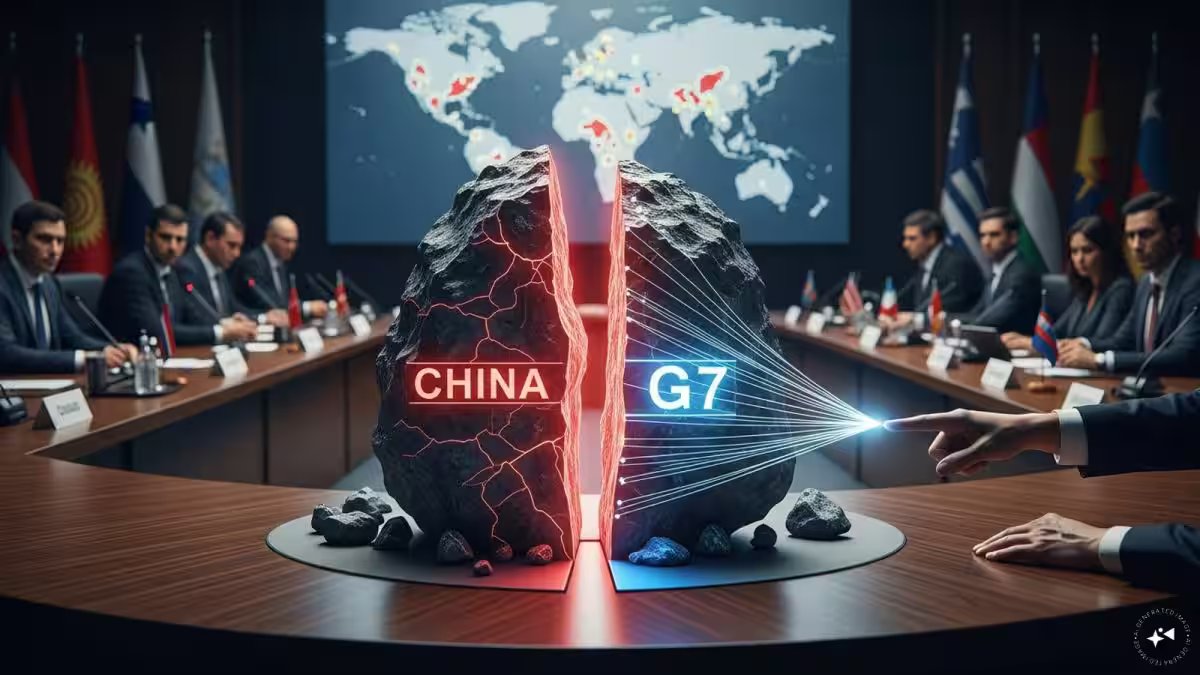
China dominates the critical minerals supply chain, refining between 47% and 87% of copper, lithium, cobalt, graphite and rare earths, according to the International Energy Agency. These minerals are used in defence technologies, semiconductors, renewable energy components, batteries and refining processes.
US Treasury Secretary Scott Bessent plans to press G7 countries and key partner nations to accelerate efforts to cut their dependence on China for critical minerals when he hosts senior finance officials on Monday, according to a senior US government source.
The talks will begin with a dinner on Sunday evening and bring together finance or cabinet ministers from the G7 economies, alongside representatives from the European Union, Australia, India, South Korea and Mexico. The official told Reuters that the participating countries together represent roughly 60 per cent of global demand for critical minerals.
Speed will be a central focus of the meeting, the official said, describing the challenge as complex and involving multiple countries and policy approaches. “This is a massive task with many moving parts, and the core message is that progress needs to happen faster,” the official said.
Bessent told Reuters on Friday that he had been pushing to convene a standalone meeting on critical minerals since the G7 leaders’ summit in Canada in June. At that gathering, he delivered a presentation on rare earths to leaders from the United States, Britain, Japan, Canada, Germany, France, Italy and the European Union.
Although G7 leaders agreed at the summit on a plan to strengthen supply chains and support economic resilience, the senior official said Bessent has since become increasingly dissatisfied with the slow pace of follow-through.
Japan remains the notable exception among the group. After China abruptly halted shipments of critical minerals to the country in 2010, Tokyo moved swiftly to diversify its supply sources. Most other G7 nations, however, continue to rely heavily on China for key materials, even as Beijing has signalled it may tighten export restrictions.
China currently holds a dominant position across the critical minerals supply chain, accounting for between 47 per cent and 87 per cent of the global refining of copper, lithium, cobalt, graphite and rare earth elements, according to data from the International Energy Agency.
These materials are essential for a wide range of strategic industries, including defence systems, semiconductor manufacturing, renewable energy technologies, batteries and industrial refining processes.
The US is expected to issue a statement after the meeting, but no specific joint action is likely, the official added.
US urges others to follow its lead
“The United States is in the posture of calling everyone together, showing leadership, sharing what we have in mind going forward,” said the official. ”We’re ready to move with those who feel a similar level of urgency … and others can join as they come to the realisation of how serious this is.”
The official gave no details on what further steps were planned by the Trump administration, which is pushing forward to boost domestic production and reduce reliance on China through agreements with Australia, Ukraine and other producers.
The U.S. signed an agreement with Australia in October aimed at countering China’s dominance in critical minerals that includes an $8.5 billion project pipeline. The deal leverages Australia’s proposed strategic reserve, which will supply metals like rare earths and lithium that are vulnerable to disruption.
The official said there had been progress, but more work was needed. ”It’s not solved,” they added.
Canberra has said it has subsequently received interest from Europe, Japan, South Korea and Singapore.
Monday’s meeting comes days after reports that China had begun restricting exports to Japanese companies of rare earths and powerful magnets containing them, as well as banning exports of dual-use items to the Japanese military.
The meeting was planned well before that action, US officials said. China was still living up to its commitments to purchase US soybeans and ship critical minerals to US firms.
With inputs from agencies
End of Article