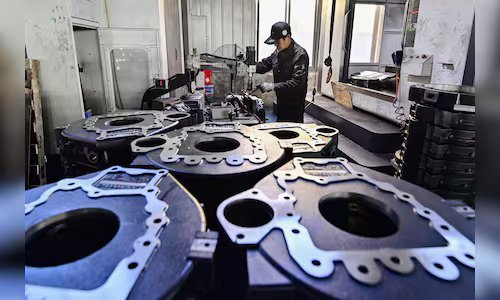
The moderation comes just days after government data showed the economy expanded by a stronger-than-expected 8.2% in the July–September quarter. Manufacturing was a key driver of that performance, but momentum now appears to be slowing as the Trump administration’s tariff measures begin to weigh on activity.
The HSBC India Manufacturing Purchasing Managers’ Index (PMI), compiled by S&P Global, fell to 56.6 in November from 59.2 in October, slipping below the flash estimate of 57.4. Despite the decline, the index remained well above the 50-mark that separates expansion from contraction, extending its uninterrupted growth run to 53 months, the longest streak since the survey began in 2005.
“India’s final November PMI confirmed that US tariffs caused the manufacturing expansion to slow,” said Pranjul Bhandari, chief India economist at HSBC. She added that business sentiment had weakened sharply. “Expectations for future output showed a big fall in November, potentially reflecting increasing concerns about the impact of tariffs. The boost from cuts in goods and services tax may be fading and might be insufficient to offset the tariff headwind to demand.”
The loss of momentum showed up across the board. Factory production and total new orders grew at their slowest pace since February. Survey participants cited tough market conditions, delays in starting new projects and heightened competition as key reasons for the slowdown.
The impact of US tariff action was a notable drag, even though the survey did not explicitly name the US as an export destination. Growth in new export orders eased to its weakest level in over a year, with softer international demand partly offset by continued sales to buyers in Africa, Asia, Europe and the Middle East.
Official trade data has also reflected strain, with India’s trade deficit widening to a record high and exports to the U.S. slipping nearly 9% from a year earlier, hit by punitive duties of 50% on Indian goods.
Hiring trends also reflected caution. Job creation slipped to its weakest level in 21 months, while the index tracking expectations for future output dropped to its lowest reading since mid-2022 amid concerns over rising competitive pressures, including from global players.
There was, however, some relief on prices. Input cost inflation slowed to a nine-month low, giving manufacturers more room to restrain price increases. Output charges were the softest since March.
Easing price pressures could give the Reserve Bank of India room to cut interest rates. The central bank is widely expected to reduce the repo rate by 25 basis points to 5.25% at its policy meeting this week, supported by consumer inflation hovering at historic lows.