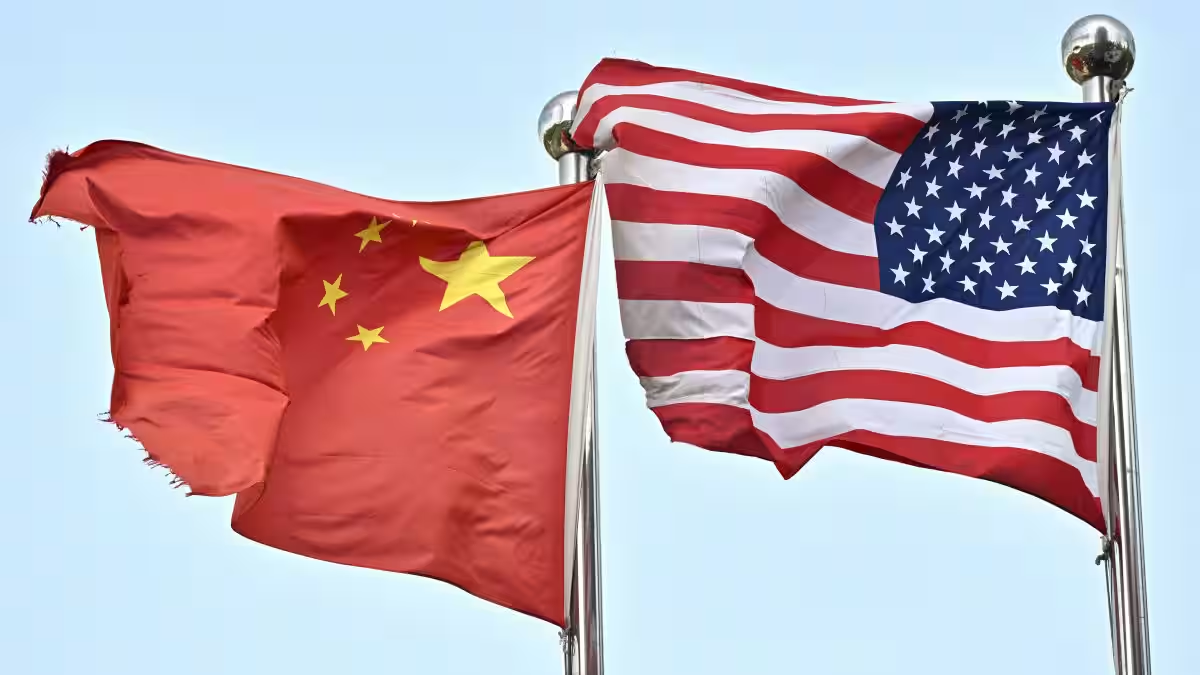
Trump’s updated national security strategy markedly softens its focus on China, reshaping Washington’s stated priorities while omitting several long-standing threats
Eight years after US President Donald Trump’s previous National Security Strategy (NSS) framed
China and Russia as “revisionist” powers intent on undermining American dominance, his new 2025 document, released earlier this week, strikes a muted tone on both adversaries. The 2017 version warned that Beijing and Moscow sought to erode US security and prosperity, tighten control over information, and expand military reach.
Developments since then have included China more than doubling its nuclear arsenal, conducting military exercises encircling Taiwan and breaching American networks, while Russia has waged a prolonged war in Ukraine and pursued shadow operations across Europe.
Despite this escalation, the latest 33-page strategy makes only sparse reference to either country.
The strategy places its primary focus on the Western Hemisphere, updating the Monroe Doctrine with what is described as a “Trump corollary”, concentrating heavily on restricting migration and the flow of drugs.
Alongside this hemispheric emphasis, the strategy signals a recalibrated approach to China. The new document plays down ideological differences and avoids framing Beijing as the single greatest challenge to US interests, in contrast to the Biden administration’s stance. China is named only a handful of times, chiefly in connection with economic and trade considerations, with indirect references to external competitors appearing elsewhere in the text.
Trump’s security blueprint narrows focus while easing tone on global adversaries
Russia appears in four paragraphs and without explicit criticism of its invasion of Ukraine, a conflict that has produced more than 1.5 million casualties. Instead, the document casts the US as a potential mediator capable of easing tensions between Moscow and Europe and helping restore strategic stability. The strategy also avoids any substantive discussion of China’s daily cyber activities targeting American corporate, telecommunications and government systems, even after recent warnings of further intrusions.
North Korea, once described by Trump as capable of inflicting catastrophic nuclear harm on the US, is absent altogether. Its arsenal has grown from an estimated one to two dozen nuclear weapons in 2017 to more than 60 today, yet the new strategy offers no assessment. Iran appears briefly and inconsistently, with Trump claiming that the US “obliterated Iran’s nuclear enrichment capacity” in June, while a later passage states only that the programme has been “significantly degraded”. Critics note that the report does not specify how Washington intends to prevent Tehran from rebuilding its capabilities.
The administration emphasises that the document concentrates on a limited set of threats, arguing that not every issue can drive American strategic planning. It asserts that the overarching aim is to ensure the US remains the world’s strongest and most successful nation for decades.
The report maintains the language of “strategic competition” regarding Taiwan and calls for deeper cooperation with Pacific partners to deter any attempt to seize the island. However, it drops the previous administration’s explicit declaration that the US does “not support Taiwan independence”. It instead adopts softer wording, stating that Washington does “not support any unilateral change to the status quo in the Taiwan Strait”, reflecting continuity in principle but a notable adjustment in tone.
End of Article