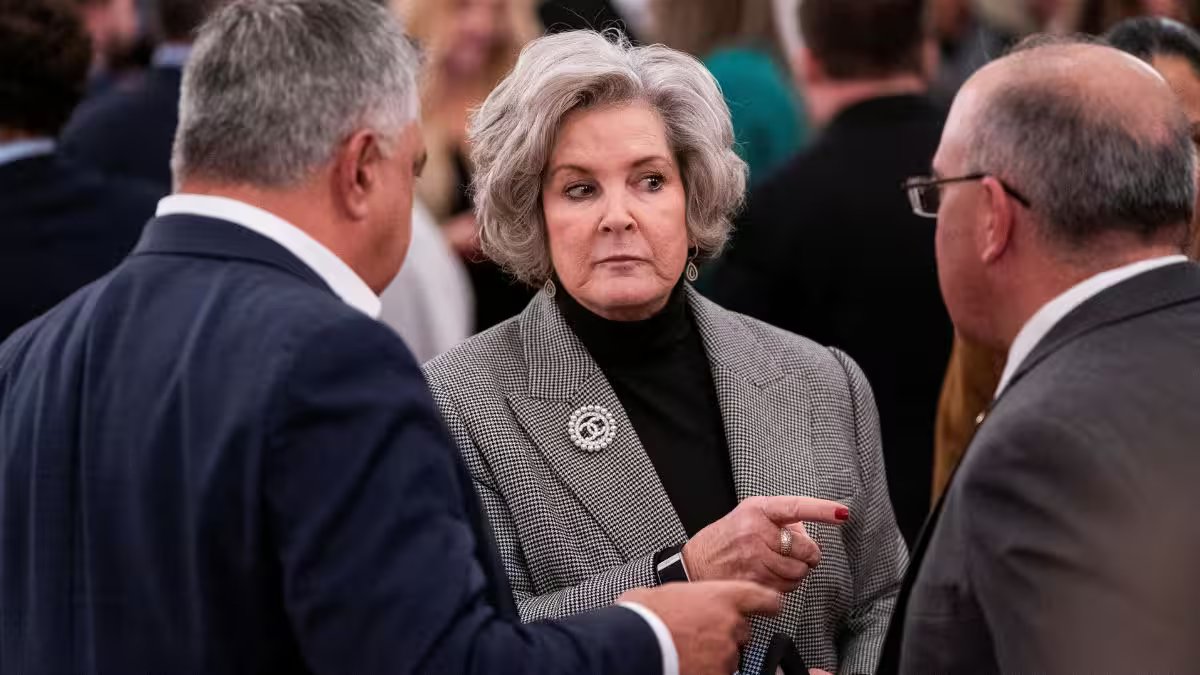
White House Chief of Staff Susie Wiles has delivered one of the most revealing insider accounts of United States President Donald Trump’s second term in office.
Her comments, drawn from a series of 11 interviews conducted by author Chris Whipple during Trump’s first year back in the White House and published by Vanity Fair, have pulled back the curtain on internal tensions that stretch from immigration enforcement and trade policy to foreign affairs and the personal dynamics shaping Trump’s inner circle.
For an official known for operating behind the scenes and avoiding public attention, Wiles’ remarks stand out not only for their candour but also for their breadth.
She spoke at length about Trump’s personality, the administration’s struggles over tariffs and deportations, her misgivings about how sensitive cases such as the Jeffrey Epstein files were handled, and her blunt assessments of powerful figures including US Vice President JD Vance and billionaire Elon Musk.
The interviews also reveal moments where Wiles attempted — and failed — to alter Trump’s course, as well as instances where she accepted being overruled as part of her role.
The fallout was swift.
Wiles publicly rejected the framing of the Vanity Fair article, calling it a “hit piece,” while Trump and senior officials rushed to affirm their confidence in her leadership. The administration criticised the tone and intent of the coverage, none of the quoted remarks themselves were disavowed.
Understanding Trump
At the core of Wiles’ account is her description of Trump as a leader driven by intensity, and a belief in his own limitless capacity to act. She
described Trump as having “an alcoholic’s personality,” a phrase that drew immediate attention because Trump does not drink.
Wiles explained that the comparison stems from her personal background growing up with an alcoholic father, the well-known sports broadcaster Pat Summerall, which she said prepared her to manage people with outsized and demanding temperaments.
“He has an alcoholic’s personality,” Wiles said, elaborating that Trump operates with “a view that there’s nothing he can’t do. Nothing, zero, nothing.”
In a more reflective explanation, she added, “High-functioning alcoholics or alcoholics in general, their personalities are exaggerated when they drink. And so I’m a little bit of an expert in big personalities.”
Wiles pointed out that her role is not to restrain the president but to help facilitate his choices and translate his instincts into policy. She rejected the idea that she enables Trump’s excesses, saying, “I’m not an enabler. … I try to be thoughtful about what I even engage in. I guess time will tell whether I’ve been effective.”
She also made clear that being overruled does not rankle her. “There have been a couple of times where I’ve been outvoted,” she said. “And if there’s a tie, he wins.”
Trump himself publicly endorsed Wiles’ description, telling the New York Post that she was correct to characterise him that way and explaining that he has a “possessive and addictive” personality.
He reiterated his trust in Wiles and again described her as the “most powerful woman in the world,” highlighting her central position within the administration.
About unfinished scores
One of the most sensitive subjects Wiles addressed was Trump’s pursuit of accountability — or retribution — against those he believes wronged him during his years out of office.
According to Wiles, early in the second term there was an understanding aimed at limiting how long that impulse would dominate the administration’s agenda.
“We have a loose agreement that the score settling will end before the first 90 days are over,” she said, describing her early efforts to contain Trump’s desire for payback against political adversaries, particularly those involved in investigations and prosecutions against him.
As the year progressed, however, Wiles’ assessment evolved. By August, she said she no longer believed Trump was engaged in an open-ended campaign of revenge.
“I don’t think he’s on a retribution tour,” she said, offering an alternative explanation for his mindset, “‘I don’t want what happened to me to happen to somebody else.’”
Even so, Wiles acknowledged that opportunities for retaliation still arise and that Trump does not shy away from them. “There may be an element of that from time to time,” she said, adding that Trump “will go for it … when there’s an opportunity.”
When asked specifically about
the prosecution of New York Attorney General Letitia James on mortgage fraud allegations, Wiles conceded, “Well, that might be the one retribution.”
Addressing whether such impulses were understandable, Wiles remarked, “Who would blame him? Not me.”
Epstein, Bondi, and a political headache that would not fade
Among the most striking parts of Wiles’ interviews were her comments on the handling of the Jeffrey Epstein case, which has continued to dog the administration politically.
Wiles was sharply critical of Attorney General Pam Bondi’s
initial response to the anticipated release of Epstein-related documents.
She said Bondi “completely whiffed” the early handling of the files, particularly after raising expectations that damaging information about Epstein’s alleged associates would be released, only for the US Justice Department to later say such a client list did not exist.
The reversal angered Trump’s right-wing supporters and prolonged the controversy.
Wiles said she personally reviewed the Epstein documents and acknowledged that Trump’s name appears in them. However, she stressed that “he’s not in the file doing anything awful.”
She also addressed
Trump’s public claims about former US President Bill Clinton, stating clearly that there was no evidentiary basis for those assertions. “There is no evidence” Clinton visited Epstein’s island, she said, adding that “The president was wrong about that.”
Bondi later defended Wiles publicly, saying on X that the chief of staff works tirelessly to advance Trump’s agenda and that efforts to sow division within the administration would fail.
Vance, Musk, and internal friction
Wiles said Vance has “been a conspiracy theorist for a decade,” and suggested that his transformation into a staunch supporter of Trump was “sort of political,” noting that he once compared Trump to Adolf Hitler before aligning himself with the Maga movement.
Despite the critique, Vance emerged as one of Wiles’ most vocal defenders after the interviews were published.
Speaking to reporters in Pennsylvania, he praised her consistency and loyalty, saying, “I’ve never seen her be disloyal to the president of the United States and that makes her the best White House chief of staff the president could ask for.”
He also addressed her comment about his conspiratorial streak with humour, saying, “Sometimes I am a conspiracy theorist, but I only believe in the conspiracy theories that are true.”
Wiles was far more openly critical of billionaire Elon Musk, who headed
Trump’s Department of Government Efficiency (Doge), a body tasked with rapidly shrinking the federal government’s budget and workforce.
She said Musk acted unilaterally and without sufficient regard for institutional processes, describing him as “a complete solo actor … an odd, odd duck” and an “avowed ketamine user” recalling confrontations over his decision to lock staff out of their offices.
Her strongest criticism centred on Musk’s
dismantling of the US Agency for International Development (USAID). Wiles said the approach left her “initially aghast” and argued that it undermined programmes that had long served US interests abroad.
“Because I think anybody that pays attention to government and has ever paid attention to USAID believed, as I did, that they do very good work,” she said, while also noting that “no rational person could think the USAID process was a good one. Nobody.”
Wiles also offered brief character sketches of other officials, referring to
US Health Secretary Robert F Kennedy Jr as “quirky Bobby” and White House budget chief Russell Vought as “a right-wing absolute zealot.”
Explaining her tolerance for ideological hardliners, she said of Kennedy, “He pushes the envelope — some would say too far. But I say in order to get back to the middle, you have to push it too far.”
Tariffs, trade, and an unexpectedly painful rollout
Trade policy emerged as one of the most divisive issues within the administration. Wiles said she advised Trump to delay and refine his sweeping tariff plans, including
the April 2 announcement of “Liberation Day” tariffs that imposed import taxes ranging from 10 per cent to 99 per cent on much of the world.
The move rattled global markets, raised recession fears, and forced a pause in the broader tariff strategy as negotiations lurched from one crisis to the next.
Wiles described the rollout as chaotic, characterised by excessive “thinking out loud” and a lack of internal agreement. She said she urged aides to “work into what he’s already thinking” and even asked Vance to tell Trump to “not talk about tariffs today” until the team reached unity.
Trump proceeded anyway.
The aftermath, she said, exposed deeper divisions than she had anticipated. “It’s been more painful than I expected,” Wiles said, acknowledging that while she believed a compromise approach could succeed, the execution proved far more destabilising than planned.
Immigration enforcement and admitted mistakes
Wiles also acknowledged shortcomings in the administration’s immigration enforcement, particularly in cases that drew public outrage and judicial scrutiny.
When a federal judge criticised
the deportation of a Maryland resident that the administration later admitted was a mistake, Trump publicly defended the action. Wiles, however, was more candid.
“We’ve got to look harder at our process for deportation,” she said, stating the need for greater care and internal safeguards. She specifically called for a “double-check” in cases where uncertainty exists.
Her comments were even more direct regarding the deportation of two mothers along with their US citizen children,
one of whom was undergoing cancer treatment.
“It could be an overzealous Border Patrol agent, I don’t know,” she said. “I can’t understand how you make that mistake, but somebody did.”
Russia, Ukraine, and Venezuela
Regarding Russia and the war in Ukraine, Trump has argued that President Vladimir Putin could be persuaded to end the conflict
if Kyiv cedes territory in eastern Ukraine and Western nations offer economic incentives.
But, Wiles expressed deeper scepticism. Referencing expert views in August, she said, “The experts think that if he could get the rest of Donetsk, then he would be happy.”
But she added, “Donald Trump thinks he wants the whole country,” indicating that Trump privately believes Putin’s ambitions extend far beyond limited territorial gains.
Wiles also addressed US actions against Venezuela, particularly
attacks on boats suspected of carrying drugs in the Caribbean Sea and eastern Pacific.
While the administration has framed the strikes as counter-narcotics operations, Wiles suggested a broader objective. In November, she said Trump “wants to keep on blowing boats up until Maduro cries uncle,” implying that regime change is the underlying goal.
She noted, however, that any land-based military action would require congressional approval.
Wiles dismissed the Vanity Fair article as “a disingenuously framed hit piece on me and the finest President, White House staff, and Cabinet in history,” accusing it of omitting context and selectively using her words to create a negative narrative.
Trump, Vance, and multiple Cabinet officials publicly defended her, highlighting her loyalty and effectiveness. While the administration challenged the framing of the story, none of the quotes attributed to Wiles were denied or corrected.
With inputs from agencies
End of Article