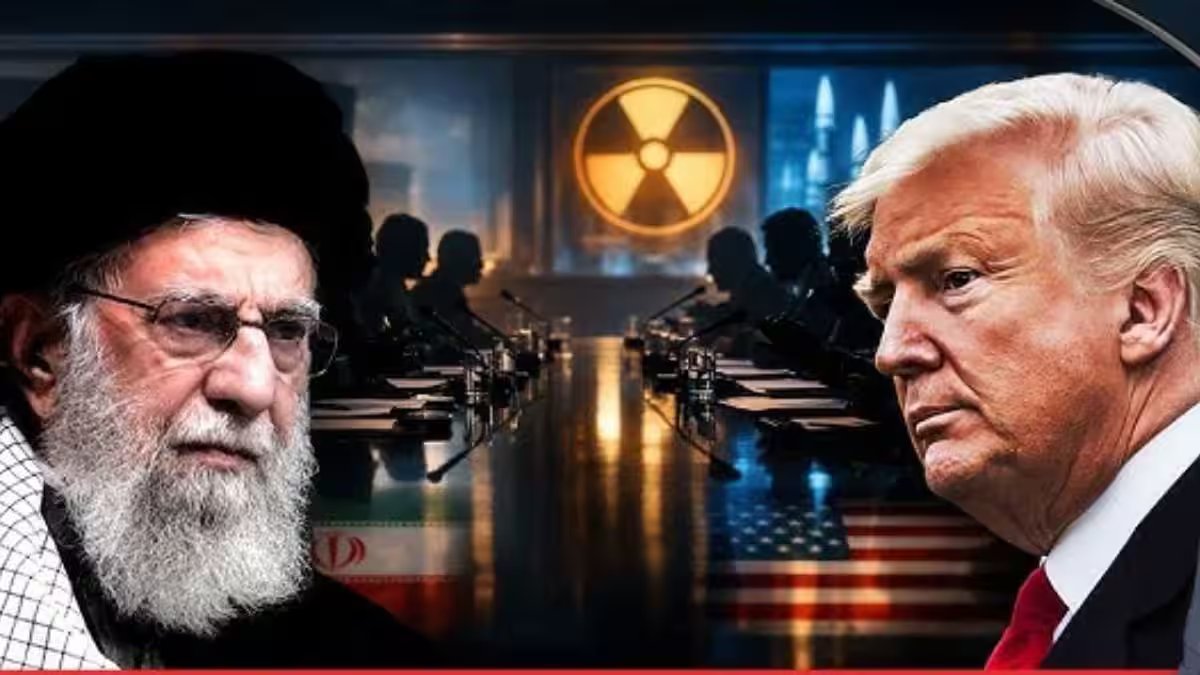
President Donald Trump has taken the unusual step of tapping military leaders for high level diplomacy, sending the top US commander in the West Asia to talks over Iran’s nuclear program and positioning the Army secretary as a key negotiator on ending the Russia-Ukraine war.
The Trump administration has deployed senior military figures to lead high-stakes diplomatic efforts, sending the top US commander in the West Asia to discussions on Iran’s nuclear program while positioning the Army secretary as a key intermediary in negotiations aimed at ending the Russia-Ukraine war.
This unconventional approach highlights the administration’s reliance on military expertise to navigate complex foreign policy challenges, signaling both capabilities and potential consequences to other global actors.
US military leaders join sensitive talks
Admiral Brad Cooper, commander of U.S. Central Command, attended indirect negotiations with Iran in Oman, appearing in full dress uniform, a symbolic display of U.S. military power. Cooper’s presence marked a departure from standard diplomatic practice, where senior military officials rarely take frontline roles in negotiations.
Meanwhile, Army Secretary Dan Driscoll resumed his involvement in Ukraine-related discussions this week, acting as a liaison between Ukrainian officials and Trump-appointed negotiators such as Special Envoy Steve Witkoff and presidential adviser Jared Kushner. Driscoll’s role has focused on maintaining dialogue between sessions, leveraging his military background to assess proposals and keep talks moving forward.
Experts note that involving military leaders reflects a broader shift in Trump’s approach, prioritising operational knowledge and the implicit threat of force over conventional diplomacy. Elisa Ewers, a former national security official, said the move demonstrates a devaluation of traditional diplomatic channels in favor of military-led negotiation.
“It often takes sustained effort and nuanced diplomacy to reach agreement. Not every challenge requires a hammer,” Ewers said.
Other analysts highlight historical precedents. Eliot Cohen, a former State Department counselor, noted that military officials have previously contributed to arms control negotiations, though sending a senior civilian military leader like Driscoll to direct peace talks remains unusual.
The Oman talks aim to reduce tensions between the U.S. and Iran, with Trump describing the discussions as “very good” while warning of steep consequences if Iran fails to reach an agreement. Cooper’s participation is intended to provide technical expertise on Iran’s nuclear and military capabilities, while also reinforcing the U.S.’s readiness to act militarily if necessary, analysts say.
“Cooper brings both subject-matter knowledge and the leverage of American military strength,” said Cohen, now a scholar at the Center for Strategic and International Studies. “It is both practical and symbolic.”
Driscoll’s work on Ukraine has similarly combined operational insight with continuity, helping maintain momentum in talks after previous sessions stalled. Joined in Abu Dhabi by General Alexus Grynkewich, commander of U.S. and NATO forces in Europe, Driscoll has facilitated high-level military-to-military communication, the first such engagement between Washington and Moscow in four years.
US pushes for quick resolution to Russia-Ukraine conflict
The United States wants Ukraine and Russia to end their nearly four-year war by June, and has offered to host talks between the two sides in Florida next week, Ukrainian President Volodymyr Zelensky said.
US-led efforts to end Europe’s deadliest conflict since World War II have stepped up a gear in recent weeks, but Moscow and Kyiv remain at odds over the key issue of territory.
Russia, which occupies around 20 percent of its neighbour, is pushing for full control of Ukraine’s eastern Donetsk region as part of any deal and has threatened to take it by force if talks fail.
But Ukraine says ceding ground will embolden Moscow and so it will not sign an agreement that fails to deter Russia from invading again.
“The United States has proposed for the first time that the two negotiating teams – Ukraine and Russia – meet in the United States, probably in Miami, in a week’s time,” Zelensky told reporters in comments made public early Saturday.
“They say that they want to do everything by June,” he added.
The US has mediated two rounds of negotiations between the two sides in Abu Dhabi since January, brokering a major prisoner exchange but failing to reach a breakthrough on territory.
Both Moscow and Kyiv said talks have been difficult.
With inputs from agencies
End of Article