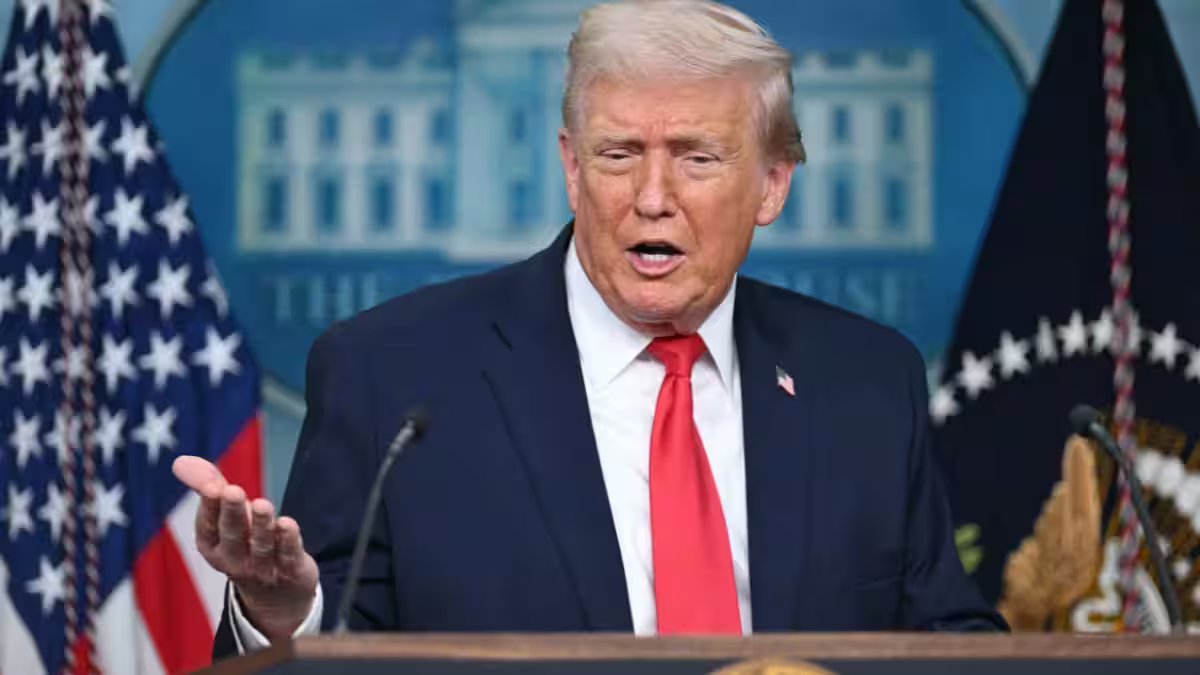
Trump has once again sparked controversy by joking about a possible fourth term, even though the Constitution limits presidents to two elected terms.
US President Donald Trump has once again stirred controversy by publicly suggesting he might seek a fourth term in office, a notion that directly conflicts with constitutional limits.
On Thursday, Trump posted on Truth Social, “Record numbers all over the place! Should I try for a fourth term?”
The comments came shortly after a rise in US stock markets. While Trump has previously hinted at a third term, the latest post escalates speculation, even as “Trump 2028” merchandise continues to be displayed in the White House.
At 79, Trump appears to treat his current presidency as a continuation rather than a second term, framing the 2020 election, won by Democrat Joe Biden, as an interruption rather than a definitive end to his tenure.
Constitutional limits on presidential terms
The 22nd Amendment restricts presidents to two elected terms and also limits individuals who serve more than two years of another president’s term to only one additional elected term.
Trump first assumed office in 2017, completed a full four-year term, and returned to the White House in 2025. Legally, he remains within the two-term limit, making any talk of a fourth term constitutionally impossible.
Approval ratings show mixed support
Despite Trump’s claims of soaring popularity, recent polls suggest a more challenging political landscape:
-
An early January AP–NORC survey of over 1,200 adults found roughly 40 percent approved of Trump’s performance, while half said he was focused on the wrong priorities.
-
On economic management, only about a third approved of his handling of the economy, with a majority saying his policies have worsened the cost of living.
-
Immigration and foreign policy also drew mixed to negative responses, with declining approval for his approaches.
A separate New York Times/Siena College poll in mid-January showed similar results: 40 percent approved of Trump’s leadership, while a plurality felt the country was worse off than a year ago. More than half said his policies made daily life more expensive, and fewer than one-third rated the economy as good or excellent, despite modest improvements from earlier months.
End of Article