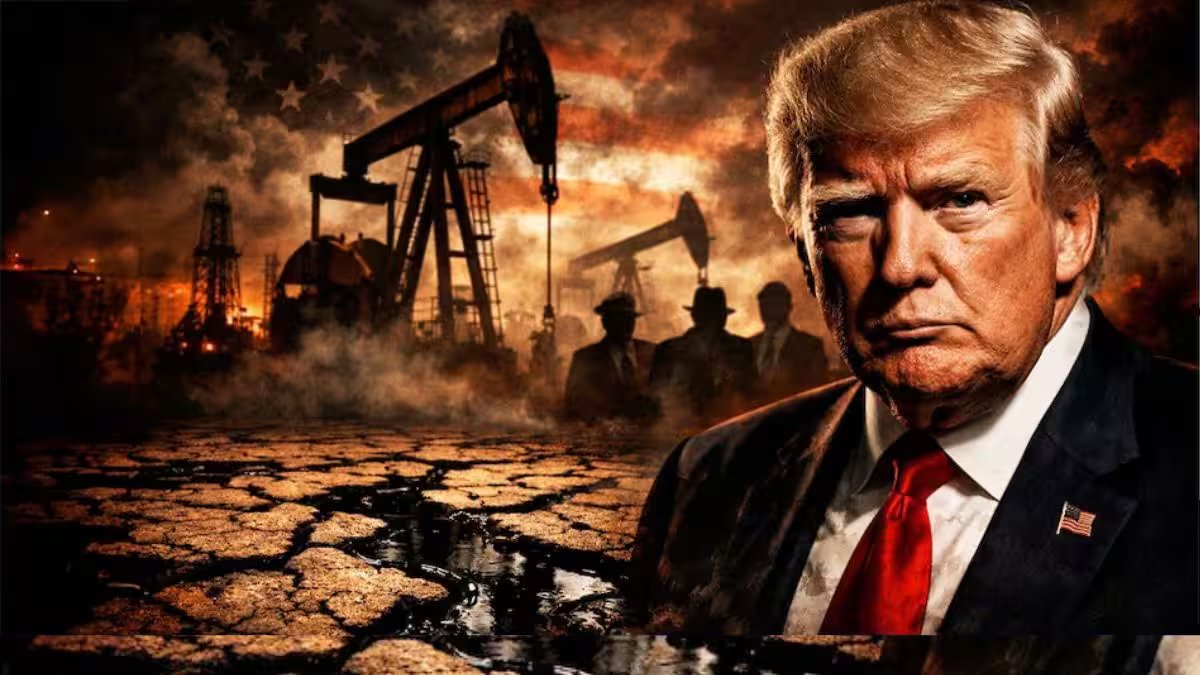
US President Donald Trump links Venezuela’s oil sales to mandatory purchases of American goods, signalling a strategy that seeks not only crude supplies but control over how Caracas uses its oil revenues.
US president Donald Trump’s latest manoeuvre on Venezuela goes beyond securing crude supplies for American refineries, extending into an attempt to dictate how Caracas spends the proceeds from its oil sales.
In a social media announcement this week, Trump said Venezuela would use revenue from a new oil agreement only to purchase American-made products, a move that critics say signals a deeper economic leverage strategy rather than a simple trade pact.
The declaration came one day after Trump revealed that Venezuela’s interim leadership had agreed to turn over between 30 million and 50 million barrels of sanctioned oil, previously stranded under embargo to the United States to be sold at market prices under US oversight.
A strategic pivot towards US economic dominance
Trump’s message, posted on his Truth Social platform, framed the purchasing condition as a commitment by Venezuela to make the United States its principal trading partner. He specifically cited agricultural products, medicines, medical devices and equipment to upgrade Venezuela’s electricity grid and energy facilities as likely imports paid for with oil revenue.
“This is a wise choice and a very good thing for the people of Venezuela and the United States,” Trump wrote, asserting the arrangement would be mutually beneficial.
However, experts warn that the stipulation represents an unprecedented level of economic control over a sovereign nation’s financial decisions. By essentially earmarking Venezuelan oil profits for American exports, the United States could embed its companies deeply into the South American country’s reconstruction process at the expense of regional autonomy and diversified trade. Analysts said that Washington’s insistence that proceeds be used exclusively on US goods flouts conventional norms around free trade and sovereignty.
Revenue control at the heart of geopolitical leverage
The broader oil deal is already controversial. Under the arrangement, Venezuela will hand over tens of millions of barrels of crude oil worth an estimated USD 2 billion which the Trump administration will sell on global markets under US supervision. The revenue is to be held in accounts controlled by US authorities, a point highlighted by Energy Secretary Chris Wright who argued that controlling both oil flows and cash provides significant leverage to drive political and economic change in Venezuela.
This represents a stark departure from earlier policy approaches, where sanctions aimed to disrupt regime finances without directly monetising Venezuela’s oil reserves for US benefit. Now, by retaining oversight of both the crude and its earnings, the United States is positioned at least for the near term as both commercial partner and financial gatekeeper.
Critics have responded sharply. Some lawmakers and international observers frame the policy as tantamount to economic coercion: rather than merely opening markets, Washington is effectively retaining control over Venezuelan oil revenue and its allocation. There are concerns this could erode Venezuelan sovereignty and reduce the ability of Caracas to prioritise its own economic recovery.
Implications for global oil markets and bilateral relations
The strategic shift also has implications beyond Venezuela’s borders. Analysts note that if Venezuela funnels oil proceeds exclusively into US products, it further isolates other global buyers such as China, Cuba and Russia- all long-standing partners of Caracas’ energy sector. This pivot may rebalance trade flows but also risks exacerbating geopolitical tensions, especially given Venezuela’s vast, under-utilised reserves.
Trump’s plan additionally highlights a broader pattern of using energy diplomacy as leverage. By tying oil proceeds to American imports and keeping revenue under US control, the administration aims to weave economic dependency into the fabric of Venezuela’s post-crisis recovery. Whether this strategy succeeds or provokes backlash at home and abroad remains to be seen.
With inputs from agencies
End of Article