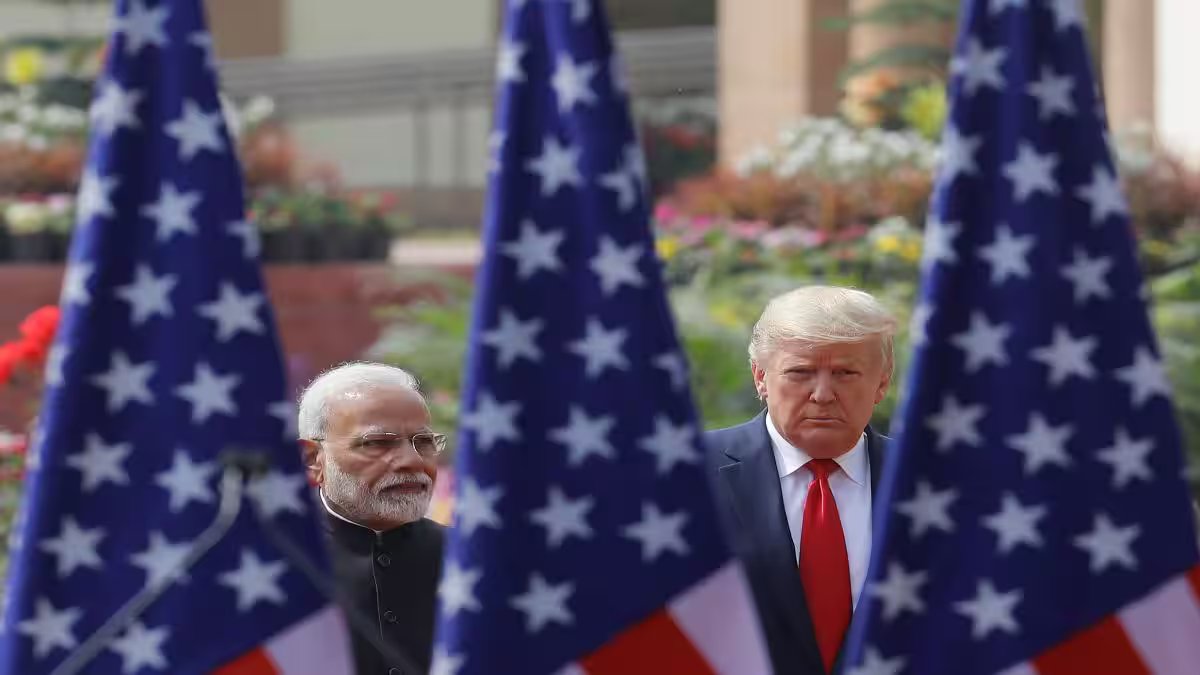
While the US remains a critical export destination, India’s trade exposure is now more diversified than during Trump 1.0. This has reduced the immediate impact of tariff shocks and given policymakers greater room to manoeuvre
As US President Donald Trump approaches the completion of the first year of his second term, India-US economic relations have taken a markedly different turn from the optimism that accompanied Trump’s return to the White House.
When Trump won the election last year, sections of India’s political and business establishment welcomed the result, betting that Trump 2.0 would deliver a more predictable and pragmatic partnership than his first term. Instead, New Delhi found itself facing some of the steepest tariff barriers imposed by the US on any major trading partner.
The US has slapped 50 per cent tariffs on India, among the highest on any country and even more than on China, upending both the trade and diplomatic relations between the two countries.
The shift has forced India to recalibrate its trade strategy-diversifying export markets, deepening ties beyond the US, and insulating its economy from unilateral trade shocks.
From optimism to tariffs
During Trump’s first term, India and the US experienced frequent friction over trade, market access and tariffs, but strategic convergence, particularly on China, kept the relationship on track. The expectation in New Delhi was that Trump’s second innings would bring more transactional clarity. That optimism faded quickly.
Within months, the US imposed sharply higher tariffs on a range of Indian exports, citing trade imbalances, market access issues, domestic political pressures and oil imports from Russia. The move placed India among the countries most affected by Trump’s renewed protectionist push.
Trade data shows resilience
Yet, despite the headwinds, India’s latest trade data suggests the economy has held up better than expected.
Trade figures for December showed resilience in exports, driven by shipments to non-US markets, particularly in West Asia, Africa, Europe and China.
According to government data, exports to China surged 67 per cent in December to $2 billion, in contrast to goods shipped to the US, India’s biggest export market, which dropped 1.8 per cent to $6.8 billion.
While the US remains a critical export destination, India’s trade exposure is now more diversified than during Trump 1.0. This has reduced the immediate impact of tariff shocks and given policymakers greater room to manoeuvre.
New markets, new partners
Under pressure from Washington, India has doubled down on expanding trade ties elsewhere. India signed free trade agreements and economic partnerships with the UAE, Australia, Oman, the UK and other regions.
At the same time, negotiations with the European Union, long stalled, have gained momentum, driven in part by shared concerns over US trade unpredictability.
India has also stepped up engagement with Latin America and Africa, positioning itself as an alternative manufacturing and sourcing hub amid global supply chain realignments.
Looking ahead, Indian policymakers appear resigned to a more uncertain trade environment with the US for the remainder of Trump’s term. While backchannel negotiations continue, there is little expectation of a dramatic rollback of tariffs in the near future.
Instead, the focus is on strengthening alternative trade corridors, improving domestic manufacturing competitiveness, and using bilateral and regional agreements to hedge against future shocks.
In that sense, Trump 2.0 may end up accelerating a shift that was already underway. India is positioning itself not as a US-dependent export economy but as a more autonomous trading power with multiple partners.
Tariffs may have hardened Washington’s stance, but they have also pushed India to look outward and, increasingly, beyond America.
End of Article