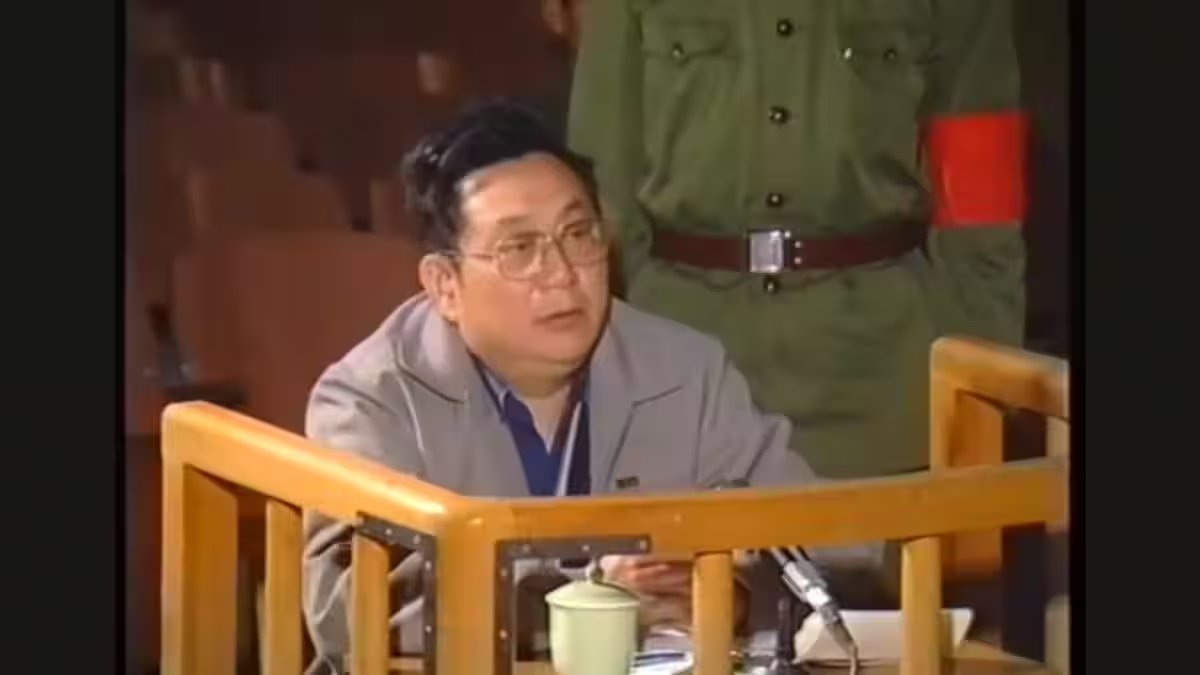
In a nearly unprecedented leak, a six-hour video has surfaced that shows the trial of Xu Qinxian, a Chinese general who refused to kill youths at the Tiananmen Square in Beijing. He said in the trial that his refusal was rooted in his conscience and professional judgement.
In a nearly unprecedented leak, a six-hour video has surfaced that shows the trial of Xu Qinxian, a Chinese general who refused the order to crush the pro-democracy demonstration at the Tiananmen Square in Beijing in 1989.
In the video, Xu said his refusal was rooted in his conscience and professional judgement. He was the head of the 38th Group Army at the time, which was one of the most prestigious military formations in China.
The video, as reported by The New York Times, has shed invaluable and rare light into the internal functioning of the Communist Party of China (CPC) and granted a window into the decision-making that led to one of the largest massacres of the post-Holocaust era.
On the evening of June 3, at the order of then-Chinese leader Deng Xiaoping, the Chinese military moved into Beijing and attacked thousands of demonstrators at the Tiananmen Square. They had been protesting for weeks for economic and political reforms.
The Times reported that Xu was summoned individually like other generals at the time to be given oral orders to kill demonstrators. This was apparently done to avoid leaving any recorded proof of orders to kill civilians.
While Deng’s administration said around 300 people, including soldiers, were killed, independent assessments and eyewitnesses have said that the Chinese military killed up to 10,000 people on the intervening night of June 3-4, 1989.
After more than three decades, the story of Xu —who refused to carry out Deng’s order— has emerged fully in the public.
‘A sinner in history’
In the trial, Xu said he refused the order as a matter of individual conscience and professional judgment, according to The New York Times.
Xu said that sending soldiers against civilians would lead to chaos and bloodshed and that a commander who carried out martial law poorly would go down as “a sinner in history”.
Xu was escorted into the courtroom by three soldiers. Four uniformed judges held the trial without any spectators.
Contradicting the common CPC defence that the situation had gone out of hand and there was no alternative to military action, Xu said that he had “disagreements” with the approach taken by the Chinese leadership.
Instead of the military action, the situation should be resolved mainly through political means, Xu told the judges.
If the central government ordered troops in, they should be deployed only to Beijing’s outskirts, Xu said.
During cross-examination, Xu admitted that the Chinese military answered to the CPC’s leadership but said it should also be subjected to the broader authority.
In doing so, Xu suggested that the very nature of the Chinese military where it belonged to the CPC, and not to the Chinese nation or state, should be reconsidered, and that the military should be subjected to a broader authority of institutions like the National People’s Congress.
At the time of the trial, Xu had been stripped of the command. Eventually, he was sentenced to five years in prison. He died in 2021 at the age of 85
Xu’s trial shows that there was a “sense even within the military that conversation, dialogue, to try to win over the students, that option had not been exhausted”, Joseph Torigian, a historian of the CPC at American University in Washington, told The Times.
End of Article