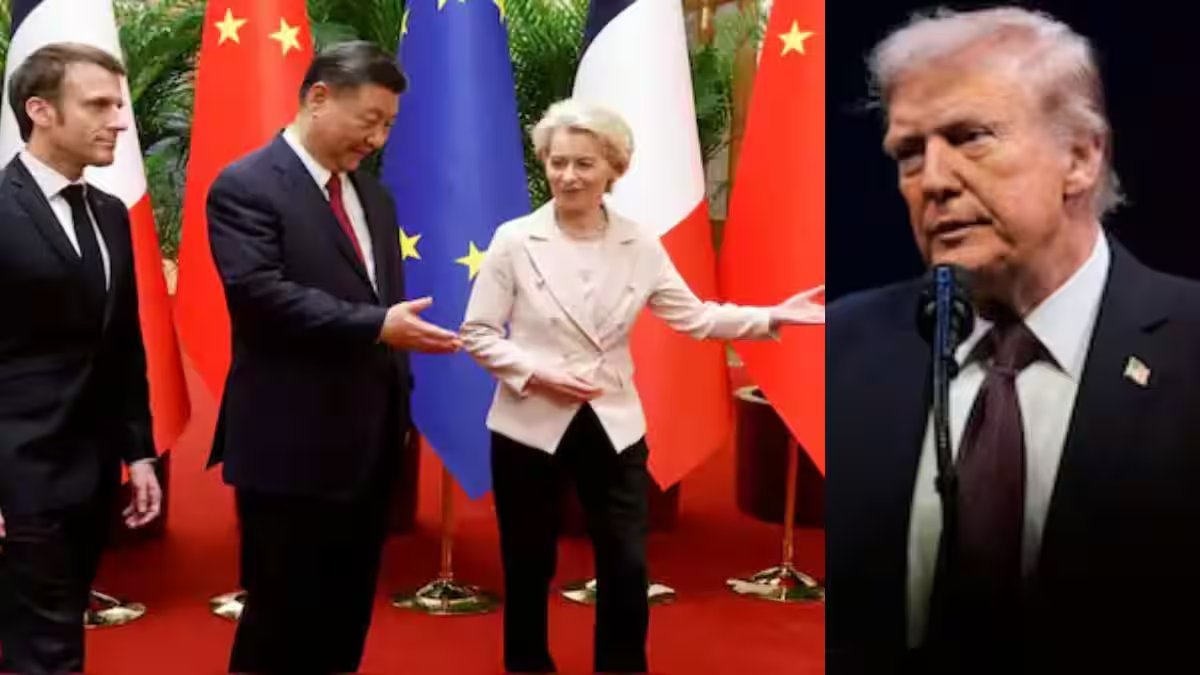
Chinese President Xi Jinping has held a string of high-profile meetings with Western leaders in recent weeks as America’s closest partners reassess their ties with Beijing amid renewed trade tensions and diplomatic strains with US President Donald Trump.
Canadian Prime Minister Mark Carney, UK Prime Minister Keir Starmer and several European leaders have visited Beijing or announced imminent trips, indicating a recalibration of relations with the world’s second-largest economy after years of frostiness.
The outreach marks a notable shift in global alignments since Trump returned to office, with US allies increasingly exploring economic and diplomatic engagement with China following clashes with Washington over tariffs and other disputes including Trump’s demand that Denmark hand over Greenland.
Carney struck a trade agreement with Beijing that slashed Canadian tariffs on Chinese electric vehicles and reduced Chinese import duties on Canadian canola oil. It was the first visit by a Canadian prime minister to China in eight years.
“We’re engaging broadly, strategically, with open eyes,” Carney said at the World Economic Forum in Davos after returning from Beijing. “We actively take on the world as it is, not wait around for a world we wish to be.”
Starmer arrived in Beijing this week to repair UK-China relations that have been strained for years over security concerns, technology restrictions and Beijing’s crackdown on democracy in Hong Kong. German Chancellor Friedrich Merz is expected to visit China next month while Finnish Prime Minister Petteri Orpo has already held talks with Chinese leaders.
Trump publicly criticised the renewed engagement. Asked about Starmer’s visit, he warned it was “very dangerous,” adding that Canada was taking an even greater risk by expanding trade with China. Trump has nevertheless signalled that he plans to visit Beijing himself in April.
Some policymakers and analysts warn that the trend risks tilting the global balance in Beijing’s favour at Washington’s expense. Others argue that both China and the US are exerting pressure on partners in pursuit of their own interests.
“Instead of creating a united front against China, we’re pushing our closest allies into their arms,” U.S. Senator Jeanne Shaheen, the top Democrat on the Senate Foreign Relations Committee, said during a hearing this week.
European Union foreign policy chief Kaja Kallas acknowledged that China poses a long-term challenge due to its “economic coercive practices,” but said Europe must expand partnerships globally. Analysts stressed that Europe’s approach is driven less by loyalty to China and more by a desire for strategic autonomy.
“This is not a China pivot,” said Una Aleksandra Bērziņa-Čerenkova of the Latvian Institute of International Affairs. “It’s a pivot toward fending for Europe as a bloc.”
Beijing, meanwhile, is engaging directly with individual European capitals rather than EU institutions, analysts say, maintaining access to wealthy consumer markets while offering limited concessions to European firms.
“They need Europe, but they don’t need to fight for Europe,” said Alicia Gracia-Herrero of Natixis.
Others see a deeper structural shift under way. “Both the Greenland issue and China’s rare-earth export controls have reinforced a European understanding that two major powers are willing to bully the EU,” said Tim Rühlig of the EU Institute for Security Studies.
European leaders acknowledge China’s economic and geopolitical importance and the need to maintain communication. “Everyone goes to Beijing, including the guy who doesn’t want us to go to China,” said Joerg Wuttke, former president of the EU Chamber of Commerce in China.
For Canada, the shift has been especially striking. In 2024, former prime minister Justin Trudeau imposed a 100% tariff on Chinese electric vehicles in line with the Biden administration. Carney reversed course, calling Canada-China trade “more predictable”, a veiled critique of Trump’s tariff threats.
Trump responded by threatening new tariffs on Canada, which Carney dismissed as bluster. In Davos, Carney warned against coercion by great powers, saying: “If we’re not at the table, we’re on the menu.”
In the UK, Starmer’s visit produced a slate of business deals, lower Chinese tariffs on Scotch whisky and 30-day visa-free entry for British visitors. The two leaders also spoke of renewing a strategic partnership and cooperation on climate change and global stability.
Finland’s Orpo signed agreements on sustainable construction, energy and animal disease control, while also raising concerns over trade imbalances, Ukraine and human rights.
French President Emmanuel Macron, Irish Prime Minister Micheál Martin and South Korean President Lee Jae-myung have also visited China in recent weeks.
Merz’s upcoming trip will be his first as German chancellor and is expected to focus on trade imbalances and Germany’s dependence on China for critical minerals.
As U.S. allies edge closer to Beijing, some analysts warn of growing fractures within the Western alliance.
“It will become impossible for the U.S. and its partners to unite to isolate China or impose collective conditions on engagement,” said Scott Kennedy of the Center for Strategic and International Studies.
With inputs from agencies
End of Article