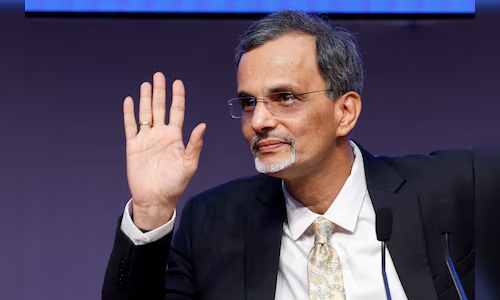
Chief Economic Adviser V Anantha Nageswaran, speaking on Thursday (January 29) about the Economic Survey 2025-26, underlined India’s position as an “oasis of macro stability” amid global uncertainty, benign inflation trends, firm public finances, strong growth momentum and a resilient external sector.
The Economic Survey 2025-26, prepared by the Department of Economic Affairs and tabled by Finance Minister Nirmala Sitharaman ahead of the Union Budget, reviews India’s economic performance over the past year and sets the context for Budget priorities by outlining key trends, challenges and the road ahead.
Below are the highlights of the CEA’s reflections on the Economic Survey:
India an ‘oasis of macro stability’ amid global turbulence
Nageswaran said India stands out as an oasis of macroeconomic stability at a time when the global environment is increasingly unpredictable and even dangerous. He noted that India’s fundamentals remain strong despite global volatility.
High growth achieved with moderate inflation
The CEA highlighted that India is achieving high growth rates alongside very moderate inflation, a rare combination globally. He said this reflects the strength of macroeconomic management and policy credibility.
Core inflation well-behaved, excluding gold and silver
Nageswaran noted that core inflation remains well-behaved, especially when volatile components like gold and silver are excluded. This indicates underlying price stability in the economy.
Benign inflation trend likely to continue in FY27
The Economic Survey projects that benign inflation trends will continue into FY27. The CEA expressed confidence that inflation will remain well-anchored going forward.
Public finances on a firmer footing
According to the CEA, public finances have strengthened significantly compared to the post-pandemic period. Improved fiscal discipline has helped restore stability and policy space.
Also Read: Late to AI, but better placed: Economic Survey says India can skip the costly AI arms race
Tax buoyancy and capex strengthen fiscal position
He said strong tax collections and buoyancy have supported fiscal consolidation. Effective capital expenditure has now reached around 4% of GDP, improving the quality of government spending.
Ample liquidity, resource availability supports private sector
The CEA pointed to ample resource availability in the financial system. He said this augurs very well for the non-government sector, enabling private investment and expansion.
External sector shows no macro warning signals
Nageswaran stated that the external sector does not flash any warning signals from a macroeconomic perspective. External balances remain comfortable and resilient.
FY27 growth seen at 6.8-7.2%, momentum intact
India’s growth is projected at a midpoint of 7% for FY27, with a range of 6.8-7.2%. The CEA said growth momentum is intact, supported by domestic reforms and policy accomplishments, even after the MoSPI base year revision.
Read More: A 10-20% chance of 2008-like global crisis in 2026, warns India’s Chief Economic Advisor
Currency moves reflect capital flows, not weak fundamentals
Addressing currency movements, the CEA said if capital flows weaken, the currency naturally reflects that. He stressed that such movements are not a reflection of India’s macroeconomic fundamentals.